Quick answer
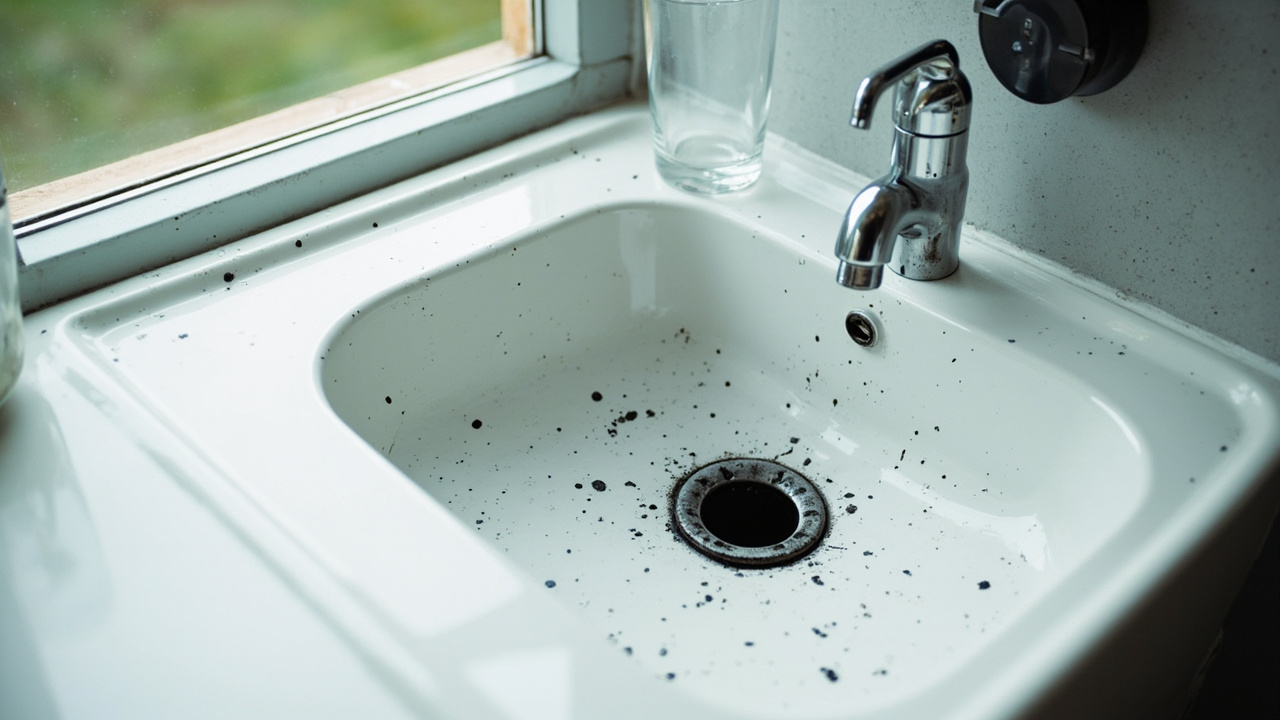
Black specks in the toilet tank that scrub off and come back, plus a brownish-black film on the tub — that’s usually manganese, not iron. Buy the wrong gear for it and you’re scrubbing the same fixtures every month; EPA’s 0.05 mg/L number is an aesthetic guideline, not a health limit.
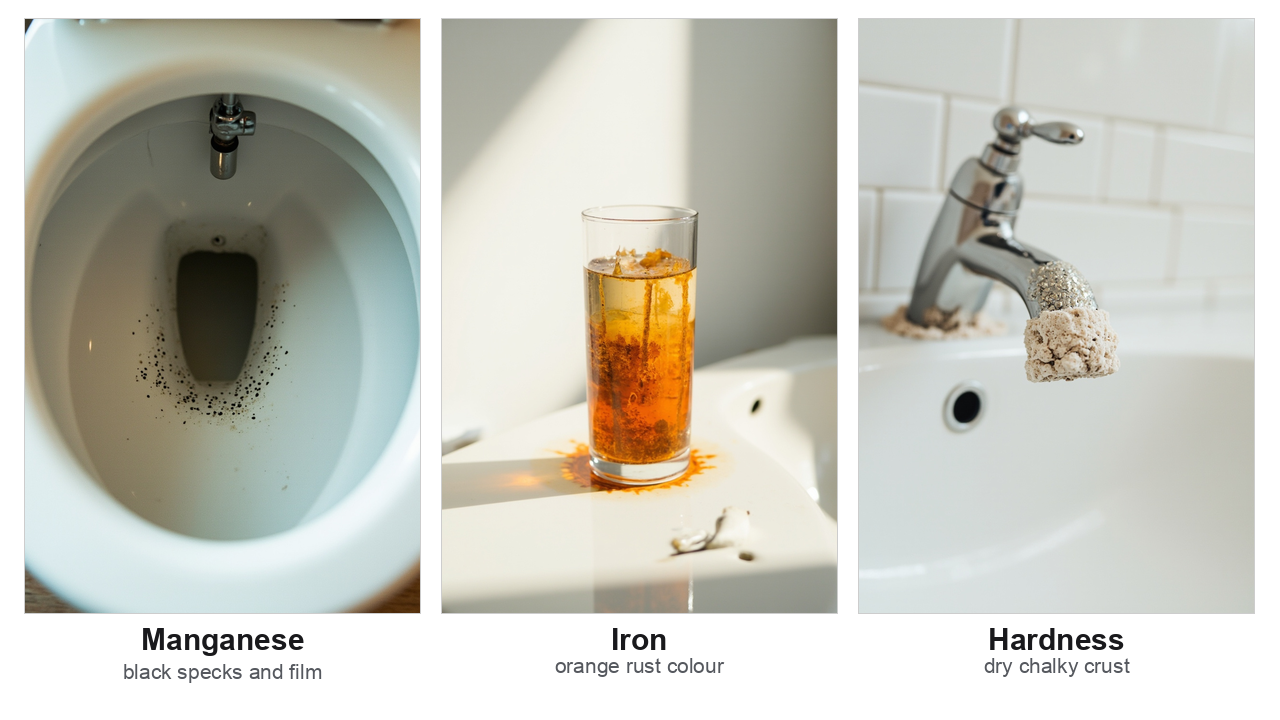
| What you see | Most likely | Go here |
|---|---|---|
| Black specks in a tank, film on the tub | Manganese | Keep reading |
| Orange or rust streaks, orange water | Iron | iron in well water |
| White chalky crust on a faucet | Hardness | water hardness explained |
| Nothing visible, no number yet | Unknown | Test before you buy |
Your reading, pH and iron level decide between nothing, a cartridge, a softener and an oxidizing system.
A TDS reading can’t pick between those three — TDS in water is a bulk dissolved-solids number that doesn’t separate manganese from iron from hardness.
What manganese in well water actually is
Manganese dissolves out of rock and soil as groundwater moves, which is why it’s a well problem rather than a city-water one. The Water Quality Association notes that manganese “can also be present in private wells, often coming from natural geological deposits.” Penn State Extension’s primer on iron and manganese in private water systems adds the fact that drives everything below. Iron and manganese often occur together, but manganese usually occurs in much lower concentrations than iron. Size a system for the iron and leave the manganese out, and you can still find black specks after the orange clears.
Two forms, and only one is easy. Clear at the tap that goes black in a glass over the next hour means it’s dissolved. Black straight out of the tap means it’s already oxidised and simply a particle. Dissolved, reduced iron and manganese are most common in groundwater below pH 7.0 — which is why pH keeps coming back here. The footprint is a bitter metallic taste and brownish-black staining on toilet tanks, showers, bathtubs, fixtures and laundry, plus scale on plumbing. And private wells aren’t regulated by the federal Safe Drinking Water Act, or by most state governments.
The numbers that matter — and the one that is not a health limit
Start with the sentence that saves the most confusion: there is no federal enforceable maximum contaminant level for manganese. Public water systems aren’t required to test for it under the Safe Drinking Water Act.
Units next, because reports mix them. At these concentrations 1 mg/L equals 1 ppm and 1 µg/L is 0.001 mg/L, so a report in µg/L isn’t reporting something scarier. And there is no single US figure to read off this table — each row has its own scope.
| Number | mg/L | µg/L | What it actually is |
|---|---|---|---|
| EPA secondary MCL (US) | 0.05 | 50 | Aesthetic guideline, not enforced. EPA says these contaminants “are not considered to present a risk to human health at the SMCL.” |
| EPA lifetime health advisory (US) | 0.3 | 300 | Non-enforceable technical guidance |
| EPA one-day and 10-day advisory (US) | 1 | 1,000 | Acute exposure; EPA advises the 0.3 mg/L value for infants under 6 months |
| Minnesota guidance (MDH) | 0.1 / 0.3 | 100 / 300 | 0.1 where an infant drinks tap or formula water, 0.3 otherwise. MDH: public water systems aren’t required to meet these values and some don’t. |
| Health Canada MAC / AO (Canada) | 0.12 / 0.02 | — | Maximum acceptable concentration and aesthetic objective, set 2019 |
The conventional softener ceiling of 500 µg/L appears in its own section, because it’s equipment performance rather than a standard.
EPA’s secondary drinking water standards page is the source for 0.05 mg/L and that sentence. EPA’s 2004 manganese health advisory is the source for 0.3 mg/L. It says states may establish higher or lower levels depending on local conditions, which is why the Minnesota row exists.
On health, stick to what the sources say. EPA’s advisory states that although manganese is an essential nutrient at low doses, chronic exposure to high doses may be harmful. It also identifies the nervous system as the primary target organ. The Water Quality Association lists infants, the elderly, and people with liver conditions as more sensitive to manganese. It also cites studies suggesting an association between manganese in drinking water and neurological issues in infants and children. An association is not a cause. WQA says most exposure comes from drinking rather than bathing, and MDH says bathing or showering in it is not harmful. This isn’t medical advice — a specific exposure question is a physician and your state health department, not a filter purchase.
Manganese vs iron vs hardness: the three stains that get confused
| Manganese | Iron | Hardness | |
|---|---|---|---|
| Stain colour | Black to brown-black | Orange to rust | White chalky |
| At the tap | Often clear, darkens sitting | Clear-then-orange, or orange at once | No colour change |
| Taste | Bitter, metallic | Metallic | None |
| EPA aesthetic number | 0.05 mg/L | 0.3 mg/L | None exists |
| Federal health advisory | Yes, 0.3 mg/L lifetime | None | Not applicable |
| Softener ceiling, dissolved | 500 µg/L | 5,000 µg/L | Not the mineral |
| pH birm needs | 7.5 | 6.8 | Not applicable |
The bottom two rows aren’t symmetric, and they’re the numbers people carry over from iron advice by mistake. If the stains are orange, the tap water runs orange, or your reading is iron, stop here and read iron in well water instead. That page owns ferrous versus ferric iron, the air-injection decision, and clearing orange rust rings. This page owns manganese only, and the two aren’t interchangeable: manganese is removed at a lower concentration and a higher pH than iron.
How to test for manganese at home
- Run the tap for two to three minutes so you’re sampling the well, not stagnant pipe water.
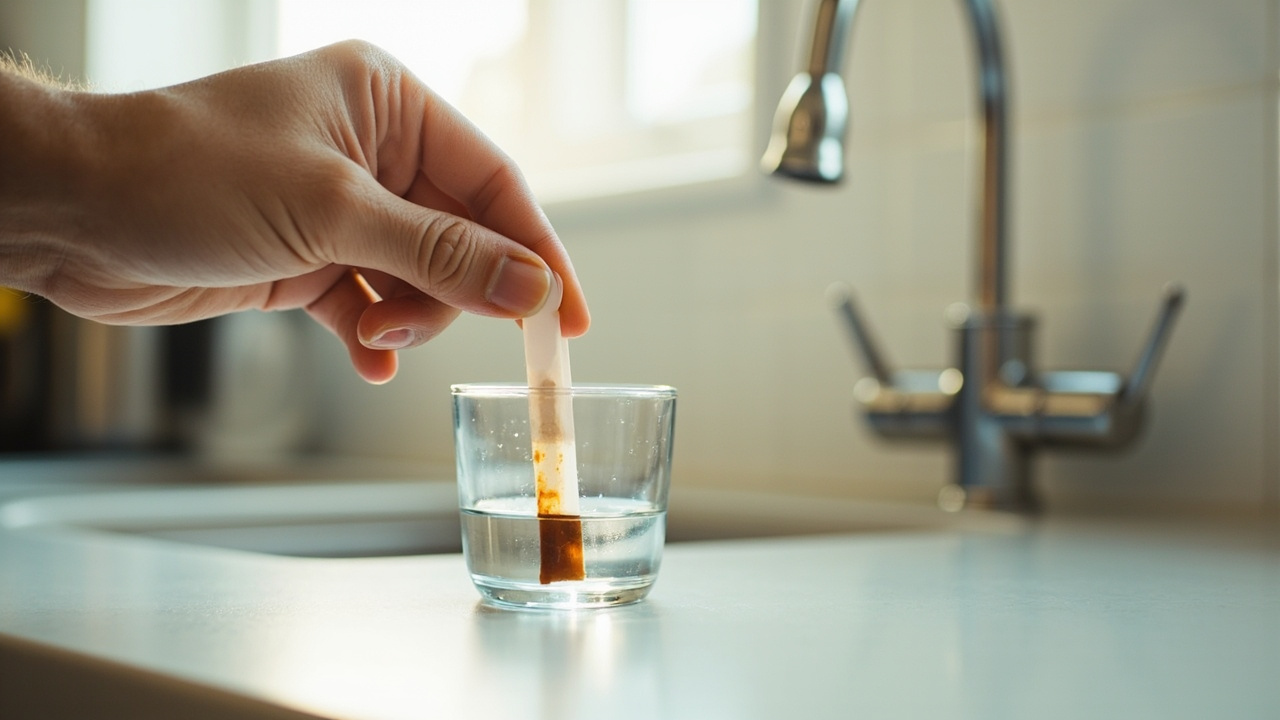
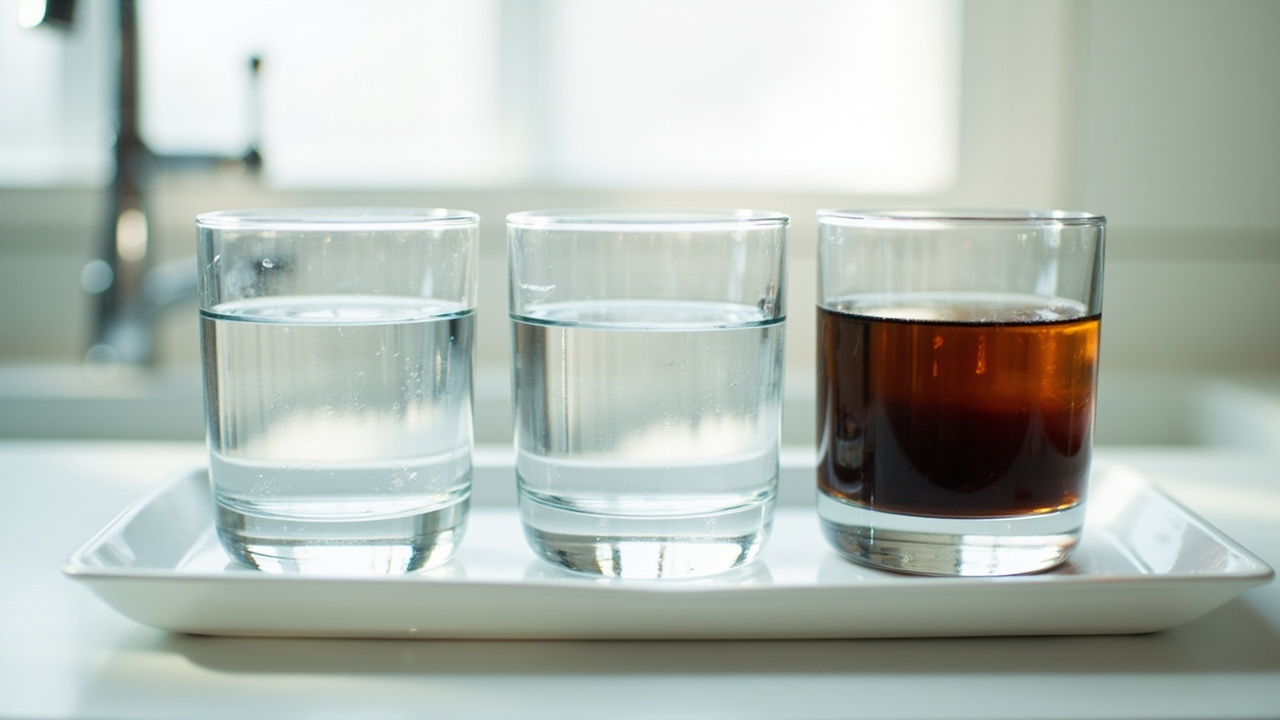
- Do the sit test. Clean clear glass, 15 to 30 minutes. Clear-then-black means dissolved. Black immediately means already oxidised.
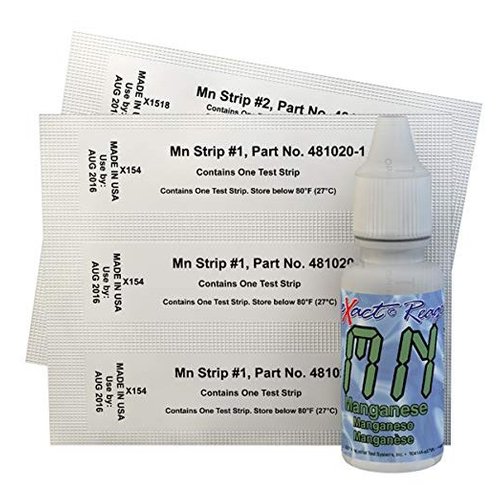
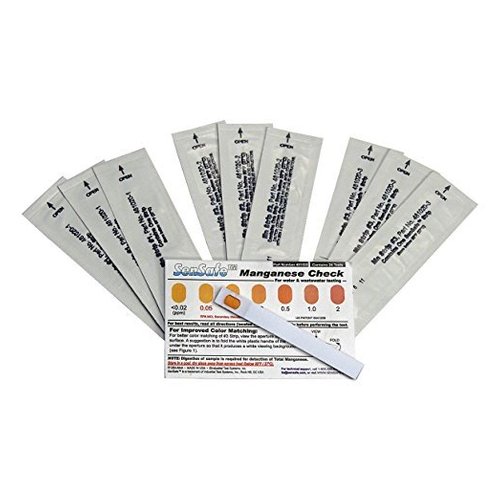
- Use a manganese-specific strip. A manganese reagent strip with a 0.03-1.5 ppm range reads on the same scale as the decision line. The colour you match tells you which side of 0.05 mg/L you’re on, no arithmetic. If a result lands on a colour block, confirm it with a second manganese test strip before buying.
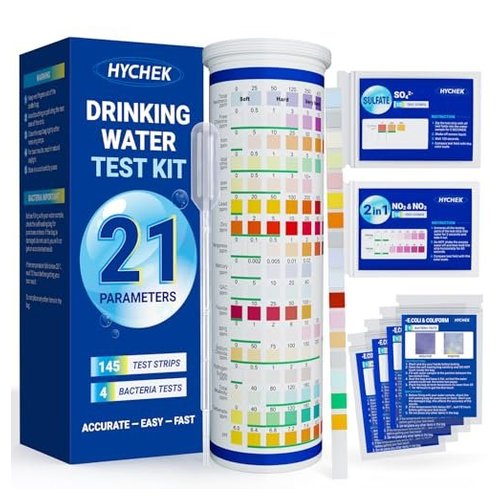
- On a private well, test more than manganese in the same pass. Iron, hardness, pH and sediment come out of the same well, and pH decides whether any of it can be removed. A 21-parameter well water test kit covers that in one go, and the same kit earns its keep on the annual retest. Hardware comparison is in hardness test kits.
- Don’t use a TDS meter as a manganese test. It’s total dissolved solids, so it can’t split manganese from iron from hardness.
- Don’t read an iron strip’s colour as a manganese result. Different pads, different scales.
- Skip the strip if you already have a manganese-specific strip and a pH reading. Those two answer the question that matters.
What your reading means — and what it does not tell you
Reading bands, briefly. Under 0.05 mg/L you’re below the EPA aesthetic guideline. 0.05 to 0.3 is above it but below the federal lifetime advisory, so it’s a staining problem. 0.3 to 0.5 sits at both the lifetime advisory and the softener ceiling. Past 0.5 mg/L needs oxidation plus filtration, with pH sorted first. The decision tree below turns each band into a specific move.
A number alone can’t answer four things. Is the manganese dissolved or already oxidised? What’s your pH? Is iron present too? Does your state have its own guidance value? That first answer decides cartridge versus greensand.
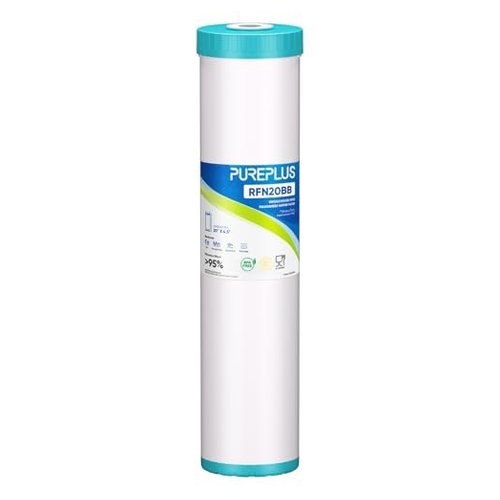
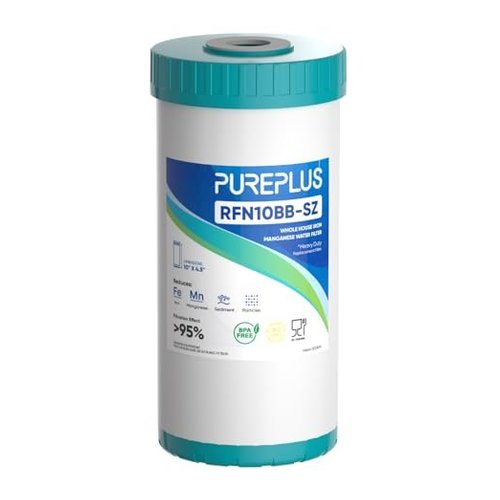
If it’s already partly oxidised or genuinely low and you own a 10-inch housing, the cartridge branch is a real option rather than a compromise. A 10” x 4.5” iron and manganese cartridge is that part. If it’s dissolved and above the aesthetic guideline, it isn’t. Sizing and flow rules are in the whole house filter cartridge guide; re-run the same strip if your pH reading moves.
pH: the variable that decides whether manganese removal works
Here’s the number people miss: for a birm filter, “the pH should be at least 6.8 for iron removal and 7.5 for manganese removal.” Same medium, same housing, different threshold — manganese is harder to oxidize than iron and needs more alkaline water to precipitate out.
Chlorine has the same problem from another angle. Penn State is blunt: chlorine isn’t recommended as an oxidant for very high manganese levels because a very high pH is necessary to completely oxidize the manganese.
There’s real tension here. Nebraska Extension puts the general optimum at an almost neutral pH of approximately 7.0; Penn State puts the manganese threshold at 7.5. Both are attributed, and the consequence is the same — measure pH before choosing the system. Without a pH reading you can’t responsibly choose between a cartridge, greensand and chemical oxidation. Penn State also warns that even under ideal conditions, manganese removal efficiency is highly variable with birm filters. How you raise a low pH belongs to water pH and alkalinity.
Can a water softener remove manganese?
Sometimes, and only up to a low ceiling. Nebraska Extension is specific: conventional softeners can be effective for dissolved iron below 5,000 µg/L, but dissolved manganese only below 500 µg/L. That last figure is 0.5 mg/L, a tenth of the iron number. Penn State phrases it as “small amounts of manganese,” and adds that softener removal efficiency varies with the iron concentration, water hardness and pH.
- Yes under 0.5 mg/L, dissolved rather than oxidised, when the water is hard enough to justify a softener anyway.
- No above 0.5 mg/L, or with any oxidised manganese that’s black straight from the tap.
- Don’t expect a salt-free conditioner to help. Salt-free units don’t bring hardness grains down on a strip, so they aren’t removing dissolved metals at all.
How ion exchange actually works explains why dissolved metals behave differently from hardness on the resin, and choosing a water softener covers sizing. Stage order is in well water treatment order — after the softener, a manganese stage does nothing useful.
Softener vs filter vs RO (one screen)
- Softener (salt): swaps hardness minerals for sodium. Fixes scale and spotting, carries only low dissolved manganese.
- Whole-house filter (greensand, birm, cartridge): oxidizes and traps what a softener can’t, and does nothing for hardness. This is the manganese route.
- RO (usually under the sink): polishes drinking and cooking water at one tap. It doesn’t treat the whole house, and on a well it fixes the glass, not the stain in the tub.
Oxidation and filtration: what actually removes manganese
| Route | When it fits | Upkeep |
|---|---|---|
| Nothing | Under 0.05 mg/L, no staining | Retest annually |
| Cartridge in an existing housing | Already-oxidised or low manganese | Cartridge swaps |
| Manganese greensand or similar media | Combined iron and manganese, 3 to 10 mg/L | Potassium permanganate regeneration |
| Birm | No regenerant wanted; uses dissolved oxygen | Backwashing only |
| Oxidation then filtration | Combined levels over 10 mg/L | Chemical feed, contact tank, carbon after |
Keep the word combined on those last two figures — they’re iron plus manganese, not manganese alone.
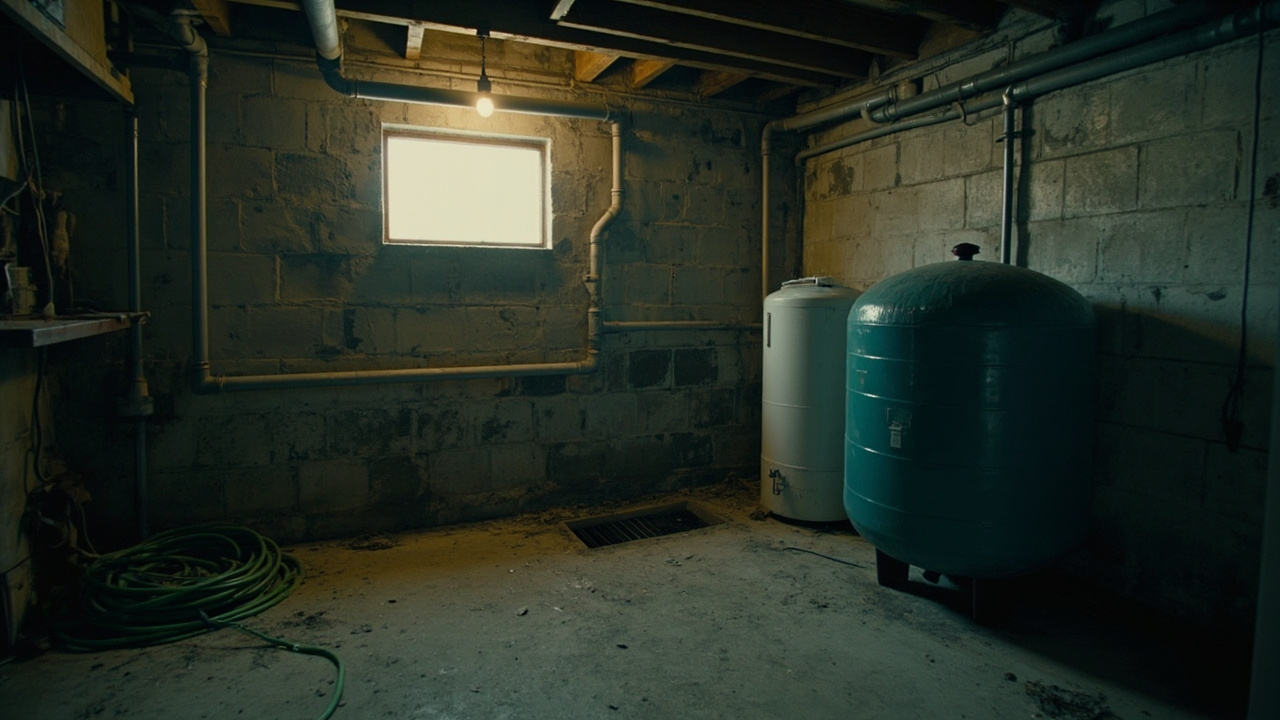
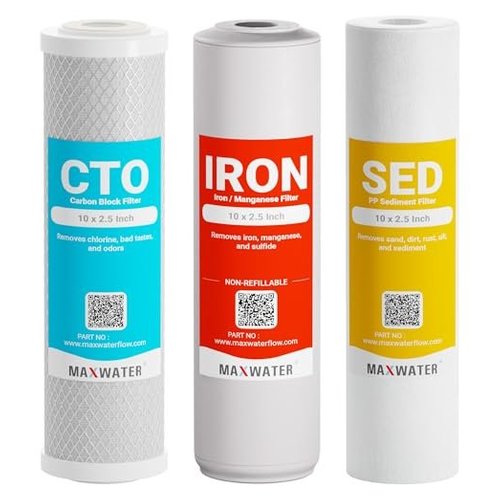
The cartridge branch is where most people land first, and it’s honest for low-level or already-oxidised manganese. A 20” x 4.5” iron and manganese cartridge gives more flow; a 10” x 4.5” iron and manganese cartridge fits the shorter housing. That’s a diameter and flow decision, not a strength upgrade — the same filter in a bigger housing moves more water and doesn’t remove more per gallon. A 10” three-stage replacement set puts sediment ahead of the manganese stage. Housings are in whole house water filters.
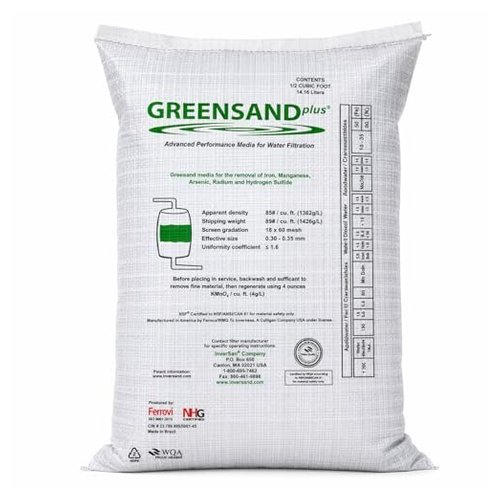
The media branch is the one the extensions actually name. The medium is treated with potassium permanganate to form a coating that oxidizes the dissolved iron and manganese, then filters them out. Note what you’re buying — manganese greensand Plus media, 0.5 cu ft is the medium, not the system. It still needs a control valve sized to your flow, a backwash line and pH in range, and the same medium priced against the vessel shows what the consumable runs. A second size turns up as often: manganese-dioxide coated media, 0.52 cu ft, listed as NSF/ANSI 61 certified media. That’s a certification on the media itself, not a claim about manganese removal — ask any seller for the certificate covering that media listing.
- Skip greensand media if you can’t get a pH number. The media choice and your pH are the same decision, and one of them is free.
- Don’t buy media without a regeneration plan. Penn State calls the maintenance significant, including frequent regeneration, because the coating is consumed during oxidation.
System context lives in well water iron filters and well water treatment order.
Manganese decision tree
- Under 0.05 mg/L, no staining — nothing, retest annually.
- 0.05 to 0.5 mg/L, dissolved, pH at or above 7.5, water also hard — a softener can carry it. Put a resin cleaner on a schedule, because metals foul resin. See water softener cleaner.
- Same range but soft water, or pH under 7.5 — a softener is the wrong answer. Greensand or oxidation filtration, pH first.
- Oxidised manganese, black straight from the tap — already a particle. Filter it, don’t ion-exchange it.
- Combined iron and manganese, 3 to 10 mg/L — greensand, with regeneration.
- Combined over 10 mg/L, or past the ceiling with iron present — oxidation then filtration, sized by a pro.
- An infant drinking tap water or formula made with tap water — your state’s number is what matters, and a lab beats a strip.
If three routes look plausible, softener vs RO vs filter sorts the tools by what they’re for.
When to send a sample to a lab instead of a strip
Staying home is fine when you’re under 0.05 mg/L, there’s no infant in the house, and you only need an aesthetic decision. Send it out when:
- Your reading is above 0.3 mg/L — at or over the federal lifetime advisory and Minnesota’s household guidance value.
- Anyone in the household is an infant. Minnesota’s guidance value drops to 100 µg/L where an infant drinks tap water or formula made with tap water. That’s twice the aesthetic guideline, so no strip result reads as “fine” there.
- Your state sets its own number, which EPA explicitly allows.
- You need a pH figure you can trust, because pH is deciding your system.
- You’re sizing above the softener ceiling. Penn State says treatment decisions should be based on iron and manganese analysis by a reputable laboratory.
- Your well has never had a bacteria, nitrate and arsenic panel. A manganese strip tests none of those.
The Water Quality Association points to a certified drinking water laboratory through EPA’s drinking water lab certification page, and MDH says all water testing should go through an accredited lab. We don’t rank local service lists or installer directories — ask your state health department which labs they work with.
When to call a pro
Keep it DIY for swapping a cartridge, changing media, setting a control valve on existing plumbing, or running a strip test. Call a licensed plumber or treatment pro for cutting into the main, relocating a vessel, adding a chemical feed line, or an active leak. Combined levels over 10 mg/L need a contact tank sized to your flow, and a control valve and backwash assembly has to meet code. Shut the water off and relieve pressure before opening any housing, and don’t force fittings — overtight plastic housings crack.
Common mistakes
- Buying greensand media before you have a pH number. The medium needs pH 7.5 for manganese while the general optimum is approximately 7.0. Skipping the free check means buying media twice. Start with a manganese-specific strip with a 0.03-1.5 ppm range and a pH reading in the same session.
- Reaching for a phosphate or polyphosphate sequestrant. It’s the standard answer for low dissolved iron. Penn State says phosphate addition is generally ineffective in treating manganese.
- Mixing the two bases. The greensand range of 3 to 10 mg/L is about the combined level; the softener ceiling of 500 µg/L is manganese alone.
- Using a TDS meter as a manganese test. It can’t tell you whether 200 ppm is manganese or hardness. A 21-parameter well water test kit is what separates them.
- Using bleach or alkaline builders on black stains. Nebraska Extension is direct: soaps and detergents do not remove these stains, and bleach and alkaline builders such as sodium and carbonate may intensify them.
Related
- iron in well water — orange stains, ferrous versus ferric iron, air injection
- water hardness explained — gpg versus ppm, and what hardness actually does
- water pH and alkalinity — the pH range map and raising a low reading
- well water treatment order — which stage a manganese unit belongs in
Key takeaways
- There is no federal enforceable limit for manganese. 0.05 mg/L is an aesthetic guideline EPA doesn’t enforce and says isn’t a health level.
- 0.3 mg/L is the federal lifetime health advisory, and states may set their own. Minnesota’s guidance value is 100 µg/L where an infant drinks tap or formula water.
- Manganese is not iron. The softener ceiling is 500 µg/L against iron’s 5,000 µg/L, and birm needs pH 7.5 against 6.8.
- pH decides whether removal works. Measure it before buying media.
- Polyphosphate sequestrants work on dissolved iron and are “generally ineffective” on manganese.
- Test first. The sit test plus a manganese-specific strip answers most of it; a 21-parameter kit does it in one pass with pH included.
- A private well is the homeowner’s responsibility, and a manganese strip tests none of bacteria, nitrate or arsenic.