Quick answer
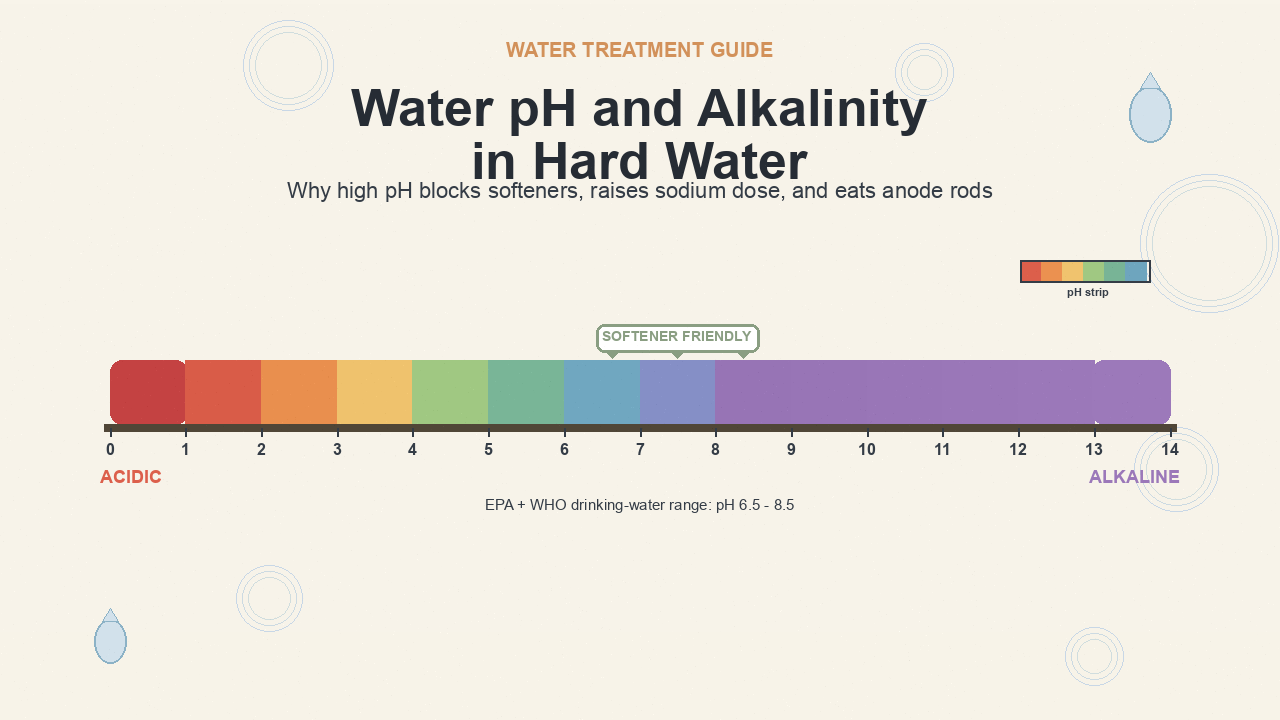
pH and alkalinity are different. pH is the live acidity reading (0-14); alkalinity is the buffering capacity (mg/L CaCO3, mostly bicarbonate). Hard water usually sits pH 6.5-8.5 with high alkalinity — this shortens anode rod life, pushes brine demand up, and decides whether you can treat low-pH well water at all.
What hardness people call pH (and why they confuse it)
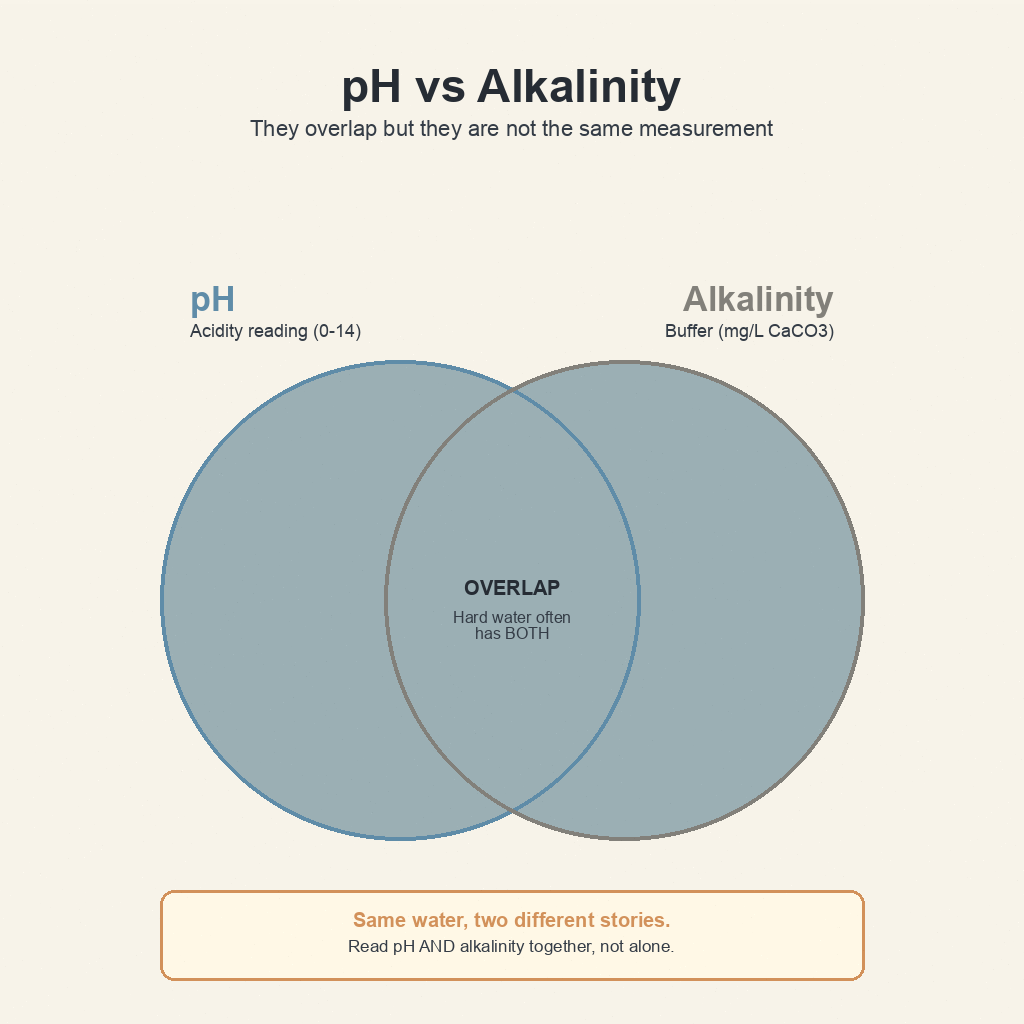
The number on a city water report next to “pH” is NOT the same as hardness (gpg) or alkalinity (mg/L CaCO3). The water-hardness article covers gpg/ppm; this one drives corrosion and scale.
- pH is logarithmic: pH 6.5 is 10× more acidic than pH 7.5, and pH 5.5 is 100× more acidic. A small number change is a big chemistry change.
- Alkalinity is the buffer: how much acid you can dump in before pH moves. Hard water with alkalinity 150+ mg/L can absorb a lot of acid and still read “neutral”.
- Why this matters for a softener: high alkalinity keeps pH stable but forces the resin to swap more ions per regeneration, which is why salt use climbs.
- Why this matters for copper pipes: low pH + low alkalinity leaches metal; high pH + high alkalinity plates the inside of pipes.
Don’t read pH alone. The two numbers tell different stories.
Skip the deep chemistry if you already have a fresh CCR (Consumer Confidence Report) showing pH 6.5-8.5 and moderate alkalinity. Jump straight to the “When to adjust pH” decision tree below.
The pH range map (acidic → alkaline)
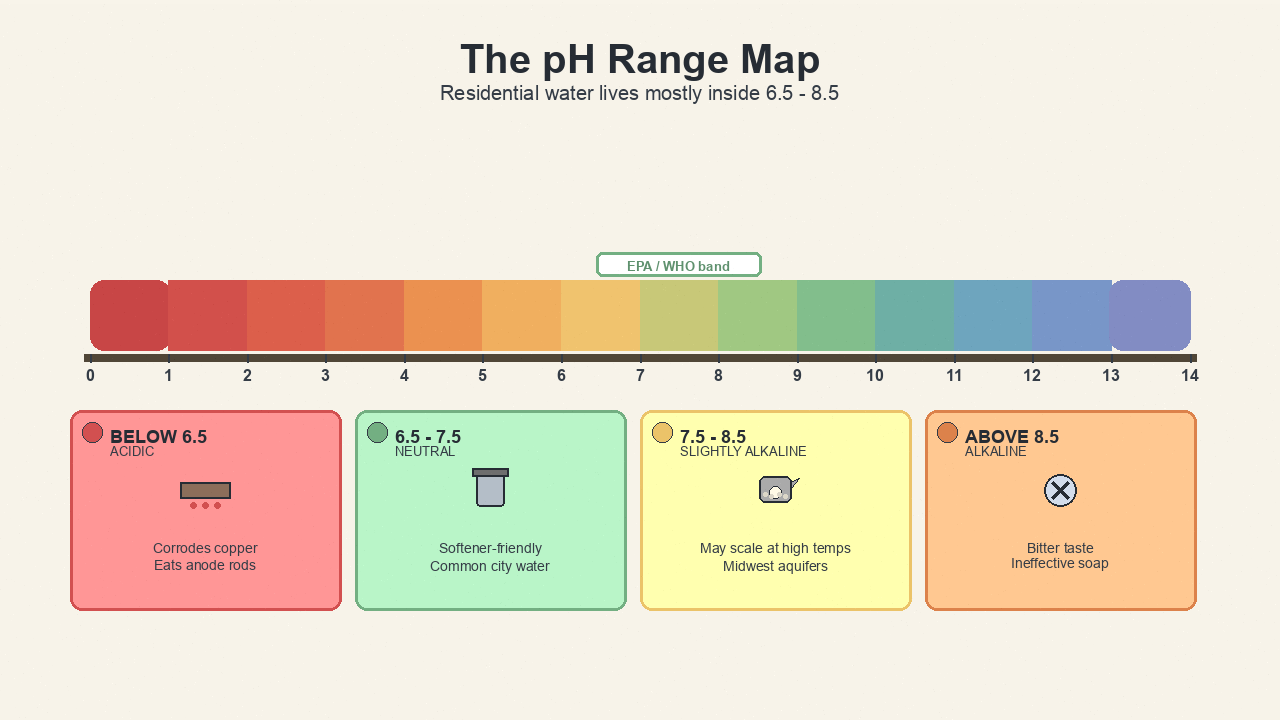
| pH range | What it usually means | Hard water homes see it? |
|---|---|---|
| Below 6.5 | Acidic — corrodes copper, leaches lead, eats anode rods fast | Yes, common on private wells with CO2 or low-mineral source water |
| 6.5 to 7.5 | Neutral — softener-friendly | Yes, the typical city water range |
| 7.5 to 8.5 | Slightly alkaline — can still be hard, may form scale at high temps | Yes, common in Midwest and Southwest hard-water aquifers |
| Above 8.5 | Alkaline — bitter taste, scale in kettles, ineffective soap | Rare in residential supplies, more of a groundwater / well issue |
The EPA’s secondary (non-enforceable) drinking water range is pH 6.5-8.5 EPA Secondary Drinking Water Regulations. The World Health Organization uses the same 6.5-8.5 band as the operational target for public supply WHO pH in Drinking Water. Most homes land inside it; the exceptions are private wells and surface-water systems with aggressive source.
Alkalinity above 150 mg/L CaCO3 can hold pH above 7 even when CO2 shifts seasonally. Don’t treat pH alone — read alkalinity first. For how alkalinity and hardness gpg stack up in the same report, see water hardness (gpg, ppm).
Why pH matters inside a softener (resin chemistry)
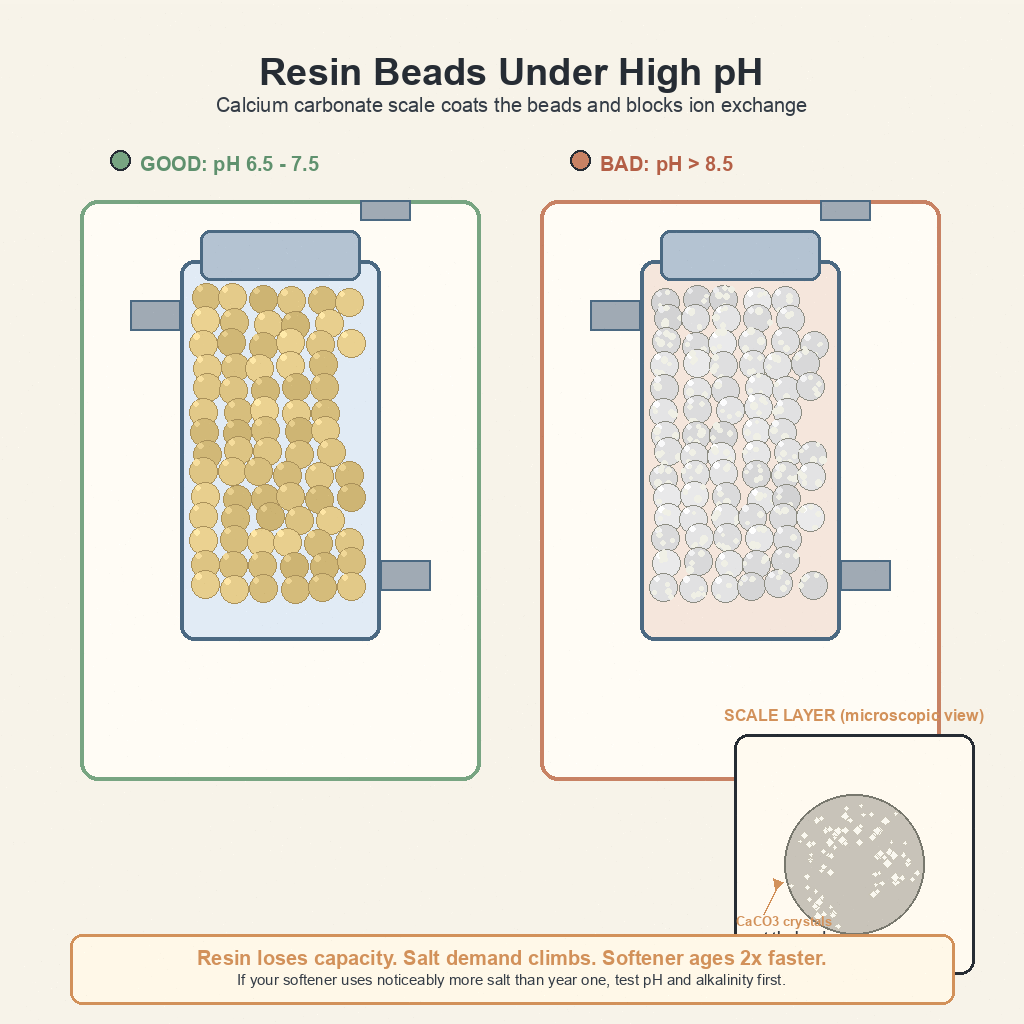
Strong-acid cation resin (the standard softening resin) works best between pH 6 and pH 11. Push the water outside that band and the chemistry changes in ways you can measure in salt use, not just in theory.
- Below 6.0 the resin starts losing capacity because hydrogen ions compete with calcium and magnesium for exchange sites. Service life drops.
- Above 9.0 the resin still softens, but the brine solution becomes less efficient, so salt-per-regeneration goes up by 10-25%. Your salt bill quietly climbs.
- Hard water with high pH (>8.5) combined with high alkalinity can also push calcium carbonate out of solution inside the resin bed, fouling the beads and shortening resin life. This is the textbook cause of “softener stopped working after 5 years”.
- Quick gut check: if your softener uses noticeably more salt than year one, test pH and alkalinity before blaming the control head. See how water softeners work (ion exchange and brine).
Skip the resin chemistry if your water is pH 6.5-8.5 and your softener regenerates on schedule. The mechanism below that band gets out of home-DIY territory fast.
How high alkalinity eats anode rods
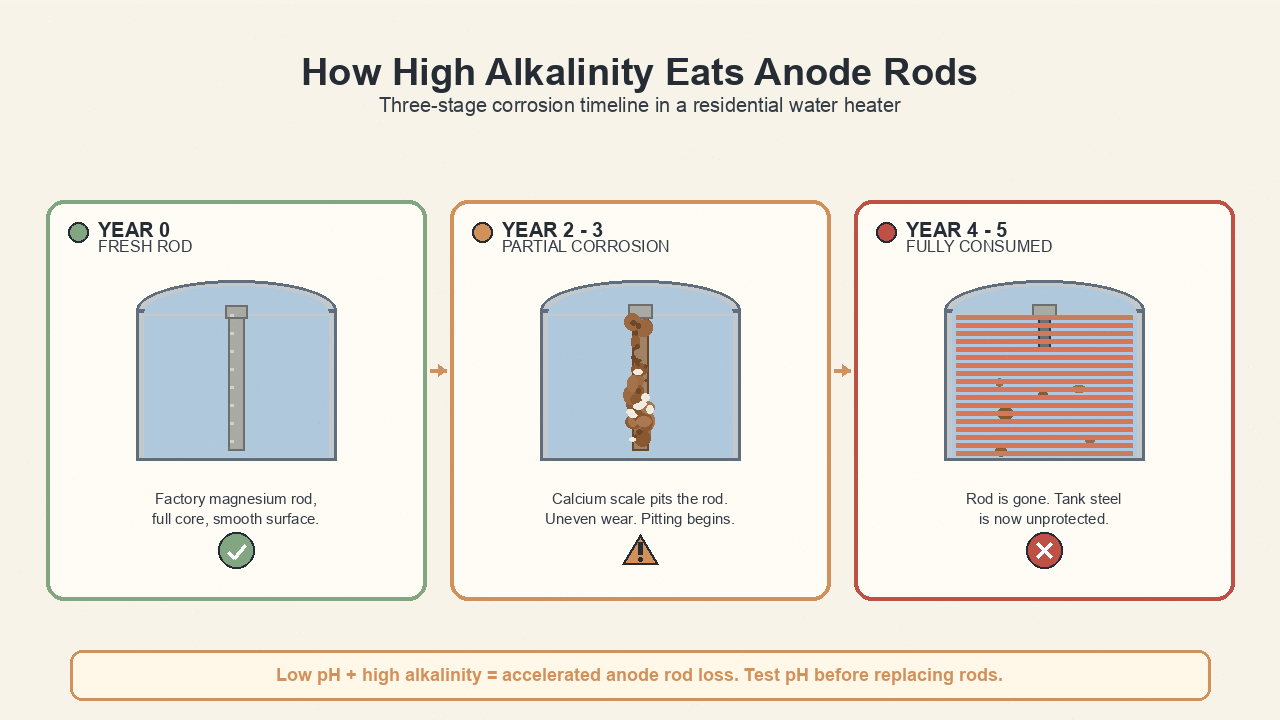
Sacrificial anode rods (magnesium or aluminum) protect the water heater tank by corroding instead of the steel. That’s the whole job — they are supposed to wear out. The question is how fast, and pH controls the answer.
- Both low pH and high chloride / high TDS strip the rod faster than its rated service life.
- High alkalinity alone does not destroy an anode rod, but it usually coexists with high pH and high hardness — creating a calcium carbonate layer on the rod that shields unevenly, leading to pitting rather than even wear.
- Symptoms: “rotten egg” smell, small black flecks in aerated water, rod completely gone in under 3 years.
- The same low-pH water that eats the anode rod also leaches iron from old galvanized lines. If you’re seeing orange staining at the same time, the deeper problem is iron in water, not just a missing rod.
Don’t switch to a powered (impressed-current) anode rod before fixing pH and hardness. A powered rod in acidic water is just hiding a plumbing problem — and powered rods themselves can over-protect the tank lining if the water is balanced.
Alkalinity Testing
Most homeowners test pH and stop there. Alkalinity is the second half of the equation — the buffer that holds pH in place — and it decides how aggressive your water actually is even when the meter reads 7.5. If you only test pH, you miss the difference between buffered water (safe for copper) and unbuffered water (still aggressive at the same number).
Four ways to test alkalinity at home, ranked from quick-and-dirty to definitive:
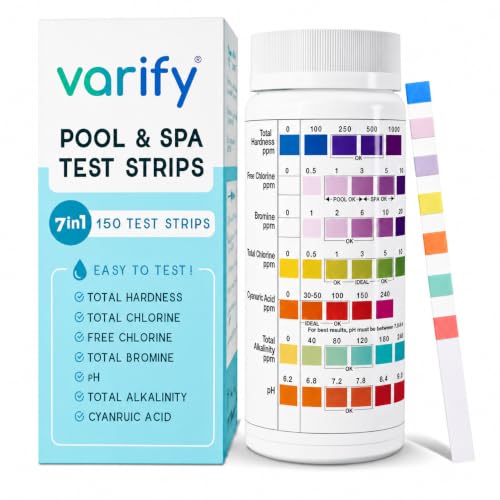
- Multi-parameter test strips — the Varify 7-in-1 strip reads pH, alkalinity, hardness, and chlorine in one dip. Alkalinity comes out as a rough mg/L CaCO3 band (0-40, 40-80, 80-120, 120-180). Good first baseline.
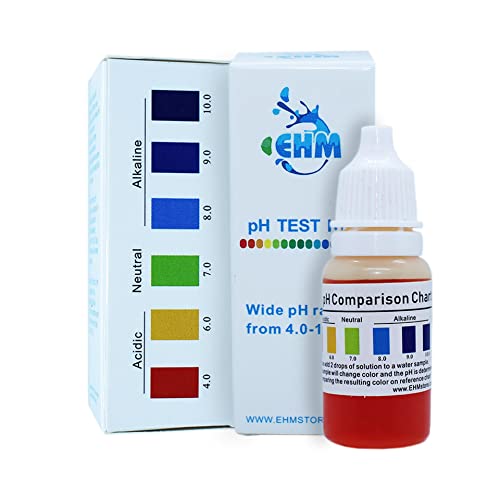
- Drop-count titration kit — the alkaline pH drop kit gives a tighter number. You count drops until the indicator color flips; each drop equals a known mg/L CaCO3 increment. Better when strip colors land between bands or when alkalinity drives the answer (e.g., sizing a calcite tank).
- Digital Hach / LaMotte colorimeter — pro-grade. Most homeowners don’t need this unless they run multiple well sources or are troubleshooting a softener that stopped softening and need to rule alkalinity in or out.
- State-certified lab test — the canonical source. Lab reports alkalinity in mg/L CaCO3 alongside hardness (gpg), pH, iron, and TDS. Run one annually on a private well, or any time a strip reading jumps unexpectedly.
Reading the alkalinity number:
| Alkalinity (mg/L CaCO3) | What it usually means | Action |
|---|---|---|
| Below 50 | Low — little buffer, pH swings with CO2 shifts | Aggressive to copper, anode rods eat fast |
| 50 to 150 | Moderate — typical city water band | Usually no action; softener runs normally |
| 150 to 300 | High — strong buffer, scale-forming when paired with high pH | Watch brine use, retest seasonally |
| Above 300 | Very high — scale-forming, brine demand climbs | Plan treatment: softener handles hardness, but alkalinity separately may need soda-ash or acid neutralization |
Retest alkalinity when any of the following happens:
- You install any pH-adjustment equipment (calcite, soda-ash feed, RO + alkaline post-filter).
- The softener starts eating noticeably more salt — alkalinity is the first variable to check before assuming the resin is dead.
- After well pump, pressure tank, or major plumbing work that changes source water.
- Seasonally — shallow wells swing alkalinity with rain and drought. Surface-water systems can shift alkalinity by 50-100 mg/L between spring runoff and late summer.
Don’t substitute a TDS reading for alkalinity. TDS counts all dissolved solids, not just the bicarbonate buffer that defines alkalinity. A 350 ppm TDS can sit on top of either 80 mg/L or 300 mg/L alkalinity — the TDS meter cannot tell you which.
Skip this section if your city CCR already reports alkalinity in the 50-150 band. You already have the answer.
Sodium dose tradeoff (alkalinity → salt)
The softener’s brine dose is sized for the grains of hardness removed per regeneration, not for pH. When pH is high (>8.5) and alkalinity is high (>200 mg/L CaCO3), the resin’s effective capacity drops by roughly 10-20% per regeneration, so the control head has to either regenerate more often or use a stronger brine dose.
Net effect:
- Salt use goes up. See water softener salt (sodium dose context) for how brine demand shifts with feed-water chemistry.
- Softener runs out of capacity between regenerations, so you may see “soft but feels weird” as hardness bleeds through.
- Drinking-water concern: every 8 gpg of hardness removed adds ~30-50 mg/L of sodium. High-alkalinity homes on low-sodium diets should not drink the hot softened line, or route a cold unsoftened line to the kitchen tap. See what is hard water for the bypass pattern.
Don’t assume the softener is mis-sized before testing pH. A correctly-sized unit can still blow through salt on alkaline feed — the cause is chemistry, not capacity.
What to test (and what each tool actually measures)
You need three readings: pH, alkalinity, and hardness. Iron is covered in iron in water, but wells should run iron alongside pH.
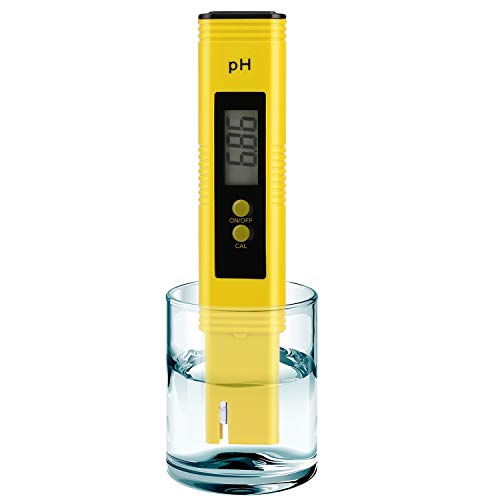
- pH meter (digital pen) — 0.01 resolution, needs calibration with buffer solution periodically. Best for ongoing monitoring once you have a baseline. The digital pH meter gives a calibrated reading in 30 seconds.
- Multi-parameter test strips (pH + alkalinity + hardness + chlorine) — dip-and-read, good for a one-shot baseline. The Varify 7-in-1 strips read pH, alkalinity, hardness, and chlorine in one dip. Pool-test strips rebranded for residential — same chemistry, but the reading you care about is pH and alkalinity, not chlorine.
- Alkalinity drop titration — more precise than strips for high-alkalinity water. The alkaline pH drop kit works for spot drinking-water checks when strip colors land between bands.
- City water CCR / well-water lab test — the canonical source. Get alkalinity, pH, hardness, and iron from one lab report before buying treatment. The mg/L CaCO3 reporting follows Hach total-alkalinity Hach Total Alkalinity.
For the testing workflow, see the hardness test kits guide — same meters, slightly different protocol for pH.
Don’t substitute a TDS meter for pH testing — TDS reads total dissolved solids, not acidity.
When to adjust pH (decision tree)
Is your water from a private well?
├── YES
│   ├── pH below 6.5 → install a Calcite neutralizer at point of entry (Fix A)
│   ├── pH 6.5 to 7.5 → leave pH alone, focus on hardness and iron
│   └── pH above 8.5 → treat hardness first (softener), retest pH; if still high, evaluate soda-ash feed (pro)
└── NO (city water)
    ├── pH 6.5 to 8.5 → usually no pH adjustment needed; softener handles the rest
    ├── pH below 6.5 → rare; if a CCR shows this, call the water utility
    └── pH above 8.5 → softener + check anode rod annually; don't inject acid
Fix A — low-pH well water: Calcite neutralizer
Calcite (calcium carbonate) is a sacrificial media that slowly dissolves into water, raising both pH and alkalinity at the same time. That’s why it is the residential default for low-pH wells — it doesn’t feed acid into the drinking line Water Systems Council pH well-water information.
Sizing:
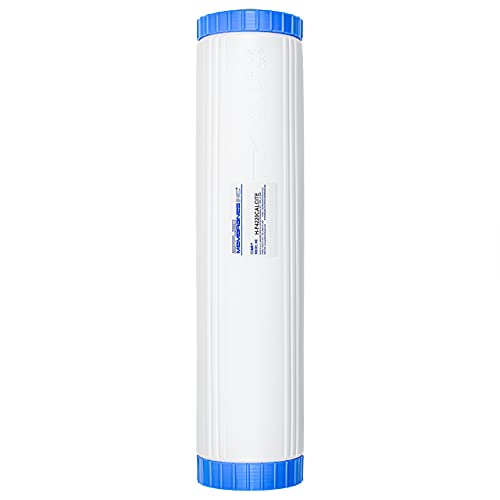
- Drop-in cartridge (point-of-use): 1.0-2.0 cu ft, replaced every 6-12 months. The APPLIED MEMBRANES 4.5”x20” calcite cartridge drops into a standard 20” housing — good for one or two fixtures, not whole-house.
- Backwashing mineral tank (whole-house): sized to peak flow gpm, auto-backwashed. Plumber job — sizing depends on pH swing and hardness. Sits before the softener.
Skip this if you are on city water with a CCR showing pH 6.5-8.5.
pH Adjustment Methods
Fix A above covers calcite for low-pH well water — the residential default. It isn’t the only method. Here are the four ways pH actually gets adjusted in home water systems, and when each one makes sense.
Method 1 — Calcite neutralizer (covered above)
Calcium carbonate media slowly dissolves into the water, raising both pH and alkalinity at the same time. Cheap, no electricity, no chemicals. Whole-house installs use a backwashing mineral tank ahead of the softener; point-of-use installs use a drop-in calcite cartridge in a standard 20” housing.
- Best for: pH 5.5-6.5 well water, low-to-moderate flow homes.
- Not for: pH below 5.0 (too aggressive; calcite exhausts too fast) or high-pH water (calcite pushes pH higher, making scale worse).
Method 2 — Soda-ash feed (sodium carbonate injection)
A small chemical-feed pump injects soda ash (Na2CO3) into the water line ahead of a contact tank. Soda ash raises both pH and alkalinity more aggressively than calcite, and it handles high peak flow. Needs electricity, a feed pump, a contact tank, and periodic drum refills.
- Best for: pH 5.0-6.5 wells with peak flow above 10 gpm, where a calcite tank would be oversized.
- Not for: low-pH water with very low buffering — soda ash without enough contact time overshoots pH.
Pro install only. If a plumber quotes a soda-ash feed, ask for contact-tank sizing in gallons (rule of thumb: 3-5 minutes of retention at peak flow).
Method 3 — Acid injection (rare in residential)
Downstream of the softener or at the point of entry, a metering pump injects dilute acid (usually sulfuric or hydrochloric) to drop pH. Used when source water is alkaline (>8.5) AND the softener’s brine efficiency is suffering. Acid injection needs permits in many states, a chemical drum, a neutralizing backfeed, and routine pH monitoring on the treated line.
- Best for: high-pH (8.5+) feed where soda-ash is impractical.
- Not for: most homes. The added complexity (permits, acid handling, monitoring) makes this a commercial / industrial solution. If your well reads pH 9+, hire a water-treatment engineer, not a general plumber.
Method 4 — RO + alkaline post-filter (drinking water only)
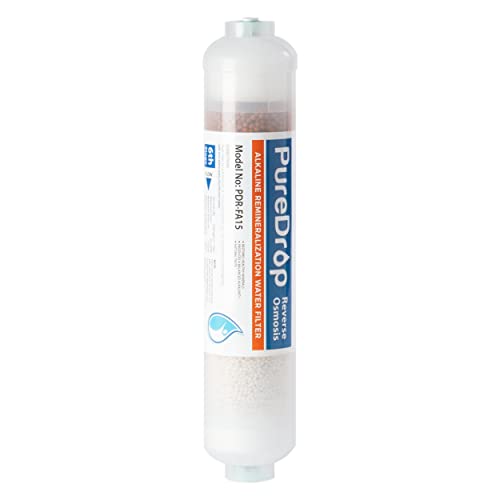
Reverse osmosis strips almost everything out, then an alkaline inline cartridge adds calcium and magnesium back and raises pH to 8-9 at the tap. This is for taste and pH at the kitchen tap, not whole-house chemistry. The Puredrop alkaline filter is the standard 10” cartridge.
- Best for: anyone drinking RO water who wants higher pH and mineral taste.
- Not for: anyone trying to fix whole-house pH. An RO at the kitchen sink does not touch the water heater, the copper, or the anode rod. See iron in water for why whole-house pH still matters even with a kitchen-side RO.
| Method | pH direction | Whole-house? | DIY-friendly? | Maintenance |
|---|---|---|---|---|
| Calcite neutralizer | Raises | Yes | POU yes; whole-house pro | Replace media every 2-5 yr |
| Soda-ash feed | Raises | Yes | Pro only | Refill drum monthly |
| Acid injection | Lowers | Yes | Pro only | Refill drum, monitor pH |
| RO + alkaline post-filter | Raises (tap only) | No | Yes | Replace cartridge every 6-12 mo |
How pH-adjustment choice interacts with hardness gpg:
- Calcite adds hardness as it dissolves (typically +1-2 gpg on top of raw). If your raw hardness is already 25 gpg, calcite pushes it higher and your softener works harder. For raw hardness context, see water hardness (gpg, ppm).
- Soda ash does not add hardness. Better choice when raw hardness is already high.
- Acid injection does not change hardness. Useful when alkalinity (not hardness) is the underlying problem.
- RO strips everything, then alkaline adds back a controlled amount. Independent of raw hardness.
Don’t stack methods. If you install calcite AND a soda-ash feed in series, you will overshoot pH and create new scaling problems inside the water heater. Pick one method, size it for peak flow, retest after 30 days, then adjust.
Skip this section if your raw water is already pH 6.5-8.5 with moderate alkalinity. None of these methods apply to you.
Drinking water pH — what NOT to do
Two mistakes show up on well-water forums:
- Acidifying at the tap. Injecting acid at the kitchen tap fixes the meter but makes the water worse to drink. WHO explicitly warns against it — low-pH water leaches metals from plumbing and the acid dose is hard to control WHO pH in Drinking Water.
- Drinking softened acidic water as-is. If the softener sits downstream of low-pH water, it swaps hardness for sodium but does not fix the corrosion problem. You still get metal leaching from the pipes.
The right answer for drinking water:
- Run the kitchen cold line unsoftened (or through a separate small RO) so the kitchen tap is not on the aggressive feed.
- Add an alkaline post-filter to the RO. The Puredrop PDR-FA15 alkaline inline filter is a 10” cartridge that goes after the RO membrane and re-mineralizes the water to roughly pH 8-9 at the tap. No plumber needed.
Skip the inline alkaline cartridge if you don’t have an RO. The cartridge adds calcium and magnesium back into already-mineralized water — the result is hardness with extra steps.
Anode rod protection (the right order)
If you are on acidic or high-TDS water and the anode rod is gone, the order matters:
- Test pH first. If it is below 6.5, install a calcite neutralizer (Fix A above) — the same calcite cartridge sized to your flow, up-stream of the softener. No amount of rod replacement saves you while the water is still aggressive.
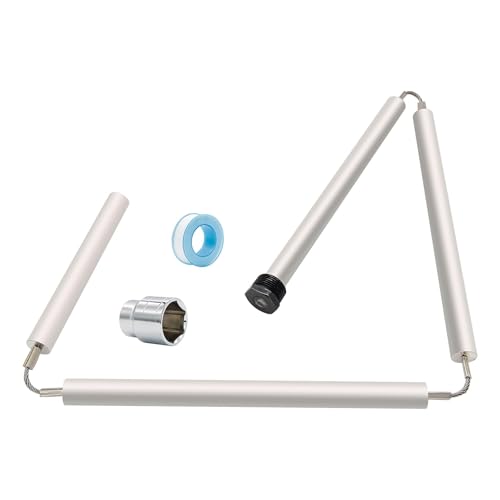
- Then replace the rod. The 44-inch flexible magnesium anode rod fits most residential water heaters (GE / Rheem / Reliance / Richmond / Kenmore 40-50 gal). Magnesium (not aluminum) handles harder working conditions.
- Recheck in 12 months. Pull the rod at the one-year mark. If it has lost more than half its mass, your pH is still wrong and the calcite tank needs attention.
If you don’t want to keep replacing sacrificial rods, a powered (impressed-current) anode rod is an option — but only after pH and hardness are in range. Powered rods are NOT a substitute for fixing feed-water chemistry.
Skip the anode-rod replacement if your water is pH 6.5-8.5 with moderate hardness. The factory rod is probably still working; the noise you are hearing is sediment, not anode loss.
Common mistakes
- Reading pH without reading alkalinity. The two numbers tell different stories. A 7.5 pH with 30 mg/L alkalinity is aggressive water; a 7.5 pH with 200 mg/L is buffered. Test both before touching your plumbing. A Varify strip gives a one-shot baseline.
- Trusting a TDS meter for pH. TDS reads total dissolved solids; a 350 ppm TDS tells you nothing about acidity. Use a pH meter or strips for pH.
- Replacing the anode rod before fixing pH. A fresh rod in acidic water is a six-month repair, not a fix. Calcite neutralizer first, rod second.
- Adding acid at the kitchen tap. Acid dose at point-of-use is hard to control; WHO guidance is clear: don’t acidify at the tap. Fix the whole-house side with a calcite tank or accept slightly low pH for drinking.
- Skipping the lab test on a private well. A strip is a baseline; the well-water lab report is the source of truth. It should cover alkalinity, pH, hardness, and iron in one run. When strip colors land between bands, an alkaline pH drop kit reads more precisely.
Related
- Water hardness (gpg, ppm) — parent parameter; how hardness gpg/ppm sit next to alkalinity in the same report
- Iron in water — sibling parameter; low pH leaches iron and copper from plumbing
- Hardness test kits — testing workflow for pH + alkalinity + hardness together
- How water softeners work (ion exchange and brine) — why pH changes brine chemistry and where calcite sits in the sequence
- Water softener salt (sodium dose context) — high-alkalinity homes on low-sodium diets
- What is hard water — start-hub; bypass / kitchen-tap pattern for sodium-restricted diets
- Water softener not working (symptom hub) — if your actual problem is a softener that stopped softening, start there
Key takeaways
- pH is a live acidity reading (0-14); alkalinity is a buffering capacity (mg/L CaCO3). They are not the same number.
- Hard water homes usually land pH 6.5-8.5 with high alkalinity — the softener-friendly band the EPA and WHO both reference.
- Low pH (below 6.5) eats anode rods fast; high pH + high alkalinity (above 8.5 / above 200 mg/L) pushes softener salt demand up by 10-25%.
- Test pH and alkalinity together: pH meter for ongoing monitoring, Varify strip kit for a one-shot baseline.
- Low-pH well water → calcite neutralizer at point of entry, NOT acid at the tap. For drinking water, pair the RO with an alkaline post-filter instead of acidifying.
- Anode rod problems → test pH first, then replace with a magnesium rod AFTER fixing chemistry with a calcite neutralizer.
- TDS meters do not read pH — use them as context, not as the answer.