Quick answer
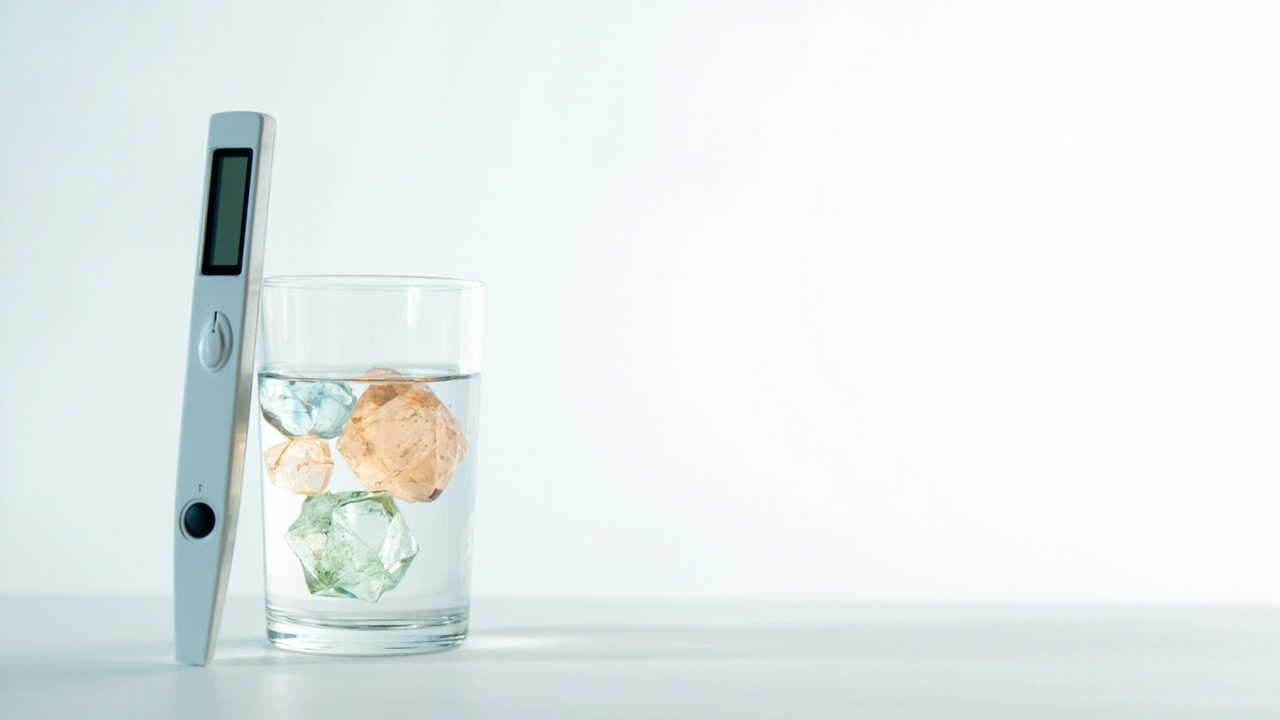
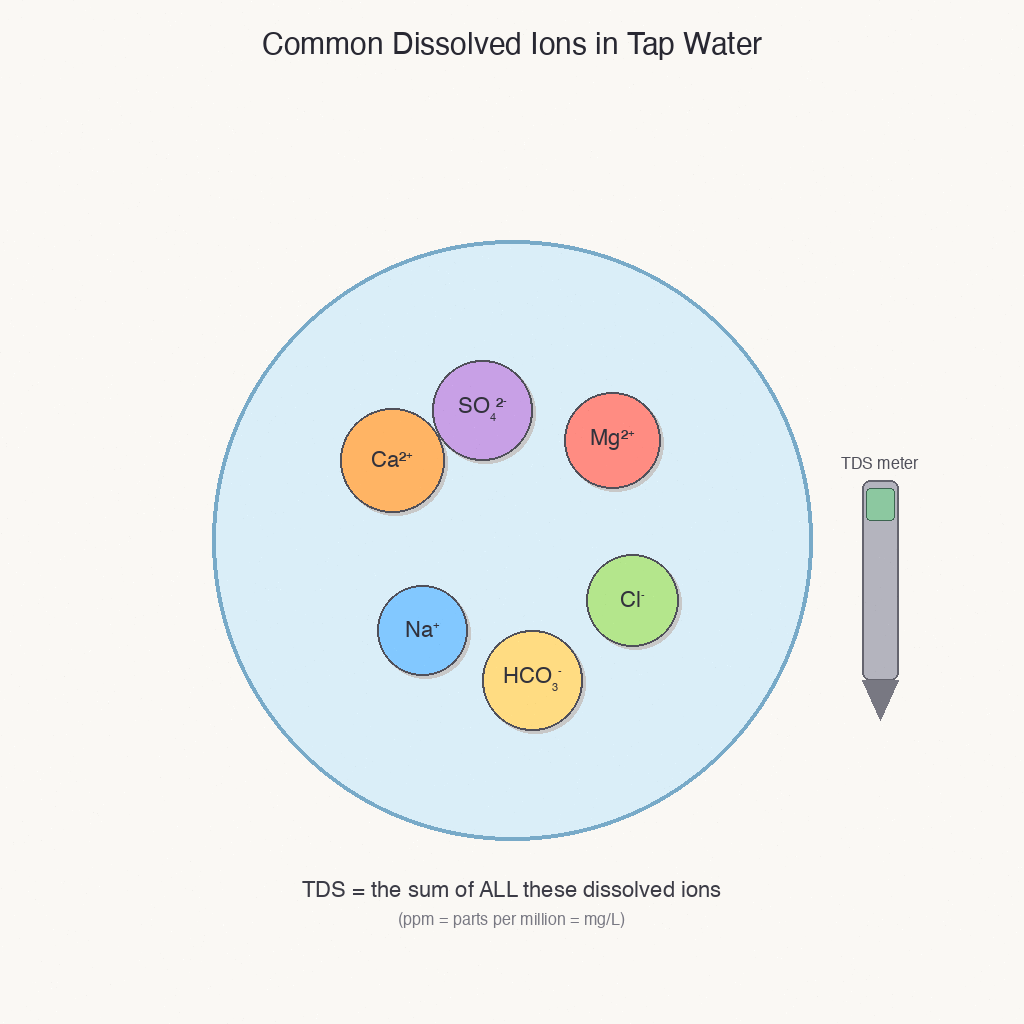
TDS stands for Total Dissolved Solids — every dissolved substance in your water summed up, measured in ppm or mg/L. Calcium, magnesium, sodium, chloride, sulfate, and bicarbonate all count. TDS is not hardness — hardness is only the calcium and magnesium slice, so a TDS meter can’t give you grains-per-gallon. EPA’s secondary standard is 500 mg/L; above that, taste and scaling worsen. Reverse osmosis cuts TDS by 90-99% and is the fastest fix at the drinking tap.
What TDS actually is
TDS = Total Dissolved Solids. It is the combined weight of every inorganic (and some organic) substance dissolved in a sample of water, reported as mg/L or ppm — the two are interchangeable for dilute drinking water. The ions that typically dominate TDS in North American tap and well water are:
- Calcium (Ca²⁺) and magnesium (Mg²⁺) — the hardness ions
- Sodium (Na⁺) and potassium (K⁺) — often from road salt, water softeners, or natural geology
- Chloride (Cl⁻) — from road salt, sewage, or natural deposits
- Sulfate (SO₄²⁻) — from gypsum, shale, or industrial runoff
- Bicarbonate (HCO₃⁻) — the alkalinity ion, mostly from limestone
- Nitrate (NO₃⁻) and silica (SiO₂) — usually small contributors, but relevant in agricultural or well-water areas
What TDS does not include: suspended sediment, bacteria, colloids, or anything that won’t pass a 2-micron filter. A cloudy glass can read low TDS if the cloudiness is suspended silt rather than dissolved ions.
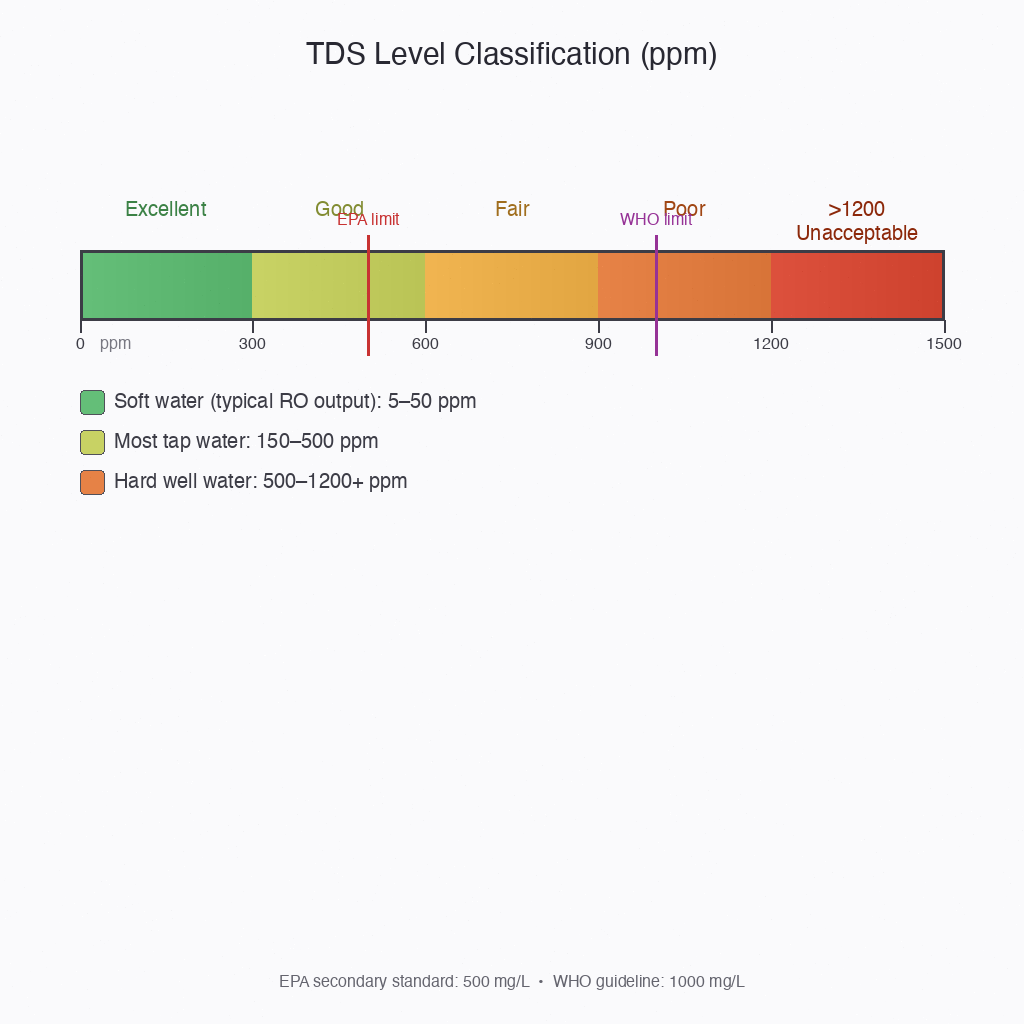
This is why TDS is a bulk water-quality indicator, not a safety test. A low TDS doesn’t mean your water is safe — it means dissolved ions are low. A high TDS doesn’t mean your water is dangerous — it means taste, scaling, and appliance life will suffer. EPA’s secondary maximum contaminant level for TDS is 500 mg/L for aesthetic reasons (taste, color, corrosion). WHO notes that water above 1000 mg/L is “significantly and increasingly unacceptable” to consumers. [Sources: EPA Secondary Drinking Water Regulations; WHO Guidelines for Drinking-water Quality, 4th ed.]
TDS vs hardness (the key distinction)
This is the single most confused concept in residential water treatment, and getting it wrong costs homeowners money.
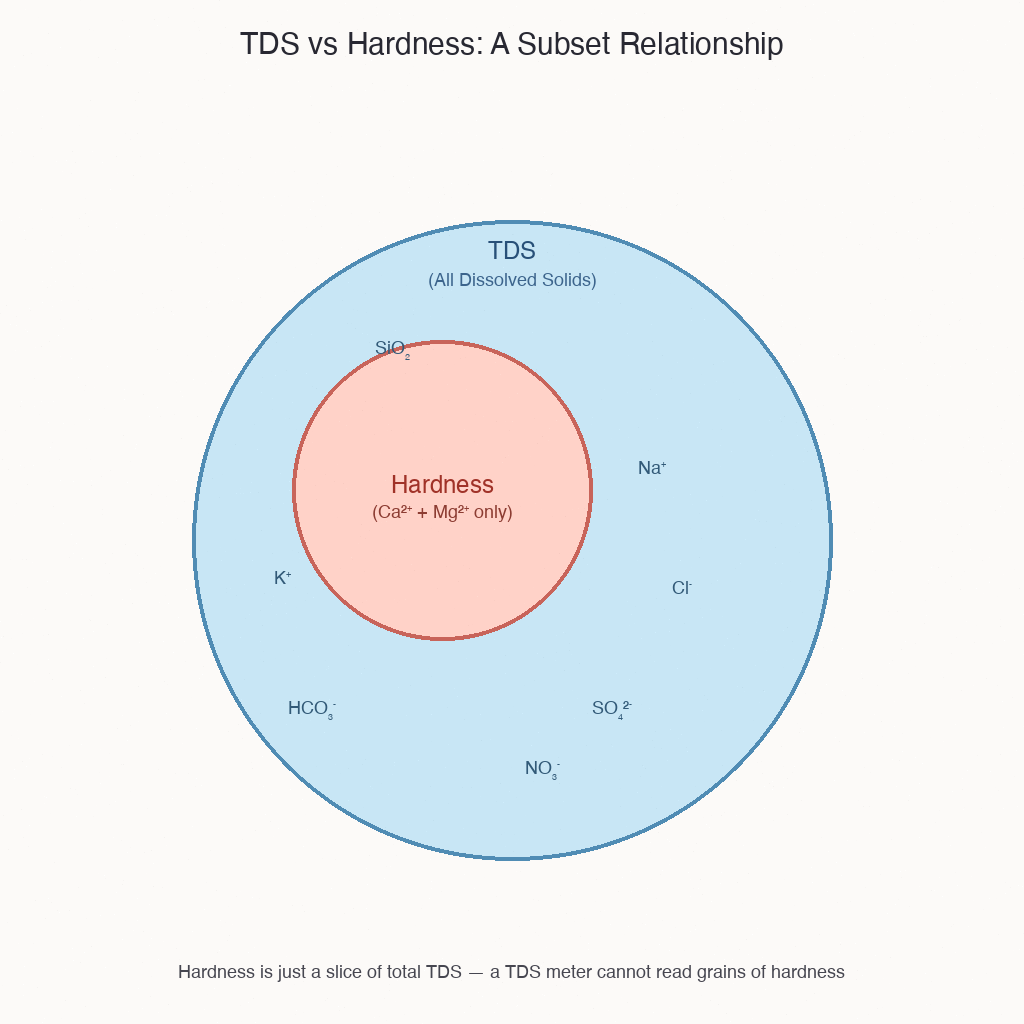
Hardness measures only the calcium and magnesium ions in your water, expressed as calcium carbonate (CaCO₃) equivalent — usually in grains per gallon (gpg) or ppm.
TDS measures everything dissolved — calcium and magnesium, plus sodium, chloride, sulfate, bicarbonate, potassium, nitrate, silica, and trace minerals.
In other words, hardness is always a subset of TDS. A TDS reading of 300 ppm might include 100 ppm of hardness ions (Ca²⁺ + Mg²⁺) plus 200 ppm of everything else. A different sample with the same 300 ppm TDS could have 200 ppm of hardness and only 100 ppm of “everything else.” Both have identical TDS but completely different scaling behavior and require different softener sizing.
| Sample | TDS (ppm) | Hardness (as CaCO₃) | Hardness share of TDS | Dominant non-hardness ions |
|---|---|---|---|---|
| City tap (Midwest) | 320 | 180 | 56% | Sodium, chloride |
| City tap (coastal) | 280 | 70 | 25% | Sodium, chloride |
| Well (limestone aquifer) | 480 | 280 | 58% | Bicarbonate, sulfate |
| RO output | 18 | <5 | <25% | Trace sodium |
| Softener output | 320 | <5 | <2% | Sodium (Na⁺, from ion exchange) |
Note the last row carefully. A water softener trades calcium and magnesium for sodium. Hardness drops to near zero, but TDS barely changes — the sodium takes the calcium’s place in the TDS count. This is why a TDS meter cannot confirm your softener is working. To verify softening, you need a hardness test kit — strips or drops that react specifically to Ca²⁺ and Mg²⁺ — not a TDS pen.
Skip / Don’t #1: Don’t use a TDS reading to set or verify your softener’s hardness setting. The two parameters move independently after the softener. Use a hardness test kit for that job.
Skip / Don’t #2: Don’t assume a low TDS reading means soft water. A softener’s output has near-zero hardness but almost unchanged TDS because sodium replaces calcium.
In most North American municipal water, hardness runs 30-60% of TDS, but the ratio can swing from under 20% (high-sodium coastal supplies) to over 70% (deep well in limestone). The Water Quality Association and most state extension labs publish regional ratios; USGS maintains a national hardness map that pairs with state TDS reports. For the underlying hardness framework, see our water hardness fundamentals guide.
TDS units and the conductivity conversion
TDS is reported in three units you’ll see on meters, lab reports, and regulatory documents:
| Unit | Used for | Equivalent |
|---|---|---|
| ppm (parts per million) | Most consumer TDS meters, US marketing | 1 ppm ≈ 1 mg/L for water |
| mg/L (milligrams per liter) | EPA, WHO, lab reports | Same numerical value as ppm |
| ppt (parts per thousand) | Salinity / seawater | 1 ppt = 1000 ppm |
Most consumer TDS pens do not directly measure TDS. They measure electrical conductivity (EC) in microsiemens per centimeter (µS/cm) and convert to a TDS estimate using a factor. The factor depends on which reference salt the manufacturer calibrated against:
- NaCl scale (most basic pens): TDS ppm ≈ EC (µS/cm) × 0.5
- KCl scale: TDS ppm ≈ EC × 0.50–0.55
- 442 curve (natural water standard, premium meters): TDS ppm ≈ EC × 0.65–0.70
This is why two pens can read the same water slightly differently — they may use different conversion factors. For household decisions (set softener size, check RO health, compare tap vs. RO output) the exact factor doesn’t matter. For lab-grade accuracy, request a gravimetric test from a certified lab.
USGS and EPA note that conductivity-to-TDS conversions are approximate and drift in water with unusual chemistry (high iron, high organic content). The gravimetric method (Standard Methods 2540 C) is the only direct measure and the one EPA requires for compliance reporting.
TDS level chart (EPA + WHO guidance)
The EPA has not set a health-based limit for TDS. The 500 mg/L figure in EPA’s secondary standards is aesthetic — it addresses taste, color, corrosion, and scaling, not safety. WHO’s 1000 mg/L guideline is also based on acceptability for drinking, not toxicity. Here’s how the ranges map to real-world taste and behavior:
| TDS range (ppm) | Quality | What you’ll notice | Typical source |
|---|---|---|---|
| Under 50 | Very low | Flat taste; RO output or distilled | RO system, distilled water |
| 50–150 | Excellent | Clean taste; no scaling | Mountain spring, deep well (granite) |
| 150–300 | Very good | Slight mineral taste; minor spotting | Most filtered municipal tap |
| 300–500 | Good (EPA secondary ceiling) | Full mineral taste; some scale on fixtures | Typical municipal tap (most US homes) |
| 500–600 | Acceptable | Noticeable scale; chalky taste | Hard-water city supply |
| 600–900 | Fair | Heavy scale; bitter or salty taste | Hard well water, arid regions |
| 900–1200 | Poor | Aggressive scaling; taste complaints | Mineral-rich well, brackish influence |
| Over 1200 | Unacceptable (WHO) | Staining, salty taste, appliance damage | Saline intrusion, industrial contamination |
Two practical notes:
First, below 50 ppm isn’t always better. Distilled or heavily RO’d water can taste flat and is slightly more corrosive to plumbing (no buffering ions). Many RO systems add a remineralization stage that bumps TDS back to 50–100 ppm for taste.
Second, the EPA secondary standard of 500 mg/L is not a hard safety line. It’s the point where most consumers complain about taste and appliances scale faster. If your TDS is 550, your water isn’t suddenly unsafe — it’s past the aesthetic threshold. For context, iron in water and water pH and alkalinity round out the three-parameter picture (TDS + hardness + pH) that drives most home treatment decisions.
How to measure TDS at home
You have three practical options, ranked by accuracy and cost.
Digital TDS meter (best for most homes)
A handheld TDS pen costs $10–30, runs on button batteries, and returns a ppm reading in seconds. Dip the tip in a sample, stir gently, hold still, read the display. Most pens also report temperature — good pens auto-compensate for drift.
Best practice: rinse the tip in distilled water between samples, calibrate every 6–12 months with a known standard (often 342 ppm NaCl or 1413 µS/cm), and don’t trust readings below 10 ppm — at that level you’re seeing probe noise as much as actual TDS.
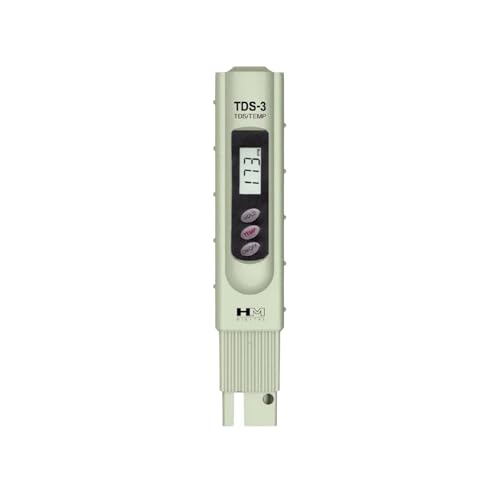
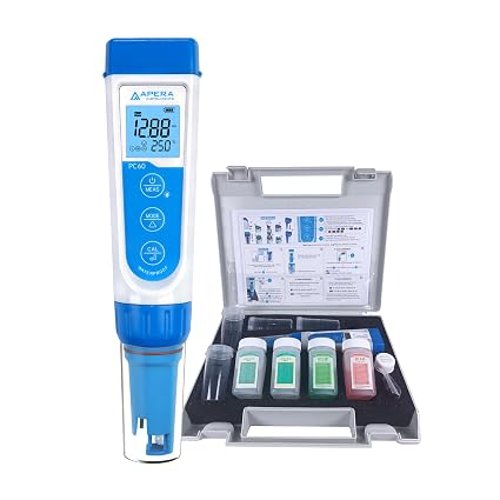
The HM Digital TDS-3 is the de-facto reference pen in the residential treatment industry — same model many installers carry to spot-check RO performance. Calibration takes two minutes with 342 ppm NaCl solution, and readings are stable within ±2%. The Apera AI316 PC60 is the upgrade path if you also want pH, EC, and salinity in one probe — useful for well owners tracking the full chemistry triangle.
TDS test strips (quick range check)
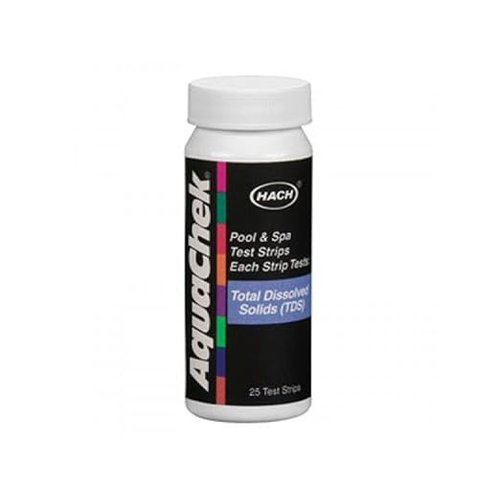
Test strips don’t give a precise ppm number — they give a range (0–100, 100–250, 250–500, 500–1000). The color-block read is fast but coarse. Strips work as a sanity check or where electronics aren’t practical. The AquaChek TDS test strips are the only dedicated TDS strip on the consumer market; the 25-pack runs about $17.
Lab gravimetric test (gold standard)
For compliance, regulatory reporting, or disputes over water quality, send a sample to an EPA-certified lab. The lab evaporates a known volume at 180°C and weighs the residue — the only method that directly measures TDS rather than estimating from conductivity. Expect $40–150 and a 1–2 week turnaround.
Don’t trust a $9 TDS pen to settle a dispute with your municipality or insurance company. The pen is a diagnostic for your own home decisions; the lab report is evidence.
How to use your TDS reading (decision tree)
A TDS reading by itself isn’t an action — it’s a starting point. Here’s what to do with the number, branch by branch. A quick range check with AquaChek TDS test strips is enough to place yourself on the right branch before you commit to a meter or a system.
TDS under 300 ppm
Excellent range. Your water is well within EPA’s secondary standard. Don’t add a whole-house RO system chasing lower TDS — the marginal benefit is small and you’ll lose the mineral taste most people prefer. If you’re on municipal water at this level, your remaining concerns are usually chlorine taste (a carbon filter handles it) or hardness (use a hardness test kit to check gpg separately).
TDS 300–500 ppm
Within EPA’s aesthetic standard but in the upper half. You’ll likely see scale on showerheads, glass, and appliances. Test hardness separately — if hardness is the dominant contributor (over 50% of TDS), a water softener addresses the scaling without needing RO. The softener won’t lower TDS (it trades Ca²⁺ for Na⁺), but it stops the scale.
TDS 500–900 ppm
Past the EPA secondary ceiling. Taste complaints, scale, and appliance wear accelerate. Action depends on what’s driving the number:
- If hardness dominates → softener + check for iron (iron raises TDS and stains; see iron in water)
- If sodium or chloride dominates (coastal, road salt) → a softener won’t help; you need RO at the sink for drinking
- If TDS is uniformly high → consider under-sink RO for drinking and cooking, plus a whole-house filter for sediment
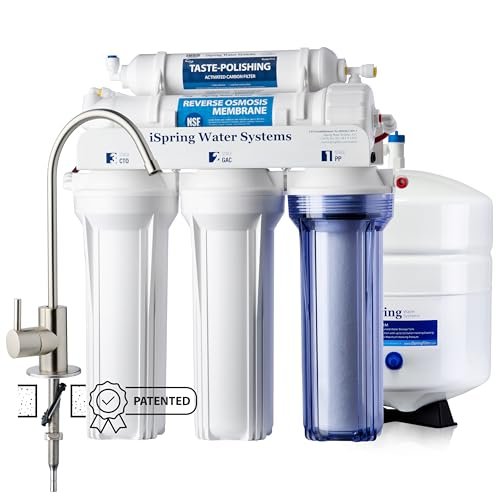
The iSpring RCC7-BN is the standard 5-stage under-sink RO system at this tier — NSF/ANSI 58 certified, 75 gallons per day, $200–230 street price. The APEC ROES-50 is the direct competitor (WQA Gold Seal certified, similar specs) if you want a second quote.
TDS above 900 ppm
Unacceptable for long-term drinking per WHO. Aggressive scaling, bitter or salty taste, appliance damage. Steps:
- Test the breakdown, not just TDS — send a sample to a lab to see what’s driving the number (sodium? sulfate? iron? chloride?). Different contaminants need different treatment.
- Drinking water only — an iSpring RCC7-BN at the sink handles drinking and cooking immediately. Whole-house treatment for high TDS is expensive and rarely necessary for taste.
- Well? Check for saline intrusion or agricultural runoff — high chloride or nitrate point to specific sources.
- Don’t buy a salt-based softener expecting it to lower TDS. It won’t. (Salt vs salt-free systems explains why.)
How reverse osmosis changes TDS
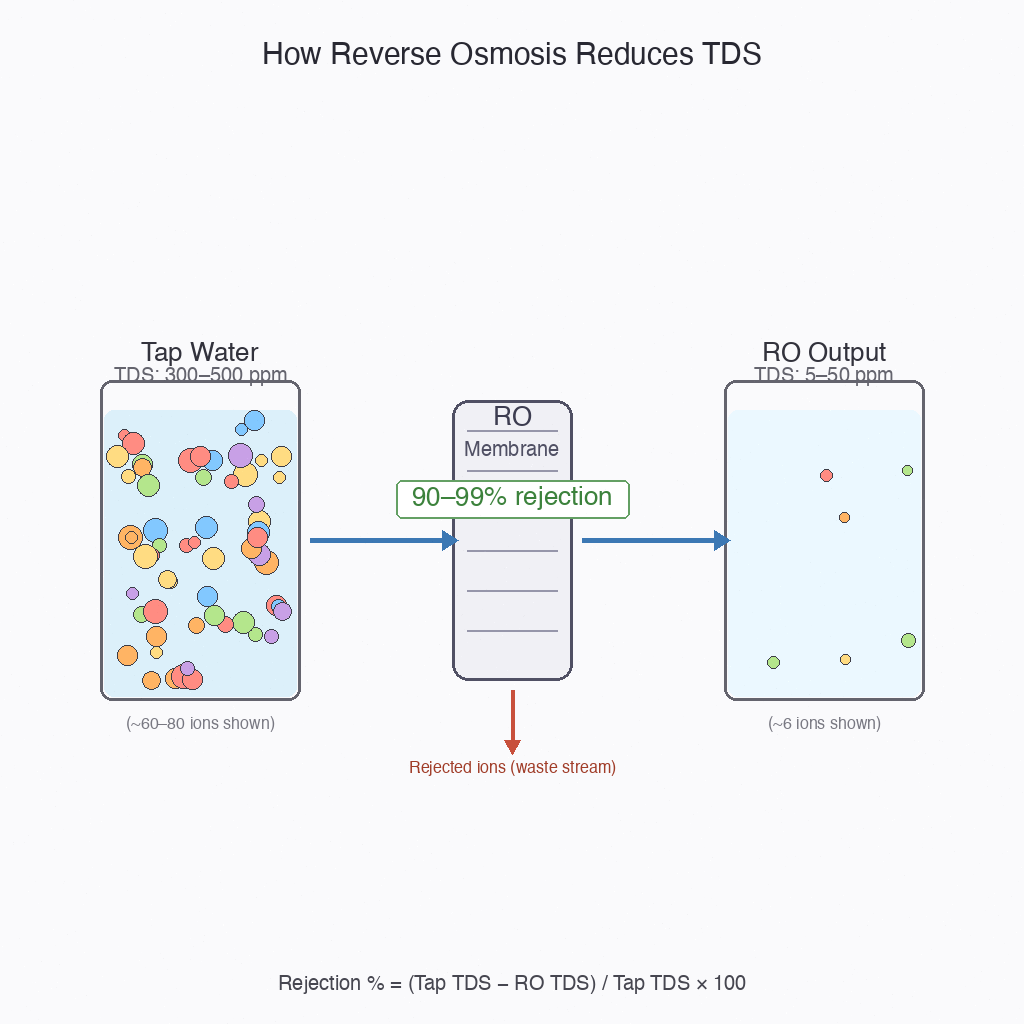
Reverse osmosis is the only common residential treatment that actually lowers TDS. A semipermeable membrane with pores around 0.0001 microns rejects dissolved ions — most residential RO membranes are rated to reject 90–99% of TDS at standard pressure (50–80 psi) and temperature (77°F / 25°C), per NSF/ANSI 58 test conditions.
Typical performance on US municipal water:
- Pre-RO TDS: 250–500 ppm
- Post-RO TDS: 5–50 ppm
- Rejection rate: 90–98%
The exact rejection rate depends on four factors:
- Membrane type and age — TFC (thin-film composite) membranes dominate; they lose rejection as they foul or age. Most rate membrane life at 2–5 years for chlorine-free feed.
- Feed pressure — below 40 psi, rejection drops. Booster pumps recover it.
- Temperature — colder water flows slower through the membrane; rejection percentage stays similar but output drops.
- Feed TDS level — very high-TDS feed stresses the membrane and shortens life.
The practical implication: a TDS meter is the fastest diagnostic for RO health. Measure tap water, then measure RO output. Calculate the rejection percentage:
Rejection % = (Tap TDS − RO TDS) / Tap TDS × 100
If your system used to reject 95% and now rejects 80%, the membrane is likely due for replacement. Most RO faucet-top dispensers don’t include a built-in TDS sensor, so a pen-style meter at the tap is the standard way to check. The HM Digital TDS-3 is the same pen installers use for this measurement. See our under-sink RO systems guide for system-level detail, and the RO filter replacement schedule for membrane replacement timing.
Salt-free conditioners do not reduce TDS. They use template-assisted crystallization to convert dissolved hardness ions into suspended microcrystals that don’t stick to pipes. The ions stay in the water; TDS before and after will be the same. This isn’t a flaw — salt-free systems prevent scale, not remove minerals. But the marketing language (“salt-free softener”) is easy to misread as “lowers TDS like a softener lowers hardness.” It doesn’t.
What you’ll need
For most homes, the testing path is one purchase:
- A TDS pen for routine checks. The HM Digital TDS-3 ($13.60) is the baseline installer pen. Calibration solution runs about $8 for years of use.
- Multi-parameter for well owners. The Apera AI316 PC60 ($131) tracks pH, EC, and salinity alongside TDS on a private well — one probe replaces three.
- A no-battery backup. AquaChek TDS test strips ($17 for 25) give a quick range check before committing to a bigger purchase.
- RO for high-TDS drinking water. If tap reads over 500 ppm and taste is the issue, the iSpring RCC7-BN ($220, NSF/ANSI 58 certified) is the standard 5-stage under-sink pick.
TDS Measurement Methods
Three practical methods cover every use case from a quick homeowner sanity check to a compliance-grade lab report. The right method depends on what decision you’re trying to make — and what TDS can’t tell you.
Digital TDS meter (handheld probe)
A handheld TDS pen is the workhorse for residential use. The HM Digital TDS-3 ($13.60) is the installer-standard — same model most water-treatment pros carry to spot-check RO performance. The Apera AI316 PC60 ($131) adds pH, EC, and salinity on a single probe — useful for well owners tracking the full chemistry triangle rather than TDS alone.
Best practice: rinse the probe in distilled water between samples, calibrate every 6–12 months with a 342 ppm NaCl standard, and don’t trust readings below 10 ppm — at that level you’re seeing probe noise as much as actual TDS. Temperature-compensated pens (most modern models) hold accuracy from 5–50°C without manual correction.
TDS test strips (colorimetric range check)
Test strips give a range rather than a precise number — 0–100, 100–250, 250–500, 500–1000 ppm. The color-block read takes about 30 seconds and works without batteries. AquaChek TDS test strips are the only dedicated TDS strip on the consumer market — useful for a fast is my tap below or above 500? check before committing to a meter or a treatment system.
Lab gravimetric test (gold standard)
For compliance, regulatory reporting, real-estate disclosure, or disputes with your water utility, send a sample to an EPA-certified lab. The lab evaporates a known volume at 180°C and weighs the residue — the only direct measure of TDS, not an estimate from conductivity. Expect $40–150 and a 1–2 week turnaround. This is the method EPA requires for compliance reporting under the Safe Drinking Water Act; a handheld pen cannot substitute.
Calibration and accuracy over time
A new TDS pen reads within ±2% of the calibrated value out of the box. After 6–12 months, the probe drifts — usually toward higher readings as the electrode ages. Recalibrate with a single-point 342 ppm NaCl standard (most pen kits include one) or a 1413 µS/cm conductivity standard for premium probes. Don’t trust an uncalibrated pen older than a year for compliance work; for home decisions, drift under 5% doesn’t change the practical advice.
Temperature compensation matters more than most users realize. TDS readings at 5°C versus 35°C can differ by 15–20% on an uncompensated pen. Most residential pens auto-compensate to 25°C; check the spec sheet. If your pen doesn’t auto-compensate, sample at room temperature before drawing conclusions about water quality.
What TDS measurements miss
None of the three methods detect bacteria, lead, pesticides, VOCs, or anything that isn’t a dissolved ion. For iron contamination, you need a separate iron test strip or lab panel — iron is a dissolved solid, so a high-iron water reads higher TDS, but a low TDS reading does not rule iron out. The water pH and alkalinity parameters also move independently of TDS and need their own probes or strips. Use TDS as a bulk screen for dissolved solids, not a safety test for contaminants.
TDS vs Hardness
Hardness is always a subset of TDS, but the ratio between them varies by geography — and the ratio drives your treatment decisions more than either number alone.
Why the ratio matters for treatment
In most North American municipal water, hardness runs 30–60% of TDS. A TDS reading of 300 ppm with 60% hardness (180 ppm as CaCO₃) needs a softener sized for roughly 10 gpg. The same 300 ppm TDS with 25% hardness (75 ppm) is mostly sodium and chloride — a softener won’t help, and RO at the sink is the only fix. The TDS number alone cannot distinguish these two cases; you need a separate hardness test to know which scenario you’re in.
Regional TDS-to-hardness patterns
The ratio varies sharply by source water:
- Midwest municipal (limestone aquifers): hardness dominates 50–70% of TDS
- Coastal municipal (sodium, chloride intrusion): hardness only 20–30% of TDS
- Mountain spring: low both, ratio varies widely
- Deep well (gypsum or shale): sulfate dominates, hardness 30–50%
- Brackish or saline-influenced wells: sodium and chloride overwhelm, hardness fraction below 20%
For an exact read, pair your TDS number with a hardness test strip reading and a regional water-quality report. USGS publishes national hardness and TDS maps; most state geological surveys have county-level data. The Water Quality Association maintains regional summary tables for member utilities.
High TDS + low hardness: the corrosion failure mode
When TDS is high but hardness is low (sodium- or chloride-dominated water), the supply is aggressive — it lacks the calcium buffer that normally protects metal surfaces. This is the corrosion pattern that drives pinhole leaks in copper pipe and accelerates tank failure in water heaters, even at modest hardness numbers. The full mechanism — and the Langelier Saturation Index that predicts it — is in our hard water and pipes corrosion guide. The short version: don’t assume high TDS means scale. High TDS + low hardness means corrosion risk, and the fix is a calcite neutralizer or side-stream remineralization, not a softener.
Low TDS + high hardness: the scaling failure mode
The opposite pattern — high hardness but moderate TDS — is the classic scaling scenario. Calcium carbonate precipitates on heating elements, showerheads, and glass. A softener addresses this directly; a salt-free conditioner alters crystal formation but doesn’t lower TDS. See salt vs salt-free systems for the trade-offs, and the hardness test kit guide for sizing the softener correctly.
How to read a TDS number when hardness is the unknown
If you only have a TDS pen and no hardness test yet, use this short-cut:
- TDS under 200 + no visible scale → hardness is likely under 100 ppm; a softener isn’t needed yet.
- TDS under 200 + visible scale → hardness is still a meaningful fraction; test hardness before assuming low TDS means low hardness.
- TDS over 400 + visible scale → hardness is likely 40–60% of the total; a softener addresses most of the scale problem.
- TDS over 400 + no visible scale → hardness is likely below 25%; the high TDS is sodium, chloride, or sulfate — investigate with iron in water and water pH and alkalinity tests before deciding on a softener, and check the corrosion guide for pipe risk at that TDS level.
Common mistakes
- Using a TDS meter to verify your softener is working. A softener swaps calcium for sodium — TDS barely moves. Use a hardness test strip to confirm softening; save the HM Digital TDS-3 for RO checks and tap-vs-RO comparisons.
- Assuming low TDS = soft water. A softener’s output reads almost the same TDS as the input because sodium replaces calcium. The hardness is gone; the TDS isn’t. The AquaChek TDS strips are a no-battery way to confirm the reading is real, not a probe glitch.
- Treating EPA’s 500 ppm as a safety line. It’s an aesthetic secondary standard, not a health-based one. Water at 550 ppm isn’t dangerous — it just tastes worse and scales faster. Conversely, water at 50 ppm isn’t automatically safe; TDS doesn’t detect bacteria, lead, or pesticides.
- Buying a whole-house RO system to chase low TDS. Whole-house RO is expensive ($2,000–10,000 installed) and rarely justified by TDS alone. An iSpring RCC7-BN at the drinking tap handles 95% of TDS-related complaints at one-tenth the cost.
- Comparing two TDS pens and assuming one is broken. Different brands use different conductivity-to-TDS conversion factors (0.5 for NaCl, 0.65–0.70 for the 442 curve). A 10–15% spread between two pens on the same water is normal, not a defect. The Apera AI316 PC60 lets you switch factors and see the difference directly.
Related
- Water hardness fundamentals — the calcium/magnesium-only parameter, and why it controls scaling
- GPG to PPM conversion chart — switching between grains-per-gallon and ppm without errors
- Iron in water — iron raises TDS and stains; the second most common diagnostic step after hardness
- Water pH and alkalinity — the third leg of the water-quality triangle (TDS + hardness + pH)
- Under-sink reverse osmosis systems — the only common treatment that actually lowers TDS
- Hardness test kits — strips and drops for measuring hardness specifically (not TDS)
- Salt vs salt-free — why salt-free conditioners don’t reduce TDS
Key takeaways
- TDS = total dissolved solids; hardness = only calcium and magnesium (a subset of TDS)
- A TDS meter cannot tell you your hardness — use a hardness test kit for gpg
- EPA’s 500 ppm TDS limit is aesthetic, not health-based. WHO flags over 1000 ppm as unacceptable.
- In most US municipal water, hardness runs 30–60% of TDS, but the ratio can swing from under 20% to over 70% depending on local geology.
- Reverse osmosis is the only common residential treatment that actually reduces TDS — 90–99% rejection.
- Salt-based softeners and salt-free conditioners do not lower TDS (softener trades Ca²⁺ for Na⁺; conditioner doesn’t remove ions at all).
- A HM Digital TDS-3 pen at the tap is the fastest RO health check: measure tap vs. output, calculate rejection %, replace the membrane if it drops.