Quick answer
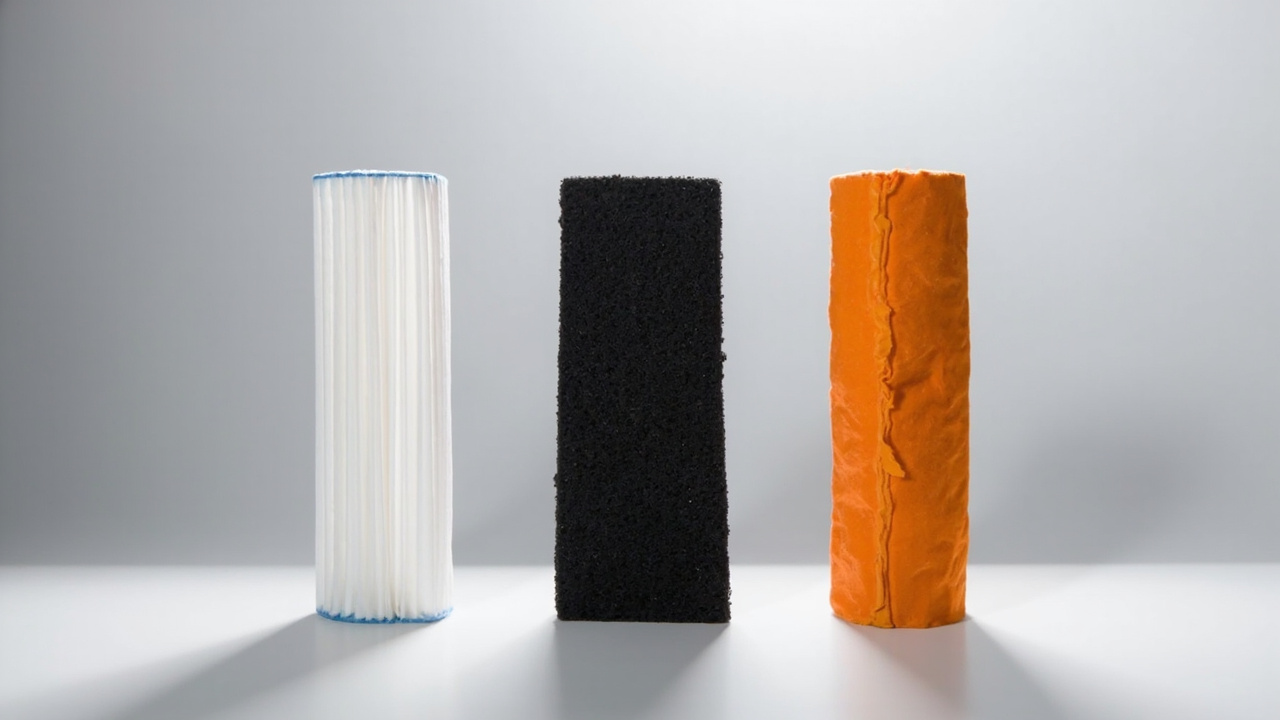
Whole-house filter cartridges come in three families. Sediment cartridges (string-wound, pleated, spun) catch sand, silt, and rust before they reach faucets and appliances. Carbon cartridges (GAC, carbon block, KDF) reduce chlorine, taste, odor, and some chemicals. Specialty cartridges target dissolved iron or hydrogen sulfide. Match the cartridge to your water source and contaminants. And remember: no cartridge softens hard water.
What filter cartridges do (and don’t)
Cartridges remove suspended particulates and reduce chlorine, taste, and some chemicals through activated carbon adsorption. Specialty media can target dissolved iron, hydrogen sulfide, or chloramine. But no cartridge removes dissolved hardness minerals — calcium and magnesium pass right through. If your problem is scale or appliance damage, you need a water softener, not a filter. Cartridges also do not reduce TDS; only reverse osmosis does that.
Three cartridge families at a glance
| Family | Removes | Micron range | Typical life | Cost per cartridge |
|---|---|---|---|---|
| Sediment (string-wound, pleated, spun) | Sand, silt, rust, particulates | 1 to 50 µm | 3 to 6 months | $5 to $30 |
| Carbon (GAC, carbon block, KDF) | Chlorine, taste and odor, VOCs, some chemicals | 0.5 to 10 µm | 6 to 12 months | $15 to $50 |
| Specialty (iron, sulfur, chloramine) | Dissolved iron, hydrogen sulfide, chloramine | Varies | 6 to 12 months | $25 to $60 |
Sediment cartridges: your pre-filter
Sediment cartridges are the first line of defense. Their only job is to catch particulates before they clog downstream carbon filters, softener resin, or appliance inlet screens. Three subtypes, in order of cost:
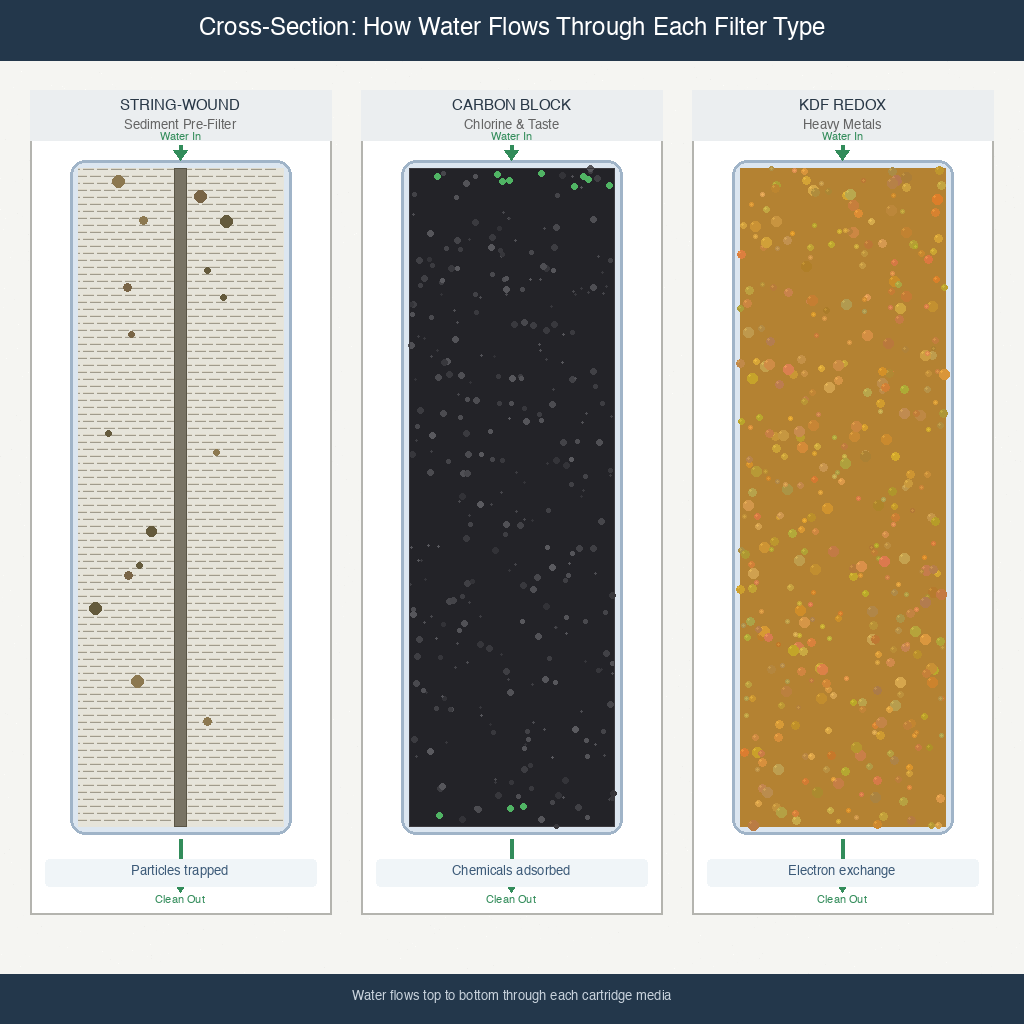
String-wound (cheapest, single-use)
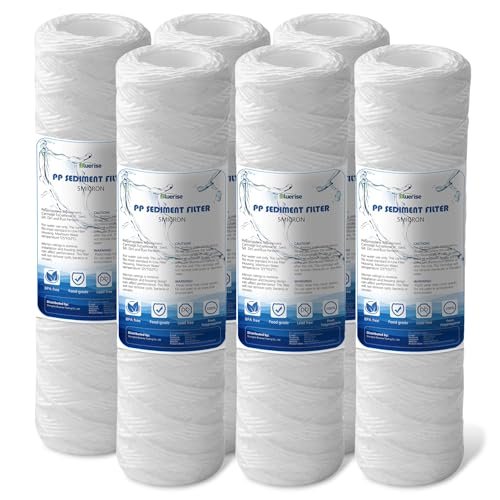
Tightly wound polypropylene cord around a core. Particles get trapped through the thickness of the wound material, not just on the surface. Typical rating 5 to 50 micron. Cost runs $5 to $15 per cartridge, and a BLUERISE 5 micron string-wound 6-pack at roughly $22 keeps replacement cost under $4 per cartridge. Lifespan is 3 to 6 months depending on sediment load. Cannot be cleaned. When loaded, throw it away. If sediment is very fine or load is very high, the cartridge can “unload” (release trapped particles downstream) once saturated.
Pleated (washable, high flow)
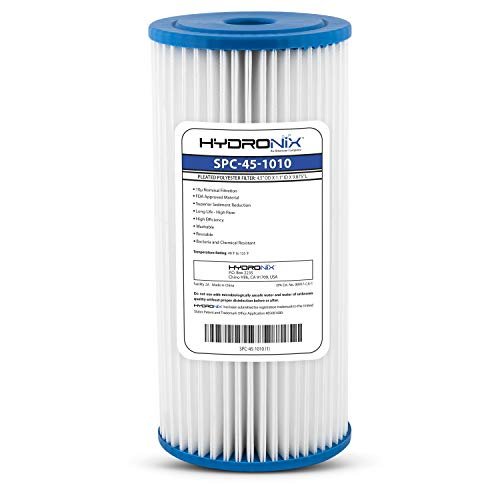
Polypropylene or polyester sheet folded into pleats around a core. Much higher surface area than string-wound, so higher flow rate and higher dirt-holding capacity. Typical rating 10 to 50 micron. A Hydronix pleated washable 4.5 inch by 10 inch cartridge costs about $12 and can be rinsed and reused 2 to 3 times before replacement. That pays off fast on high-sediment well water. Lifespan is 6 to 12 months with periodic washing. Not a depth filter, so it will not catch sub-micron particles.
Skip if: your water has very fine silt (under 5 micron). Pleated surface filtration won’t trap it. Use a spun or string-wound depth cartridge instead.
Spun / melt-blown (gradient density, depth)
Molten polypropylene spun onto a core, producing a gradient-density cartridge. The outer surface is coarse (catches large particles) and the inner core is fine (catches smaller particles). Typical rating 1 to 25 micron. Cost is $8 to $20. Not washable. Best multi-layer depth capture of any sediment type. Often used as the second stage after a coarse string-wound or pleated pre-filter.
Carbon cartridges: chlorine, taste, odor, and more
Carbon cartridges use activated carbon’s enormous surface area to adsorb dissolved chemicals. Three subtypes, in order of capability:
GAC (granular activated carbon) — fast flow, channeling risk
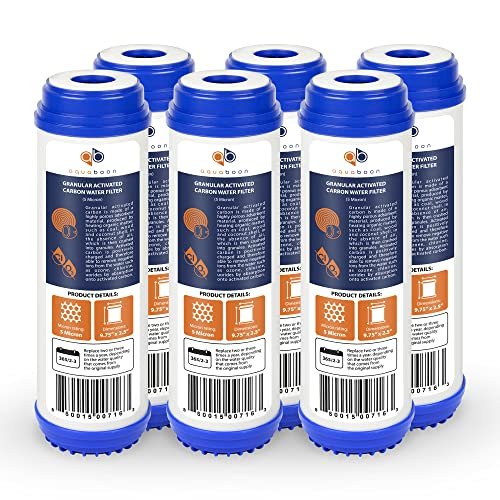
Loose carbon granules packed in a cartridge. Water flows through and chlorine, taste, and some VOCs adsorb onto the carbon surface. High flow rate, low pressure drop, lowest cost. An Aquaboon coconut-shell GAC cartridge runs about $40. Lifespan 6 to 12 months. Trade-off: water finds the path of least resistance through the loose bed (channeling), so adsorption is less complete than a carbon block.
Carbon block — finer pores, better adsorption
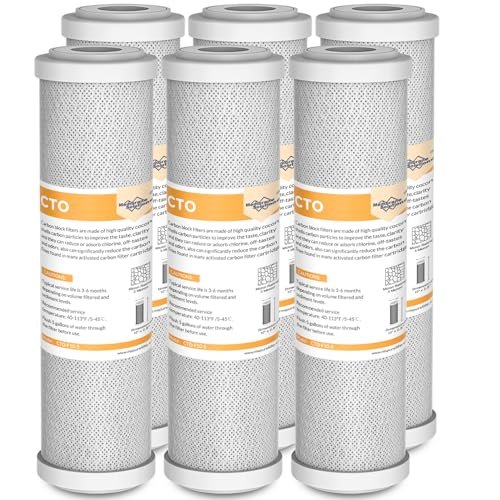
Finely ground carbon compressed into a solid block. No granules, so no channeling. Water must pass through the entire carbon matrix. Pore structure is much finer (0.5 to 10 micron), so the block also acts as a sediment filter. A Membrane Solutions 5 micron CTO carbon block 4-pack at about $34 covers a year of 3-month swaps for standard city water chlorine reduction. Better chlorine and VOC reduction than GAC, no channeling, and it catches some particulates too. Cons: lower flow rate than GAC at the same housing size. You may need a larger (4.5 inch by 20 inch) housing for whole-house flow rates.
NSF/ANSI 42 covers aesthetic chlorine, taste, and odor reduction; NSF 53 covers health-effects contaminants (lead, cysts, certain VOCs). A filter listed to NSF 42 or 53 has been independently tested. Check the specific listing, not the marketing copy.
KDF (redox media) — heavy metals and chloramine
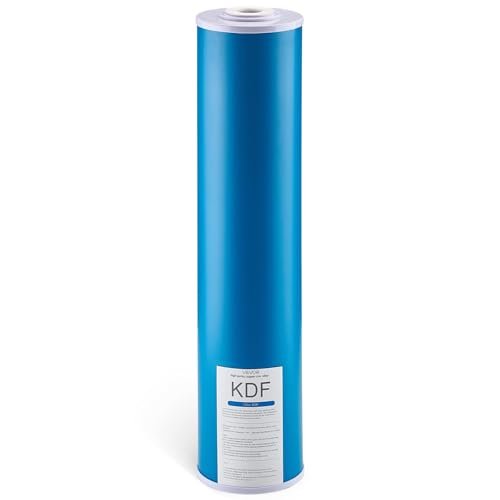
Copper-zinc alloy granules that work by redox reaction, not adsorption. Removes free chlorine, reduces some heavy metals (lead, mercury, iron, hydrogen sulfide), and inhibits bacteria and algae growth inside the filter. The VEVOR KDF plus carbon composite cartridge at about $44 handles chloramine, lead, and mercury in a 4.5 inch by 20 inch Big Blue format. Lifespan is 10 to 12 months. KDF extends the life of downstream carbon and handles heavy metals that carbon alone won’t. Most KDF cartridges on the market are KDF plus carbon block composites, not KDF alone.
Specialty cartridges: targeted contaminant removal
When you have a specific dissolved contaminant that sediment and carbon alone won’t handle, specialty media cartridges are the next step before committing to a full dedicated system.
Iron removal (greensand, birm, or proprietary composites)
Media that oxidizes dissolved ferrous iron (Fe2+) to insoluble ferric iron (Fe3+) and traps the particles. Works for moderate iron, typically up to about 3 ppm. For higher iron, a dedicated backwashing iron filter system is required.
Don’t expect a cartridge to handle 5 or 10 ppm iron. At that level you will be replacing cartridges weekly.
Sulfur and hydrogen sulfide removal
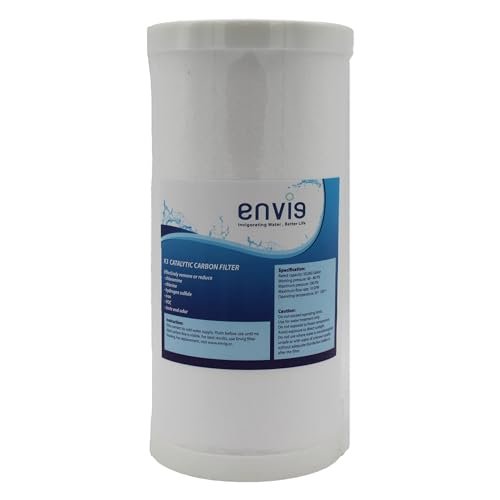
Hydrogen sulfide (H2S) produces the “rotten egg” smell in well water. Catalytic carbon, activated carbon processed to enhance its oxidation catalysis, is the most common cartridge media for H2S. Often combined with an oxidizing pre-treatment (air injection, chlorination, or hydrogen peroxide dosing) at the system level. An Envig K3 catalytic carbon and composite cartridge at about $60 handles both dissolved iron and hydrogen sulfide in a single 4.5 inch by 10 inch cartridge. Lifespan is 6 to 12 months. For strong sulfur odor, a dedicated system (air injection plus catalytic carbon tank) outperforms any cartridge. See our whole-house water filters overview for system-level options.
Understanding micron ratings
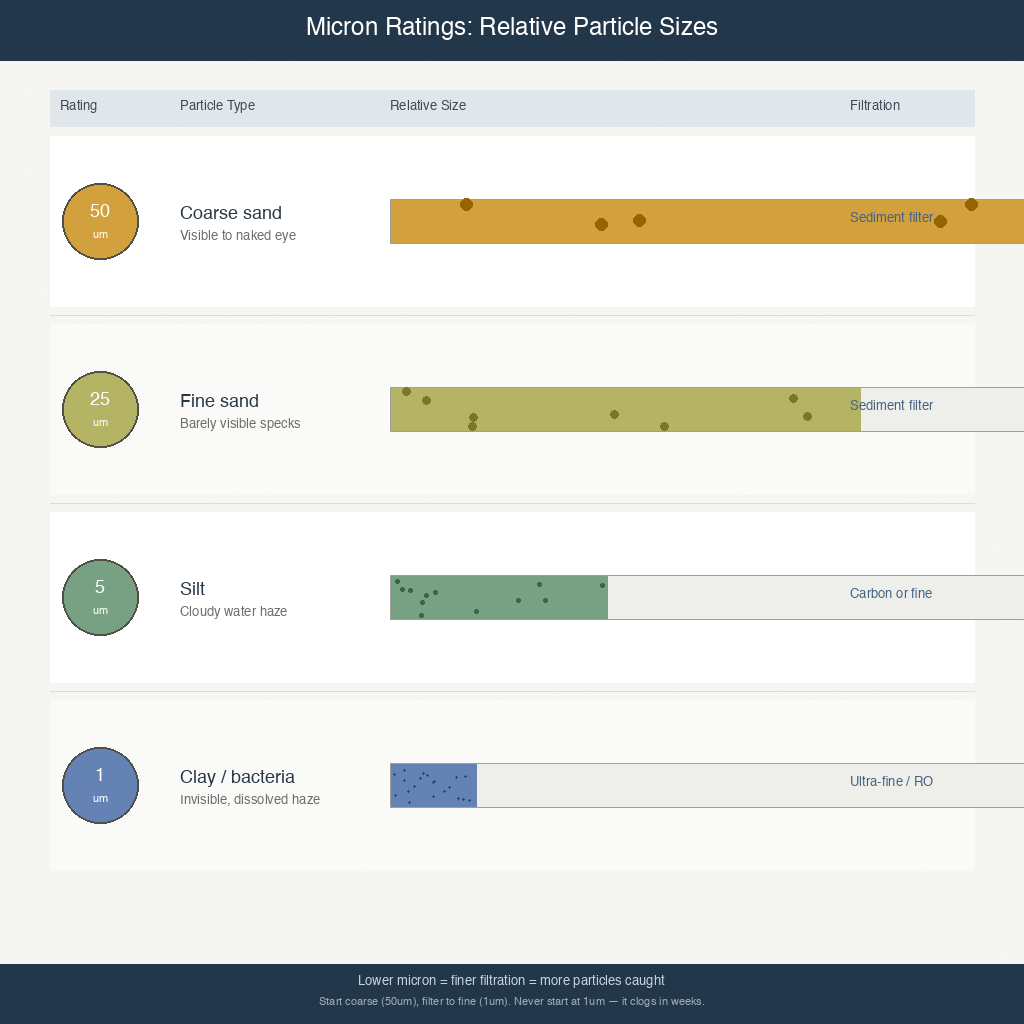
Micron ratings describe the size of particles a filter is designed to catch. Two types matter for whole-house cartridges:
- Nominal rating: the filter captures about 85% of particles at the rated size. Most consumer sediment and carbon cartridges are nominal-rated.
- Absolute rating: 99.9% capture at the rated size. Absolute ratings (typically 1 micron absolute) appear on NSF 53 listed cyst-reduction filters for Cryptosporidium and Giardia.
Rating tiers for whole-house filtration:
| Tier | Micron range | Use |
|---|---|---|
| Coarse | 25 to 50 µm | First stage for high-sediment well water or surface water |
| Medium | 5 to 25 µm | Standard city water pre-filter |
| Fine | 1 to 5 µm | Polishing stage, or NSF 53 cyst reduction |
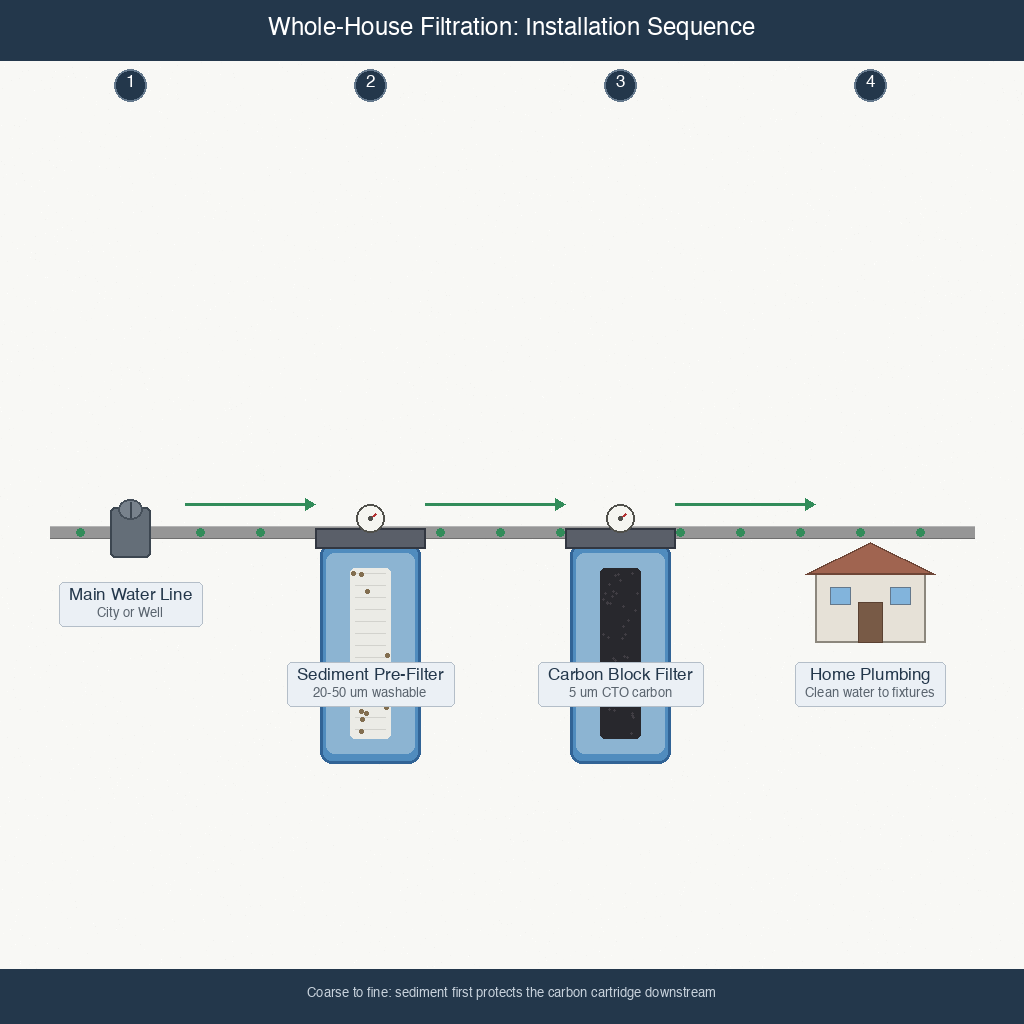
Filter coarse to medium to fine. Never start at 1 micron — it catches everything at once and clogs within weeks. Stack a 25 or 50 micron pre-filter upstream, then a 5 micron secondary, then a 1 micron carbon block for fine polishing.
Sizing your whole-house filter system
GPM calculation
Count fixtures, not bathrooms. Each faucet, toilet, shower, and appliance draws roughly 1 GPM. A 2-bathroom home with simultaneous shower, dishwasher, and laundry needs 7 to 10 GPM. A 4.5 inch by 10 inch Big Blue handles 8 to 10 GPM; the 4.5 inch by 20 inch handles 15 to 20. Undersizing causes pressure drop during peak demand.
Port sizes
- 2.5 inch by 10 inch: point-of-use or single-fixture applications only. Not suitable for whole-house.
- 4.5 inch by 10 inch (Big Blue 10): small to medium homes, 1 to 2 bathrooms, up to 10 GPM.
- 4.5 inch by 20 inch (Big Blue 20): larger homes, 3+ bathrooms, 10 to 20 GPM.
Pressure drop monitoring
Install pressure gauges before and after the filter housing. When the pressure difference exceeds 10 to 15 psi, the sediment cartridge is exhausted. A cartridge rated for 6 months might last 3 months on turbid well water or 9 on clean city water. The gauge tells you the truth.
For help converting hardness units for sizing calculations, see our GPG to PPM conversion chart.
Which filter cartridge do you need
Read down the branches. Most homes need at least a sediment pre-filter plus a carbon cartridge. The question is which carbon, and whether a specialty cartridge is also required.
Branch 1: City water, no specific complaints
Sediment pre-filter (5 to 25 micron) plus carbon block (5 to 10 micron). Handles chlorine taste and catches rust from aging pipes. Use the BLUERISE string-wound 6-pack and the Membrane Solutions CTO carbon block.
Branch 2: City water with chloramine concern
Some municipalities use chloramine instead of chlorine for disinfection. Standard GAC and carbon block reduce chloramine only marginally. You need catalytic carbon or a KDF-composite cartridge. The VEVOR KDF plus carbon composite handles chloramine, lead, and mercury in one 4.5 inch by 20 inch cartridge.
Branch 3: High-sediment well water
Heavy sediment load from well water or old galvanized pipes. Start with a washable pleated pre-filter (25 to 50 micron). The Hydronix pleated cartridge rinses and reuses 2 to 3 times. Follow with a carbon block.
Branch 4: Well water with dissolved iron
If your well water iron is above the EPA secondary limit of 0.3 mg per liter but below about 3 ppm, a specialty iron-removal cartridge downstream of a sediment pre-filter is workable. The Envig K3 iron and hydrogen sulfide cartridge handles both dissolved iron and sulfur smell in one cartridge. Above 3 ppm iron, skip the cartridge entirely. You need a dedicated backwashing iron filter system. See our well iron filters guide.
Don’t install an iron cartridge without a sediment pre-filter upstream. Iron cartridges oxidize dissolved iron into particles, and those particles need to be caught by a sediment stage, not pushed into your plumbing.
Branch 5: Well water with sulfur smell
Rotten egg smell from hydrogen sulfide. The same Envig K3 cartridge used for iron also handles mild to moderate sulfur. For strong persistent odor, you need air injection or chlorination upstream.
Branch 6: Pre-softener protection
A sediment pre-filter upstream protects softener resin from iron and sediment fouling. A 5 micron cartridge plus a standard carbon block extends resin life. See our salt bridge and mushing guide.
Replacement schedule
The calendar gives you a starting point. Your water sets the real schedule. Here are the typical ranges:
| Cartridge type | Calendar range | Real-world indicator |
|---|---|---|
| Sediment (string-wound) | 3 to 6 months | Pressure drop of 10 to 15 psi |
| Sediment (pleated, washable) | 6 to 12 months | Pressure drop after final wash |
| Carbon (GAC) | 6 to 12 months | Chlorine taste returns |
| Carbon (carbon block) | 6 to 12 months | Chlorine taste returns |
| KDF composite | 10 to 12 months | Chlorine taste or pressure drop |
| Specialty iron and sulfur | 6 to 12 months | Smell returns, iron staining returns |
Buy replacement cartridges in multi-packs. A Membrane Solutions carbon block 4-pack covers a full year of 3-month swaps for less than buying singles. If you notice dishwasher spotting and film getting worse, it may be sediment breakthrough or hardness, not a carbon problem.
Common mistakes
-
Skipping the sediment pre-filter. Running a carbon cartridge without a sediment pre-filter upstream shortens carbon life dramatically. Sediment clogs the carbon pores, and you lose both filtration and flow. A BLUERISE string-wound 6-pack at $22 costs far less than replacing a fouled carbon block every two months. Always run coarse sediment first.
-
Using carbon to fix hard water. Carbon does not remove calcium or magnesium. If scale is the problem, you need a softener.
-
Starting at 1 micron. A 1 micron cartridge as the first stage clogs within weeks. Always filter coarse to fine.
-
Ignoring pressure drop. Install pressure gauges. When delta P exceeds 10 to 15 psi, replace the sediment cartridge regardless of the calendar.
-
Mismatched sizing. A 2.5 inch cartridge in a whole-house application starves flow. Match the housing to your peak GPM. When in doubt, go one size up.
When to call a pro
Keep DIY if: swapping a cartridge, installing pressure gauges, or adding a point-of-use filter.
Call a licensed plumber if:
- Iron exceeds 3 ppm (cartridge can’t keep up; you need a dedicated iron filter system)
- Hydrogen sulfide is strong and persistent (need air injection or chlorination upstream)
- You are installing a whole-house housing for the first time (soldering, threading, code compliance)
- Pressure drop persists after cartridge replacement (problem may be in the housing, bypass valve, or downstream, not the cartridge)
We do not rank “water filter installer near me” companies.
Related
- Whole-house water filters overview
- Shower filters explained
- Softener vs RO vs whole-house filter
- How water softeners work
- Well iron filters
- Water hardness fundamentals
- TDS explained
Key takeaways
- Three cartridge families: sediment (particulates), carbon (chlorine and chemicals), specialty (iron and sulfur). None soften water.
- Always filter coarse to medium to fine. Never start at 1 micron.
- Pressure drop means sediment is exhausted. Taste return means carbon is exhausted.
- Chloramine needs catalytic carbon or KDF, not standard GAC.
- Iron above 3 ppm needs a dedicated system, not a cartridge.