Quick answer
Iron in water is a nuisance mineral, not a hardness mineral. Below about 0.3 mg/L most people never notice it; above that it stains fixtures orange, tints laundry, and adds a metallic taste. Dissolved (ferrous) iron looks clear at the tap and rusts later; oxidized (ferric) iron is already orange in the glass. Test first — the number and the form decide whether a softener is enough or you need a dedicated iron filter.
What iron in water actually means
Iron is dissolved out of soil and rock as groundwater moves; wells hit it far more often than treated city supplies. Private wells in iron-bearing geology frequently test at 1 to 10 mg/L, well above the EPA Secondary MCL. Municipal water is usually already filtered, but old or corroding mains can re-introduce iron downstream of the plant — a few utilities still distribute water with detectable iron.
Iron is an aesthetic contaminant under EPA’s Secondary Drinking Water Regulations, not a health-based one. The 0.3 mg/L limit exists because of taste, color, and staining — the same regulations cap manganese at 0.05 mg/L. If iron is on your well along with bacteria, nitrate, or arsenic, that is a different problem with a different test path; this article is about the iron.
It is worth keeping iron and water hardness (calcium and magnesium) separate in your head. Hardness produces white chalky scale. Iron produces orange or rust-colored staining. They are different minerals with different treatments, and they often show up together on the same well — which is why a single test kit that covers both saves a trip.
Iron vs manganese vs hardness (don’t confuse the stains)
- Orange / rust streaks — iron.
- Black or dark-brown specks or a slimy black film — manganese, or iron bacteria.
- White chalky crust on the faucet head — hardness, not iron.
- Rotten-egg smell with staining — sulfur / hydrogen sulfide, a separate problem.
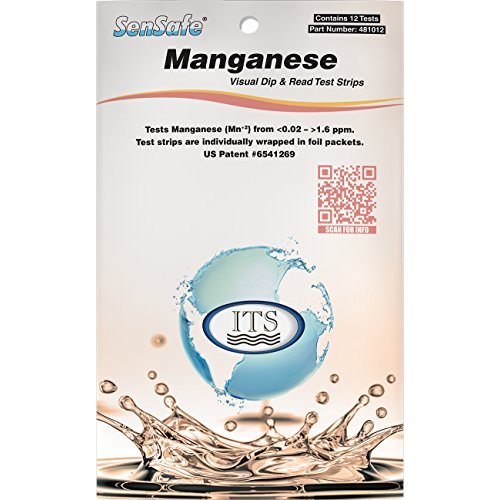
Don’t: buy an iron system on stain color alone. Black staining is usually manganese, and a manganese-rated media is a different spec than a ferrous-iron system. Test manganese separately with a manganese test strip before you buy.
Health and aesthetic limits (what 0.3 mg/L actually is)
- EPA Secondary MCL for iron = 0.3 mg/L; for manganese = 0.05 mg/L. These are non-enforceable aesthetic guidelines for taste, color, and staining, not health standards. (EPA)
- Private wells are not covered by the federal Safe Drinking Water Act at all; the homeowner tests. (EPA — Private Drinking Water Wells)
- Iron reduction claims on residential filters fall under NSF/ANSI 42 (aesthetic effects), not NSF/ANSI 53 (health effects). The certification is real, but the framing is aesthetic. (NSF)
- YMYL framing: this article doesn’t give medical advice. If iron is accompanied by bacteria, nitrate, or arsenic on a well, that is a certified-lab question for your state health department — not a filter purchase.
For the wider primer on what hard water does in the home, see what hard water actually is.
Ferrous vs ferric iron (the chemistry in plain English)
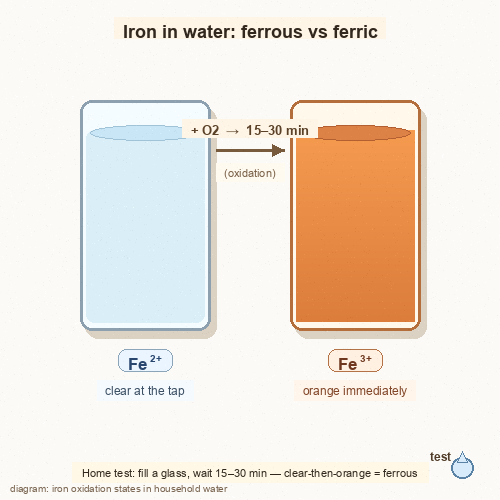
| Form | At the tap | Stain color | Behaviour |
|---|---|---|---|
| Ferrous (Fe²⁺), “clear-water iron” | Clear, turns orange in a glass after minutes-hours | Orange / rust after the fact | Dissolved; a softener can exchange it like hardness |
| Ferric (Fe³⁺), “red-water iron” | Already orange / cloudy | Immediate orange | Already a particle; needs filtration or oxidation, not ion exchange |
Simple home check: fill a clear glass, let it sit 15 to 30 minutes. Clear-then-orange = ferrous. Orange-immediately = ferric. Both together is common on wells, especially after the pump cycles a few times.
The distinction matters because ion exchange only catches the ferrous form. Ferric iron is already a particle; running it through a softener packs the resin bed with rust and shortens the resin’s life. Treatment logic below follows this form-first split.
How to test for iron at home
- Run the tap 2 to 3 minutes so you sample the well or main, not stagnant pipe water.
- Fill a clean glass; do the clear-vs-orange sit test above.
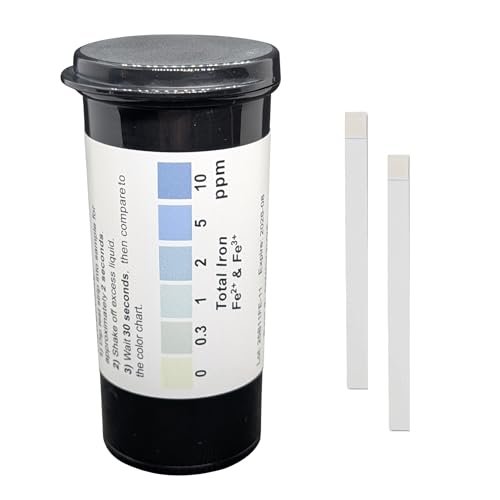
- Use an iron test strip with a 0 to 10 ppm color scale for the number.
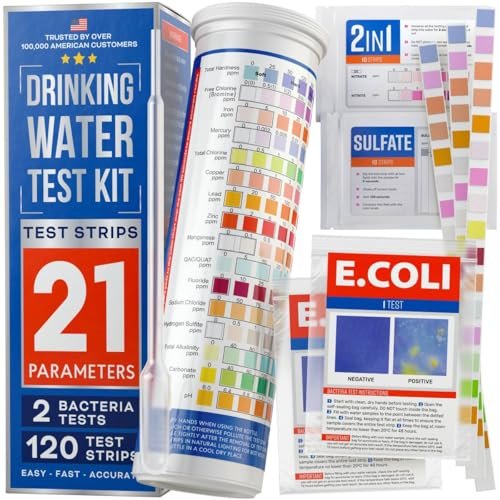
- On a private well, run a broader baseline strip kit — iron plus hardness plus pH — so you size the whole plan once. A 21-in-1 well water test kit covers iron, hardness, pH, chlorine, nitrates, and a few other basics in one pass.
- Retest after heavy rain or after the well pump was serviced — iron isn’t always stable day to day.
For the wider test hardware picture (drop-count titration, digital meters, where strips fall short), see test kits for hardness and iron.
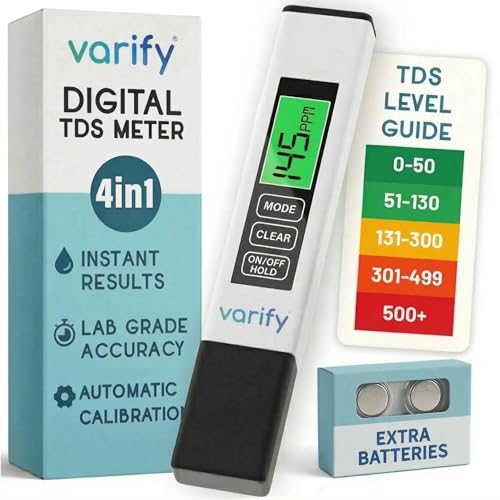
Don’t: rely on a TDS meter to measure iron. TDS reads total dissolved solids, not any single ion — a well at 250 ppm TDS tells you nothing about whether iron is 0.2 or 4 mg/L.
Skip: the trip to a hardware store if you already have a 21-in-1 strip kit and a manganese strip on hand — those two tests answer 90% of the iron question on a private well.
Iron levels: light, moderate, heavy — what each means
| Reading | Label | What it usually means |
|---|---|---|
| < 0.3 mg/L | Below the aesthetic limit | No action needed; retest annually on a well |
| 0.3 to 1 mg/L | Light | Faint staining; a softener may absorb it if the water is also hard |
| 1 to 3 mg/L | Moderate | Softener alone gets risky; iron fouls resin over time |
| 3 to 10 mg/L | Heavy | Dedicated iron treatment — oxidation or filtration |
| > 10 mg/L or ferric-dominant | Very heavy | Air injection / greensand-class system, plan on a pro |
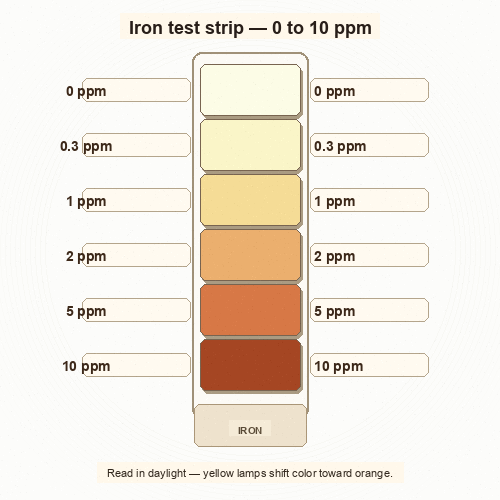
Read the strip at the same lighting you would a pool test — daylight or a daylight bulb, not a warm lamp. Iron strips at 1 ppm and 2 ppm sit one shade apart on most scales; a yellowish kitchen light reads both as “orange.” If you want a number you trust, run the same strip twice and average, or send a sample to a lab for a single anchor reading.
The number alone isn’t enough. A reading of 0.5 mg/L with ferric iron at the tap is a different fix than 0.5 mg/L of clear-water ferrous iron. Form and number, together, drive the decision.
If you have not measured yet, an iron test strip takes about a minute to read once you have a sample, and the 0 to 10 ppm scale maps cleanly onto the table.
Iron Type Identification — what the rest of the house is telling you
After you have a number from the strip and a clear-vs-orange reading from the glass test, the next move is pattern-matching what the rest of the plumbing is showing you. Iron leaves different fingerprints at different fixtures, and reading them correctly saves you from buying the wrong system.
Look in four places:
- Toilet tank and bowl. Orange or rust streaks that reappear within hours of cleaning almost always point to ferrous iron that oxidized once it sat in the bowl. A red-orange dust along the inside tank waterline is a textbook sign. If the deposit is black or dark-brown slime in the same area, switch your thinking to iron bacteria or manganese — the fix path is different.
- Aerators and showerheads. Unscrew the bathroom aerator. If a rust paste wipes off the screen, ferrous iron is precipitating the moment the water meets air. The same deposit on the showerhead, sometimes paired with reduced flow, points the same direction.
- Laundry. Orange-tinted whites, especially bath towels that come out of the machine with a peach wash, are a low-ppm ferrous signal. The stain can stay hidden on colored loads for months and then suddenly show on a guest towel.
- Dishware and glassware. Orange spots on glasses and flatware after a dishwasher cycle are usually ferric iron that precipitated somewhere upstream of the spray arm — either in the supply line or inside the tank of the appliance. Confirm with a clear glass run through an empty dishwasher cycle before chasing the supply.
Iron bacteria is its own pattern. A sudden sulfur or swampy smell, a slimy clear-orange film inside the toilet tank, and rapid fouling of softener resin and toilet components are all classic signs. A shock-chlorination of the well sometimes clears it temporarily; recurring slime usually needs continuous chlorination ahead of the iron filter — a separate piece of equipment from anything in the rest of this article.
Don’t: treat manganese as iron. Manganese stains are black or dark brown and tend to land on the same whites where iron would, which is why the manganese test strip pays for itself. Manganese-rated media costs more and sizes differently, so a misidentification walks straight into the wrong vessel.
A useful framing, especially on a well that also runs hard: keep iron and water hardness as two parallel reads, not one number on a single dial. A house at 25 gpg hardness and 4 mg/L iron needs both problems handled on purpose — that’s a softener plus an air-injection oxidizer, not just whichever problem you noticed first. The glass test, the iron strip, a hardness strip (or a well baseline kit that covers both), and a quick tour of the fixtures give you enough to pick a row in the treatment decision tree below.
When a softener handles iron (and when it doesn’t)
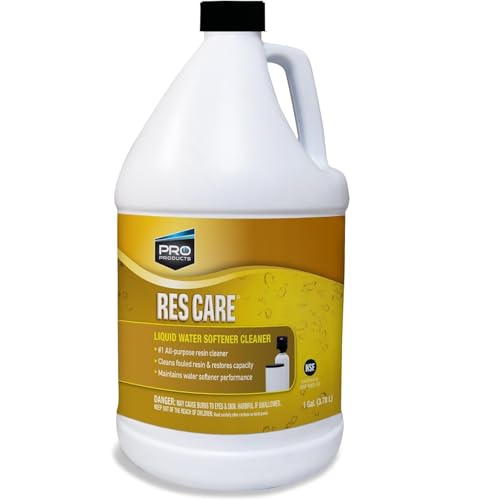
A standard ion-exchange softener can remove ferrous, clear-water iron at roughly 1 to 2 mg/L when the water is also hard enough to justify a softener at all. The mechanism is the same — swap iron for sodium on the resin — but the iron accumulates on the resin over time and gradually reduces capacity. That is why iron-carrying softeners need a resin cleaner on a schedule (typically every few regenerations, depending on ppm) plus routine softener salt pellets.
It can’t remove ferric iron — particles blind the resin bed instead of exchanging, and the resin fouls faster than the softener can regenerate.
Iron gradually fouls the resin. Capacity falls, water starts slipping through hard, and the brine tank picks up a rusty film. If you already have a softener and are noticing hardness creep back, iron fouling is one of the first things to check. For how the ion exchange mechanism works in detail, see how ion exchange actually works. For the buying path when you know iron and hardness both apply, see choosing a softener that can carry iron.
Skip: an iron filter if your reading is under 0.3 mg/L and you have no staining — you’re below the EPA aesthetic limit and any treatment is overkill.
When you need a dedicated iron filter
- Ferric iron present (water is orange straight from the tap).
- Iron above about 2 to 3 mg/L even in ferrous form.
- Manganese above 0.05 mg/L.
- Iron bacteria — slimy biofilm in the toilet tank or a sudden sulfur smell.
- Softener resin keeps fouling even with regular cleaner dosing.
Common dedicated approaches:
- Air injection / oxidizing filter — adds oxygen to convert ferrous iron to ferric, then traps the particle. Good for 1 to 10 mg/L clear-water iron on a private well.
- Manganese greensand — catalytic oxidation media, needs a regeneration chemical (usually potassium permanganate). Workhorse for moderate-to-heavy iron plus manganese.
- Chemical injection — chlorine or hydrogen peroxide fed ahead of a contact tank. Reserved for the worst cases and almost always sized by a pro.
Sediment pre-filtration protects everything downstream when ferric particles are already present. Full system picks and sizing live in well water iron filters; the broader whole-house context is in whole-house filter housings.
Filtration Options — sizing the hardware to the reading
Once you have a number and a form, the filter choice narrows quickly. Five categories cover most residential iron on private wells; each has a reading range, a maintenance footprint, and a failure mode worth knowing before you buy.
- Sediment prefilter (5- or 20-micron cartridge). Catches ferric iron that’s already a particle, plus rust flakes shed from the well casing or old galvanized plumbing. Sized in front of any other system; cartridge swapped every 1 to 3 months depending on loading. Won’t reduce dissolved ferrous iron on its own, so don’t expect it to do the whole job — pair it with an oxidizer.
- Air-injection oxidizing filter. Single tank, no chemical regenerant. Pulls in air at each regen cycle, oxidizes ferrous to ferric inside the media bed, traps the particle. Workhorse for 1 to 10 mg/L clear-water iron on a private well. Needs a stable pump pressure curve and a drain line for the backwash. Failures usually trace back to under-sized tanks relative to flow rate — running a 10 gpm shower through a 5 gpm-rated filter doesn’t oxidize, it slips through.
- Manganese greensand filter. Catalytic oxidation media, regenerated with potassium permanganate. Handles iron plus manganese together, which is the workhorse pick when both metals show up at meaningful levels. The trade-off is the permanganate feed: stock it, dose it right, and store it safely. Skip if you don’t want a regenerant chemical in the utility room.
- Catalytic carbon or KDF-55 contact. Smaller tanks, no regen. Acceptable at light iron (under about 1 mg/L) and useful as a polish at point-of-entry. Not a workhorse option for heavy iron, and carbon alone runs out of capacity faster than greensand once iron is consistently above 1 mg/L.
- Continuous chlorination (or peroxide) injection. Feeds an oxidizing chemical ahead of a contact tank, then filters out the precipitate. Sizing is a pro job — contact time, dosing pump, and retention tank all need to be set together. This is the path for heavy iron, iron bacteria, or cases where air-injection alone isn’t holding.
Point-of-use options sit at the other end of the spectrum. A reverse-osmosis (RO) tap at the kitchen sink polishes drinking and cooking water — iron drops out almost entirely — but it does nothing for shower staining or laundry tint. Run it as a final polish, not a substitute for whole-house treatment. The whole-house vs point-of-use split is laid out in softener vs RO vs filter.
Quick rule for picking the row:
- 0.3 to 1 mg/L ferrous + hard water → softener, no separate iron tank.
- 1 to 3 mg/L ferrous → air-injection oxidizer ahead of the softener.
- 3 to 10 mg/L or ferrous + ferric mix → air-injection or greensand, sized to peak household flow.
- Heavy iron or iron bacteria present → chlorination + contact tank + filter, sized by a pro.
- Manganese co-present → greensand or chlorination path, not air-injection alone.
Two variables drive the actual tank size: peak flow rate (shower + dishwasher + laundry together, usually 10 to 15 gpm in a 3-bath home) and the iron reading in mg/L. A system sized for one fixture is almost always under-sized for the household as a whole.
Treatment decision tree
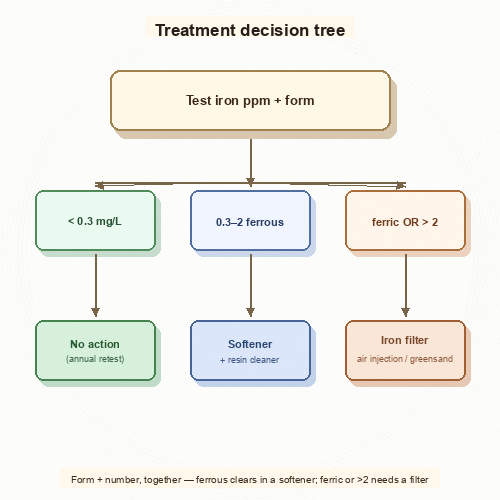
- Iron under 0.3 mg/L, no staining → do nothing; retest annually. (EPA secondary MCL)
- 0.3 to 1 mg/L, clear-water (ferrous) iron, water also hard → a softener handles it; add a resin cleaner to the maintenance loop.
- 1 to 3 mg/L, clear-water iron, water not very hard → softener plus iron pre-treatment, or go straight to a dedicated iron filter.
- Any ferric (already-orange) iron → oxidation or filtration first; a softener behind it only if hardness remains.
- Iron plus manganese, or black slime → dedicated media rated for both; get a lab test before buying.
If you are weighing whole-house treatment against point-of-use, the side-by-side is at softener vs RO vs filter — note that RO at the sink polishes drinking and cooking water but does nothing for whole-house staining. For the manganese side of an iron-plus-manganese reading, run a manganese test strip so you know which side of the problem dominates before you size the system.
Clearing existing iron stains (cosmetic, not a fix)
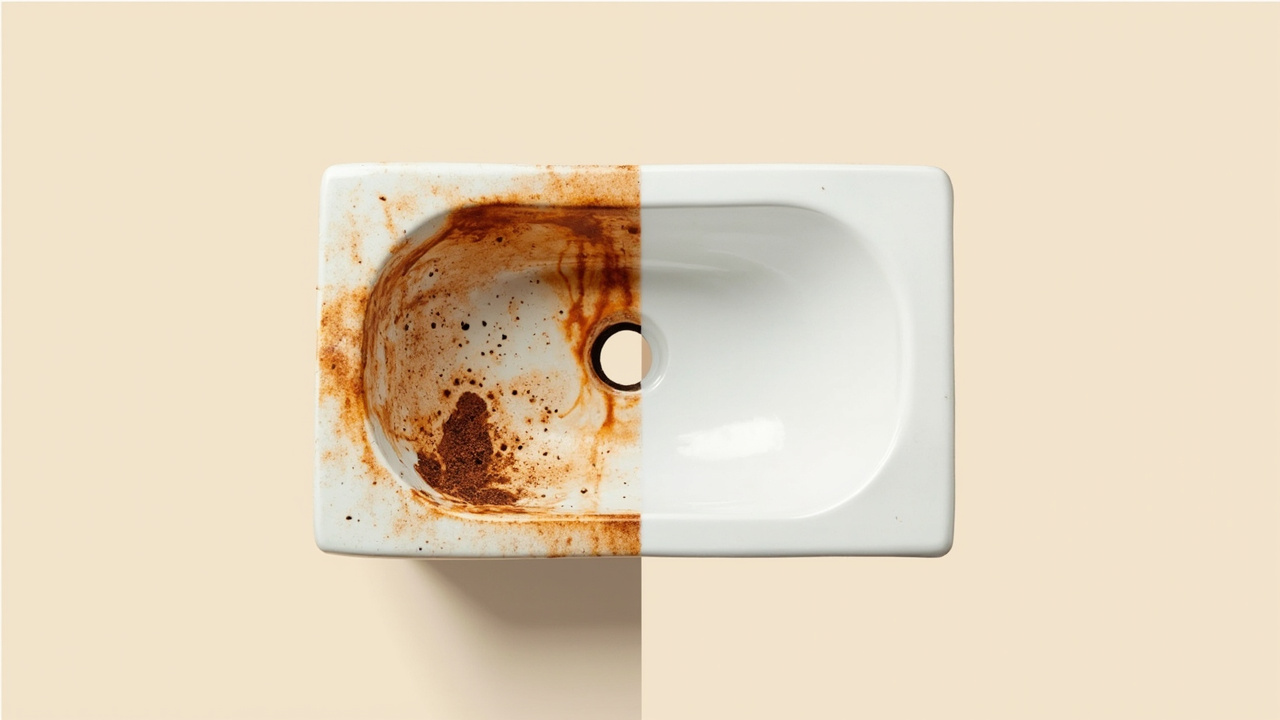
Existing orange rings do not disappear when treatment goes in. They need a reducing or rust-specific cleaner, not a standard limescale descaler. Standard vinegar and citric-acid descalers target carbonate hardness; iron stains are oxide deposits and respond to a different chemistry.
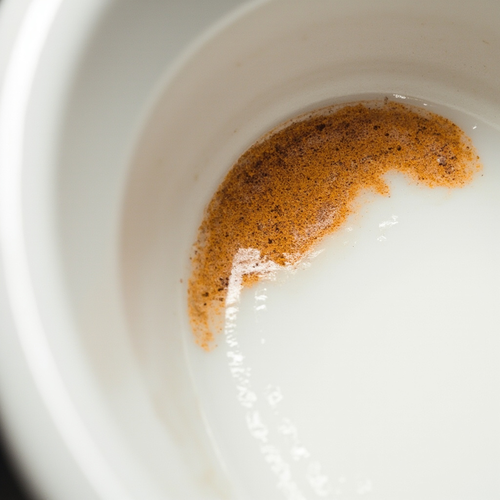
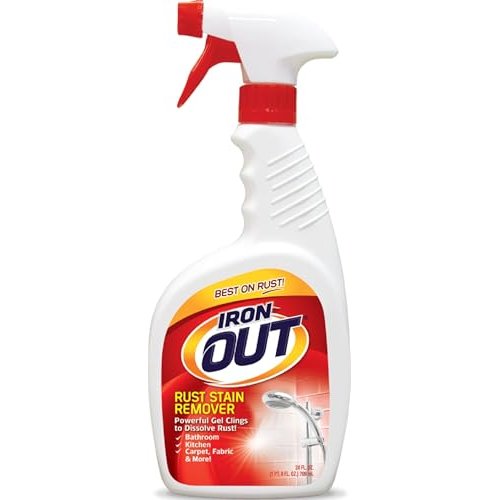
A rust-specific stain remover works on iron rings in toilets, on tubs, and on laundry that picked up an orange tint. Apply, dwell, rinse — read the label for the surface, since some are not safe on certain grout or finishes.
Don’t: use chlorine bleach on iron stains. Bleach oxidizes the iron further into the surface, which sets the stain rather than lifting it.
Treat this as symptom management, not the fix. Stains keep coming back until the water source is treated — that is the system path above.
Common mistakes
- Buying an iron filter without a number. Media choice depends on ppm and form. Guessing produces an oversized or wrong-media system. Test first with an iron test strip.
- Using a TDS meter as an iron test. TDS is a bulk reading and will not separate iron. The meter is useful as trend context, not as a diagnosis.
- Expecting a softener to fix orange water. Ferric iron blinds resin; the water gets worse, not better, and you waste salt.
- Skipping resin cleaner on an iron-carrying softener. Capacity quietly drops for months before anyone notices hard water again. A bottle of resin cleaner every few regens keeps capacity honest.
- Bleaching iron stains. Chlorine locks them in; use a rust-specific remover instead.
When to call a pro
Keep DIY if: running a glass test, using iron strips, swapping a resin cleaner bottle, replacing a sediment cartridge, setting the softener control head.
Call a licensed plumber or water treatment specialist if:
- Iron above about 10 mg/L on a private well.
- Iron bacteria present (slime, sudden odor, recurring fouling).
- Manganese above 0.05 mg/L alongside iron — dedicated media and often a regenerant are involved.
- Your well has never had a certified lab panel (bacteria, nitrate, arsenic). Get that before spending on iron equipment.
- Anything requiring cutting into the main line, a bypass loop, drain-line plumbing, or an air-gap fitting.
This site does not rank or recommend local installers.
Related
- water hardness (gpg and ppm) — hardness units and how they differ from iron
- what is hard water — top-of-funnel primer
- well water iron filters — system picks for well iron
- how ion exchange actually works — the softener mechanism
- test kits for hardness and iron — test hardware
- choosing a softener that can carry iron — buying path when iron plus hardness
- softener vs RO vs filter — which tool for which problem
- whole-house filter housings — whole-house cartridge context
Key takeaways
- Iron is an aesthetic problem at 0.3 mg/L — EPA secondary standard, not a health limit.
- Ferrous (clear) vs ferric (orange) decides the treatment path more than the raw number.
- Test before buying — the glass test plus an iron test strip takes five minutes; a well baseline kit covers more on a private well.
- Softeners handle light clear-water iron only, and only while the resin stays clean.
- Ferric iron, manganese, or above 2 to 3 mg/L means a dedicated oxidizing or filtering system.
- Stain removers are cosmetic; they never replace treatment of the water source.
- Wells are the homeowner’s responsibility — get a lab panel before a system purchase.