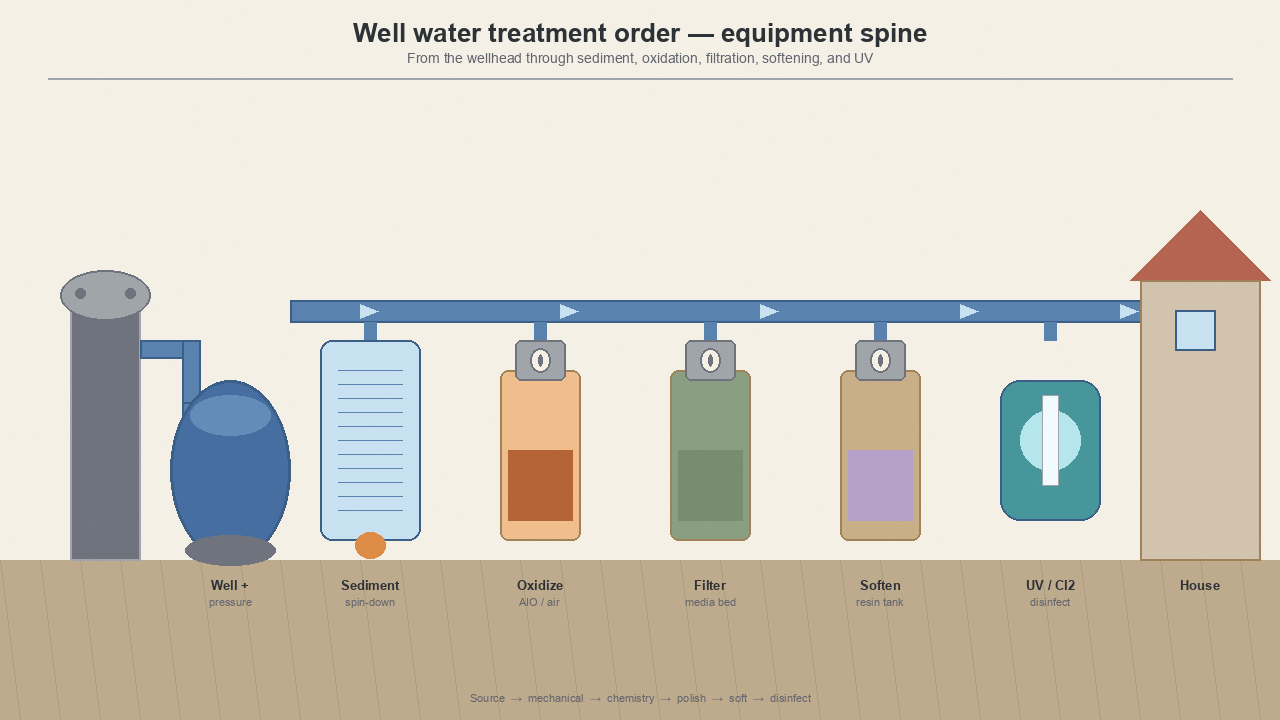
If your private well leaves orange rings, rotten-egg smell, scale crust, or a positive bacteria strip in the same house, you don’t need three random Amazon gadgets — you need a sequence. Buy stages out of order and you’ll foul resin, coat a UV sleeve, and still scrub the same fixtures. Below: the five numbers to test first, the standard order (sediment → oxidize → filter → soften → disinfect), a decision tree, and four worked household cases.
Quick answer
Well water treatment order is almost always the same: test first, then sediment, then oxidize and filter iron or sulfur, then soften hardness, then disinfect. Skipping the test or putting a softener before iron is the fastest way to foul resin and waste money. Match each stage to a lab number — flow rate, iron, hydrogen sulfide, hardness grains, and bacteria — and only buy the stages your well actually needs.
Why treatment order matters on a well
Private wells don’t get municipal pretreatment. Sand, dissolved iron, hydrogen sulfide gas, hardness minerals, and occasional bacteria can share one pipe. Each contaminant needs a different process, and most processes fail when the wrong stage sits upstream.
- Softener resin is built for calcium and magnesium ions — not ferric iron sludge.
- Carbon and UV both clog or shadow when sediment is still free-floating.
- Oxidizing iron filters need clear flow and contact time; they aren’t a softener substitute.
If the only symptom you notice is soap scum and white crust, start with the signs of hard water in your home checklist. If the dominant symptom is orange staining or metallic taste, jump to the well-water iron filter guide after you finish the sequence rules here.
What this guide is not
- Not a brand roundup. No “best 7 well systems 2026” list.
- Not a DIY well-drilling or pump guide. Pump sizing and well construction belong to a licensed well contractor.
- Not medical advice. Positive bacteria or nitrate results mean stop drinking untreated water and use a certified lab / local health department path. We don’t diagnose health conditions from a faucet.
Softener vs filter vs RO (one screen)
Keep the three jobs separate so marketing copy doesn’t rearrange your stack:
- Softener (salt-based ion exchange): swaps hardness minerals — fixes scale and spotting. It does not disinfect and it is a poor primary iron filter.
- Whole-house sediment/carbon filter: catches grit and improves taste/odor — not softening. See the whole-house water filters overview for housing sizes.
- RO (usually under sink): polishes drinking and cooking water — not every shower and not a stand-alone bacteria barrier by itself.
Salt-free “softeners” are usually conditioners. They may change how scale sticks; they usually do not bring hardness grains to zero on a strip. Match the claim to your goal before you buy.
Step 0 — Test before you buy anything
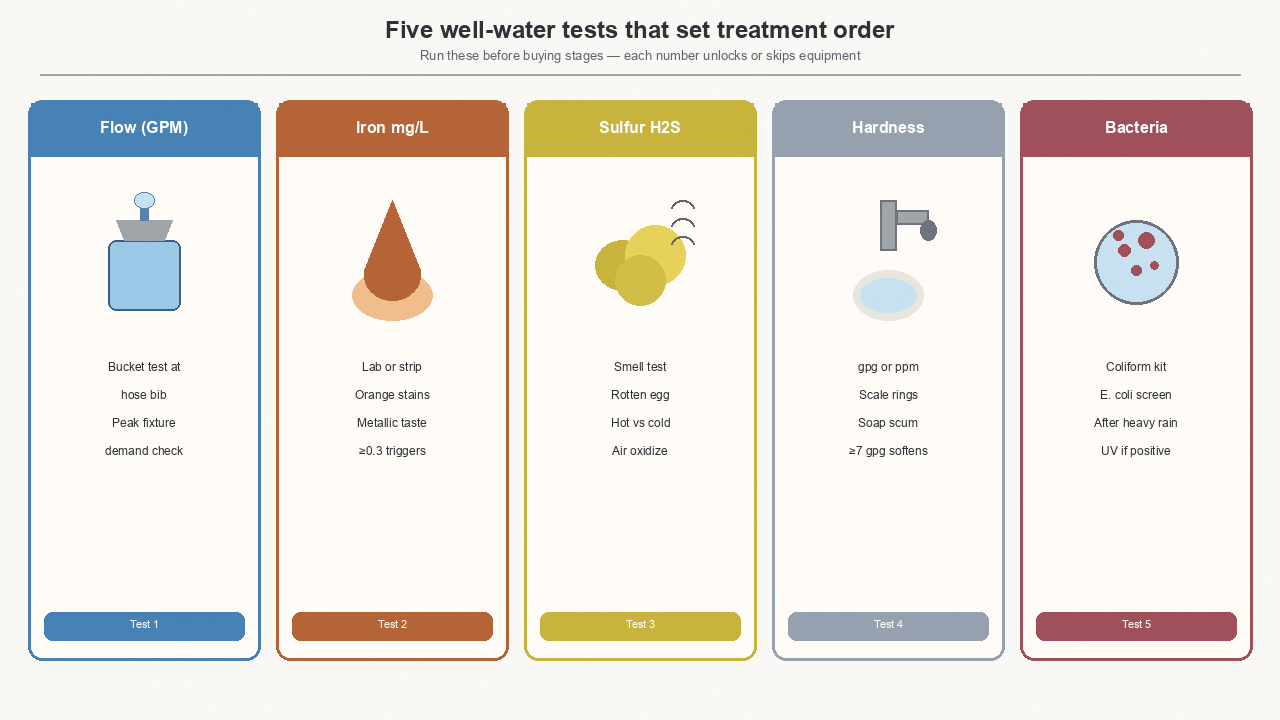
Don’t order tanks from a single bathroom symptom. Run a panel first.
The five numbers that drive the sequence
| Test | What it tells you | Typical action threshold |
|---|---|---|
| Flow / well yield (GPM) | How many gallons per minute the well can sustain | Softener, iron tank, and UV all need a GPM rating that fits peak demand |
| Iron (mg/L or ppm) | Clear-water (ferrous) vs red-water (ferric) load | >0.3 mg/L usually needs dedicated iron treatment before softener |
| Sulfur / H₂S | Rotten-egg hydrogen sulfide | Low levels may clear with oxidation + carbon; high levels need air-injection or chemical oxidizer |
| Hardness (gpg) | Softener sizing input | ≥3–7 gpg is where most homes notice scale; size off gpg × people × gallons |
| Bacteria (coliform / E. coli) | Disinfection requirement | Any positive coliform → UV or chlorination after filtration; fix the well source if it returns |
Affiliate placement here is test kits only — no system yet:
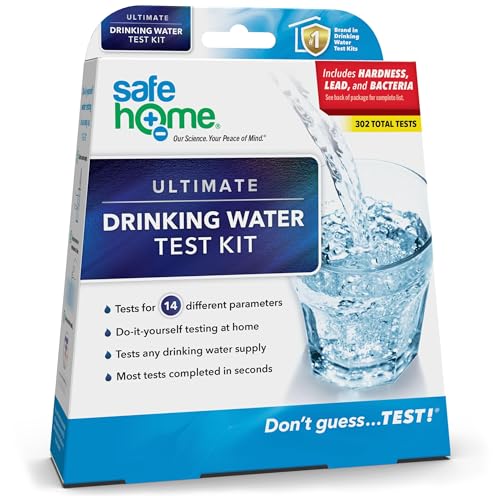
- Start with a multi-panel kit such as the Safe Home 14-in-1 DIY drinking water test kit for a first-pass screen (hardness, bacteria, pH, nitrates, and related checks).
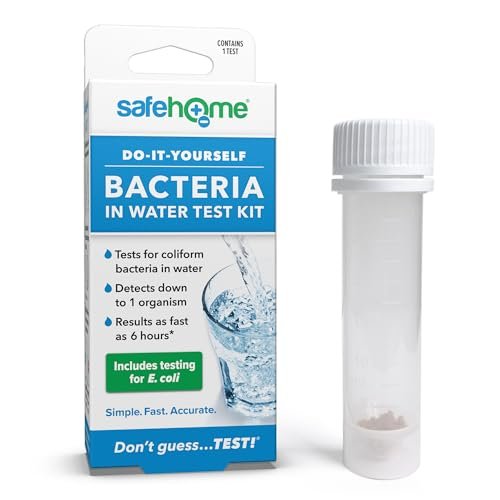
- If bacteria is the open question, add a dedicated kit like the Safe Home bacteria test kit for a faster coliform yes/no.
For a deeper kit comparison, see hardness test kits. For what the hardness number means in grains, see water hardness.
- Skip buying a softener “because the shower has spots” without a hardness number and an iron number. Spots can be hardness, iron, or both.
- Don’t treat a one-time DIY bacteria strip as a certified-lab substitute if anyone is immunocompromised, or if the strip is positive — escalate to a lab panel and stop drinking untreated water until you have a plan.
The standard treatment sequence
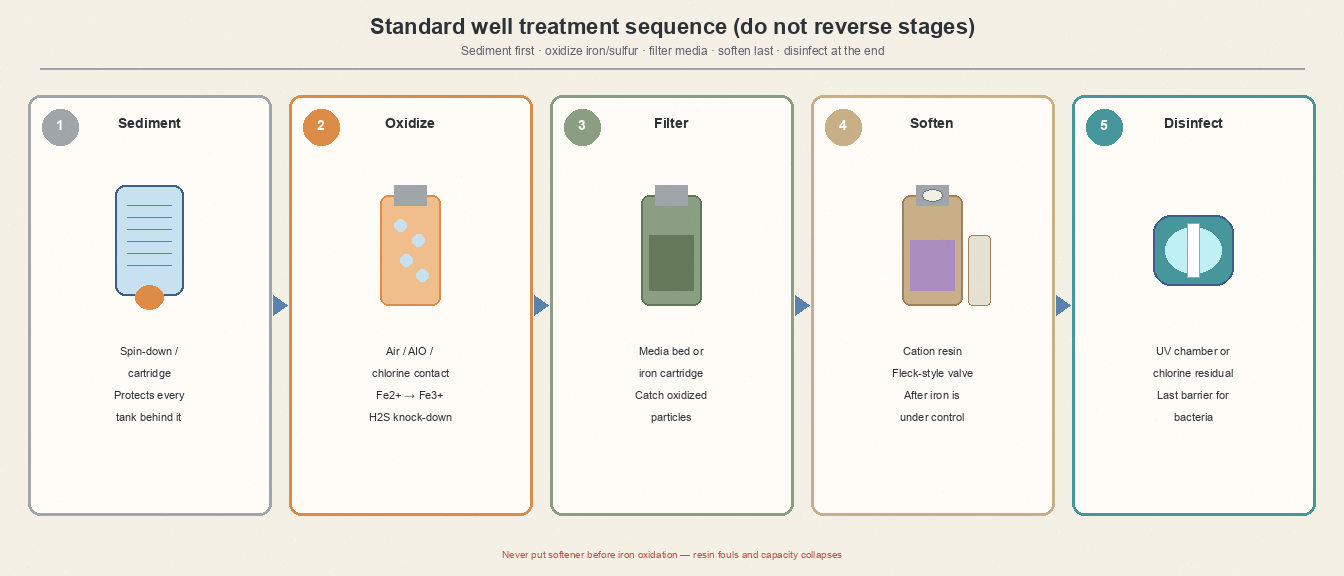
Memorize the spine. Every case study below is this spine with stages dropped when tests say they aren’t needed.
Well → [1 Sediment] → [2 Oxidize iron/sulfur] → [3 Filter] → [4 Soften] → [5 Disinfect] → HouseStage 1 — Sediment
Job: Catch sand, silt, rust flakes, and scale chips so every stage behind it lasts longer.
Typical gear: A flushable spin-down prefilter and/or a 5-micron cartridge housing.
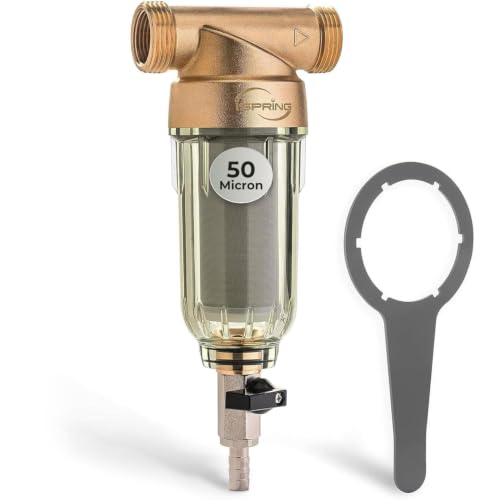
A practical first mechanical stage is the iSpring WSP-50 spin-down sediment filter — you can flush grit without opening a housing every week.
- Skip a dedicated sediment stage only if the water is consistently clear, a recent lab shows non-detect turbidity, and you’ve never pulled grit from aerators — rare on real wells.
Stage 2 — Oxidize iron / sulfur
Job: Convert dissolved ferrous iron and hydrogen sulfide into forms a filter can catch. Methods include air injection (AIO), hydrogen peroxide, chlorine injection, or catalytic media that self-oxidizes.
When required: Iron above about 0.3 mg/L, manganese present, or a persistent rotten-egg smell.
- Skip dedicated oxidation if iron and sulfur are both non-detect and there’s no staining history.
- Don’t dump “iron-removing” salt additives into a softener and call it oxidation — that’s maintenance chemistry, not treatment order.
Deep-dive handoff for media choices: well-water iron filters.
Stage 3 — Filter after oxidation
Job: Physically remove oxidized iron/manganese floc and polish taste/odor with carbon when needed.
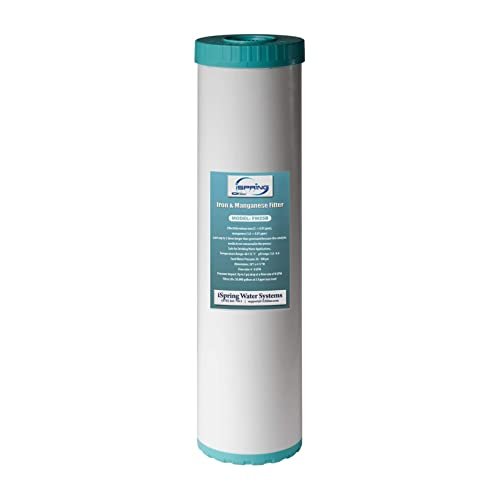
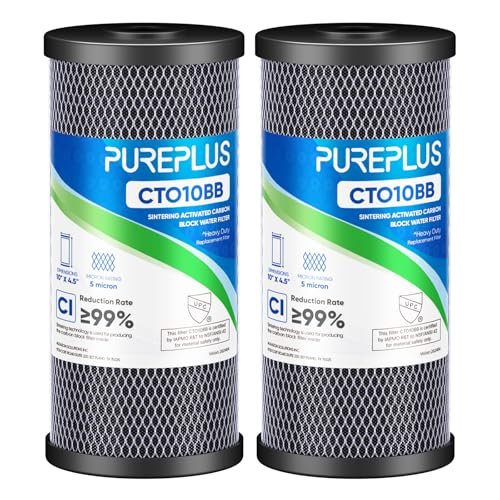
For moderate iron in a Big Blue housing, a cartridge such as the iSpring FM25B iron and manganese filter is a common step before a full backwashing iron tank. For taste/odor and residual oxidizer polish, add a CTO carbon stage like the PUREPLUS 10×4.5 carbon filter.
Order rule: sediment → oxidize → iron media/carbon. Never put fine carbon first on a sandy well.
Stage 4 — Soften
Job: Ion exchange for calcium and magnesium hardness only.
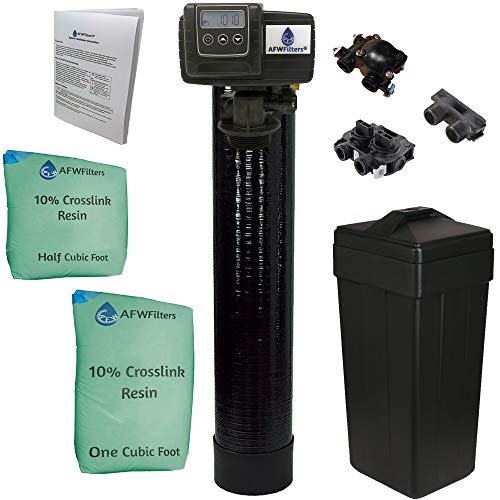
A metered Fleck-style unit such as the AFWFilters Fleck 5600 SXT softener belongs after iron and grit are controlled. Salt pellets and crystals live on the water softener salt overview — don’t duplicate that shopping list here. If an existing softener already saw well iron, a resin cleaner such as Morton MWSC softener cleanser is a stopgap while you fix order upstream.
- Skip the softener if hardness is already soft (under ~3 gpg) and your only problems were iron or bacteria.
- Don’t install the softener upstream of iron treatment. Iron coats resin, capacity collapses, and you start chasing “salt bridge” ghosts that are really fouled beads.
For brine and regen basics, see how water softeners work.
Stage 5 — Disinfect
Job: Kill or inactivate bacteria after the water is already clear. UV needs low turbidity; chlorine needs contact time.
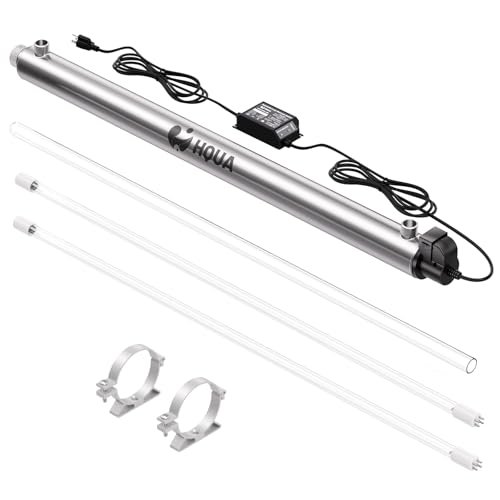
A whole-house UV unit such as the HQUA-OWS-12 12 GPM UV system is a final barrier — not a hardness or iron remover.
- Skip permanent UV if repeated certified lab tests show non-detect coliform and the wellhead is sound.
- Don’t put UV first. Particles shadow microbes; iron stains the quartz sleeve and kills dose.
Decision tree — which stages do you actually need?
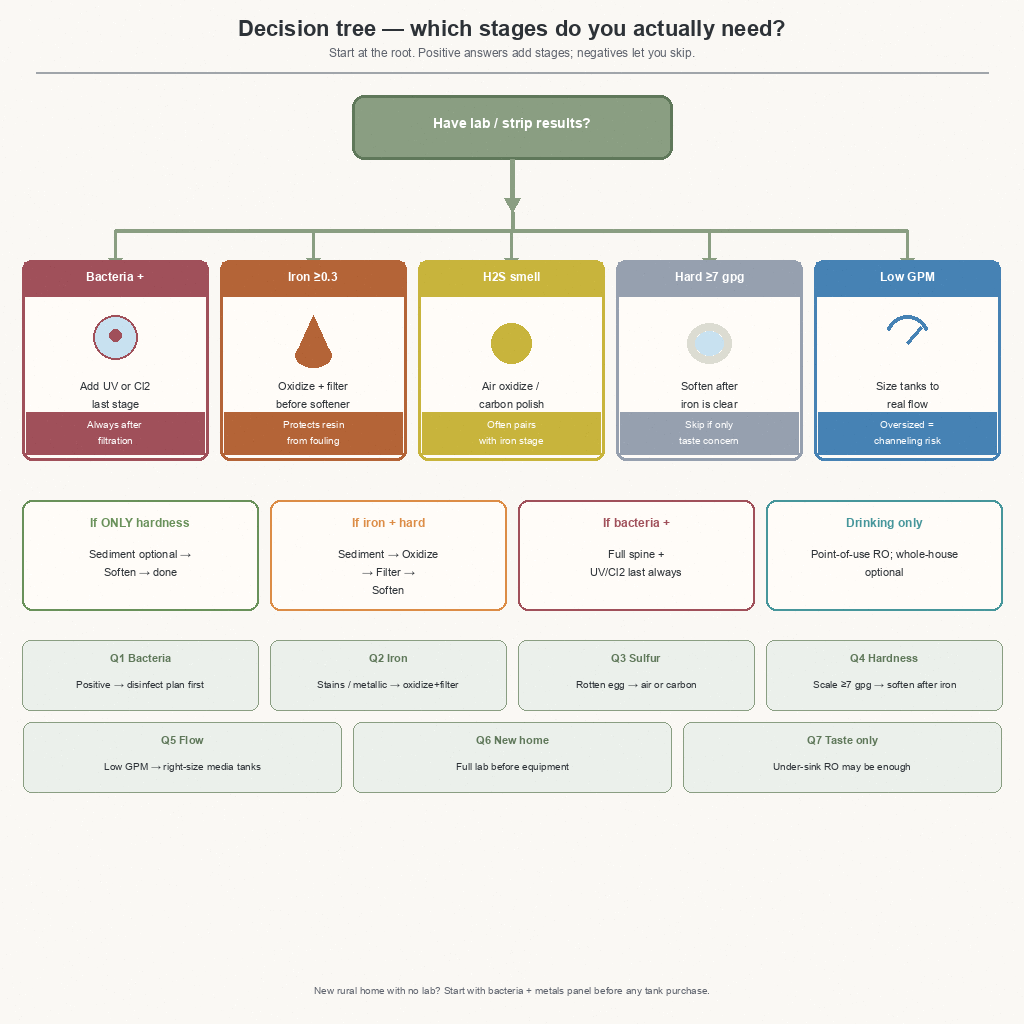
Use this after the five test numbers are in hand.
Q1: Is bacteria (coliform / E. coli) positive?
- Yes → Plan Stage 5 (UV or chlorination) after filtration. Fix wellhead/casing if it keeps returning. Don’t drink untreated water.
- No → Stage 5 optional; retest yearly or after floods/work on the well.
Q2: Is iron ≥ 0.3 mg/L or is there orange staining / metallic taste?
- Yes → Stages 1 + 2 + 3 before any softener. Details in the well-water iron filter guide.
- No → Skip dedicated iron oxidation; keep a sediment prefilter if grit is present.
Q3: Is there rotten-egg (H₂S) smell?
- Yes, mild → Oxidation + carbon (Stages 2–3) often enough.
- Yes, strong / persistent → Air-injection or chemical oxidizer tank; don’t expect a softener or fridge filter to fix it.
- No → Skip sulfur-specific oxidation.
Q4: Is hardness ≥ ~7 gpg (or clear scale on fixtures)?
- Yes → Stage 4 softener after iron/sediment are controlled. Size off gpg × people × daily gallons.
- Borderline 3–7 gpg → Softener optional; confirm symptoms via signs of hard water.
- No (<3 gpg) → Skip softener.
Q5: Is well flow (GPM) below peak fixture demand?
- Yes (low-yield well) → Prefer lower-pressure-drop stages; avoid oversized UV/iron tanks that demand high backwash flow. Pressure tank or storage work may need a pro.
- No → Standard residential tanks are usually fine if GPM ratings match the house.
Q6: Is this a brand-new rural home with no recent lab?
- Yes → Full five-number lab panel + Stage 1 sediment baseline before any big-ticket tank.
- No (documented recent lab) → Use the numbers you have; retest after major weather or well service.
Q7: Do you only care about drinking taste, not scale or stains?
- Yes → Point-of-use RO may matter more than a whole-house softener. Still keep sediment and bacteria questions honest for the whole house.
- No → Follow the full sequence for fixtures, laundry, and water heater life.
Case studies (worked examples)
Case A — Orange sinks, softener died in 14 months
- Lab: Iron 1.8 mg/L, hardness 18 gpg, bacteria ND, sulfur ND, flow 8 GPM.
- Wrong path: Softener only → resin fouled.
- Correct order: Sediment spin-down → oxidizing iron filter → carbon polish → softener → no UV.
- Mapped gear: spin-down sediment → iron stage (sister AIO guide or iron cartridge if moderate) → carbon polish → Fleck softener + salt via the salt sister page.
Case B — Rotten egg + dry feel after showers
- Lab: H₂S present, iron 0.5 mg/L, hardness 9 gpg, coliform negative, flow 6 GPM.
- Correct order: Sediment → air-injection or peroxide oxidation → catalytic or carbon filter → softener.
- Don’t treat bathroom exhaust fans and scented candles as water treatment.
Case C — New rural home, bacteria positive after heavy rain
- Lab: Total coliform positive, E. coli negative, iron ND, hardness 12 gpg, turbidity up after rain.
- Correct order: Shock-chlorinate the well (often pro) → fix sanitary seal → sediment → softener → UV last.
- Mapped gear: Retest with Safe Home 14-in-1 kit / bacteria kit → sediment → softener → UV.
- Don’t run a permanent chlorine bleach jug dripping into the pressure tank as a lifestyle.
Case D — Only hardness, city-adjacent well, clear water
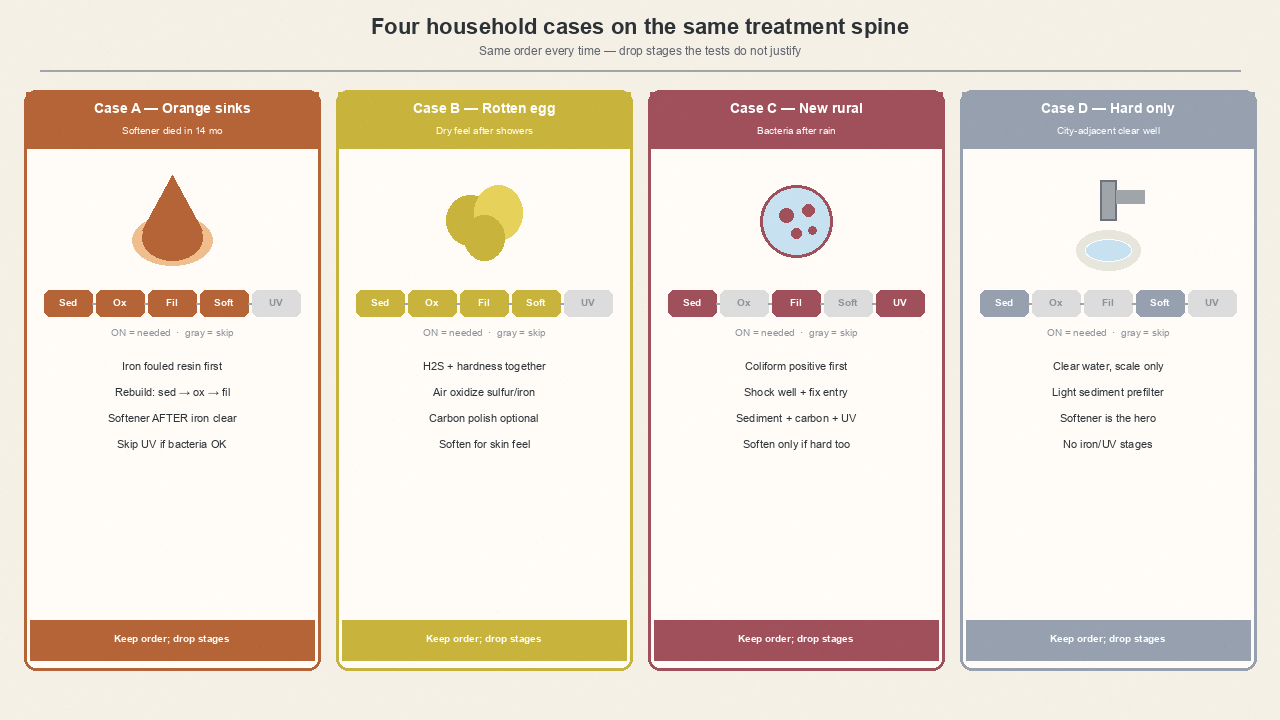
- Lab: Hardness 14 gpg, iron ND, bacteria ND, sulfur ND, flow 10 GPM.
- Correct order: Optional sediment → softener. Skip iron oxidation and UV.
- Mapped gear: Optional spin-down → Fleck softener → salt via water softener salt.
What you’ll need (after the decision tree)
Map stages to SKUs only after Q1–Q7. This is the first heavy affiliate zone — not a shopping cart to buy all at once.
| Stage | Role | Product path |
|---|---|---|
| Test | Multi-panel kit | Safe Home kit |
| Test | Bacteria kit | Safe Home bacteria |
| 1 Sediment | Spin-down prefilter | iSpring WSP-50 |
| 2–3 Iron | Iron/Mn cartridge | iSpring FM25B |
| 3 Carbon | CTO carbon | PUREPLUS carbon |
| 4 Softener | Fleck 5600 SXT | AFWFilters softener |
| 4 Maint. | Resin cleaner | Morton MWSC |
| 5 UV | 12 GPM UV | HQUA UV |
If you’re still choosing between a whole-house filter stack and a softener for hardness-only homes, read whole-house filter vs softener and softener vs RO vs filter before you spend on tanks.
Common mistakes
- Softener first, iron second. Resin becomes an expensive iron filter and fails early. Fix order, then clean or replace resin — Morton MWSC is a stopgap only.
- UV or carbon with no sediment stage. Sleeves coat, carbon pores fill, pressure drops. Add a spin-down prefilter or a 5-micron cartridge first.
- Buying stages from bathroom aesthetics alone. Orange ≠ only iron; spots ≠ only hardness. Run the five-number panel with a multi-kit before the cart.
- Oversizing UV on a low-yield well. GPM rating must match real peak flow; oversized units with low flow can under-dose if bypassed incorrectly — verify with a pro.
- Ignoring annual retest. Floods, new septic neighbors, and pump work change the profile. Retest bacteria and iron at least yearly.
When to call a pro
Keep DIY if: running test kits, flushing a spin-down, swapping cartridges, setting a softener control head, adding salt, or installing a UV unit on an existing clear bypass loop you’re qualified to work on.
Call a licensed plumber or well contractor if:
- Recurrent coliform / any E. coli after shock treatment
- Well yield too low for backwashing iron tanks or softener regen flow
- Hydrogen sulfide strong enough to blacken silverware or make the house hard to live in
- Pressure tank rapid-cycling, muddy water after pump work, or a damaged sanitary seal
- You need a building permit or backflow assembly for a whole-house chemical feed
- Cutting into the main, relocating tanks, or electrical work beyond a simple plug-in control head
We do not rank local installer directories or match you with contractors.
Related
- Well-water iron filter guide — AIO vs catalytic vs cartridge iron paths
- Whole-house water filters overview — sediment/carbon housings and media roles
- Water softener salt overview — pellets vs crystals and the salt maintenance loop
- Signs of hard water in your home — hardness symptoms vs iron symptoms
- How water softeners work — brine, regen, and capacity basics
- Water hardness numbers — gpg vs mg/L and sizing inputs
Key takeaways
- Test five numbers first: flow, iron, sulfur, hardness, bacteria.
- Default order: sediment → oxidize → filter → soften → disinfect.
- Softener is for hardness ions — not iron sludge or bacteria.
- UV and carbon belong after the water is already clear.
- Skip stages the lab says you don’t need — don’t skip sediment on a gritty well.
- Case studies fail in predictable ways — almost always wrong order, not “bad brand.”
- Retest after floods, pump work, or any positive bacteria event.