Quick answer
If your water report lists 180 ppm but your softener spec sheet asks for gpg, you’re stuck. Guessing at grain capacity wastes money and leaves scale on every faucet. One grain per gallon equals 17.118 ppm — multiply gpg by 17.118 or divide ppm by 17.118. The Water Quality Association classifies anything above 10.5 gpg (180 ppm) as very hard. If you don’t have a reading yet, a test strip gets you there in under a minute.
What gpg, ppm, mg/L, and °dH actually measure
All four units measure the same thing — dissolved calcium and magnesium, expressed as calcium carbonate (CaCO3) equivalent. The difference is the scale. Softener manufacturers in the US use one unit, lab reports use another, and European guides use a third. Converting between them is straightforward once you know the factor — and the factor is always 17.118 for gpg to ppm. Here’s what each unit means and when you’ll see it.
Why calcium and magnesium specifically? These two minerals are what make water “hard.” When water passes through limestone, gypsum, or dolomite deposits, it picks up dissolved calcium and magnesium ions. The more it picks up, the harder your water. Iron can also contribute a small amount, but hardness calculations focus on calcium and magnesium because they cause the scale, soap scum, and detergent interference that drive people to buy softeners.
GPG (grains per gallon) — the US softener standard
One grain equals 64.79891 milligrams. One US gallon equals 3.785412 liters. Divide the first by the second and you get 17.118 mg/L per grain. GPG is the unit US softener manufacturers and the Water Quality Association use for capacity ratings. If you’re buying a softener in the US, this is the number that matters for sizing.
PPM and mg/L — the lab and municipal standard
Parts per million (ppm) and milligrams per liter (mg/L) are numerically identical for dilute water solutions — 1 mg/L equals 1 ppm. The EPA, WHO, and most municipal Consumer Confidence Reports list hardness in mg/L. Lab test kits typically read in ppm or mg/L. If your city water report says “120 mg/L as CaCO3,” that’s your hardness number.
mmol/L and °dH — scientific and European units
One millimole per liter (mmol/L) of CaCO3 equals 100.086 mg/L. One German degree (°dH) equals 17.8 mg/L, or about 1.04 gpg. mmol/L shows up in WHO guidelines and scientific papers. °dH is common in Germany, the Netherlands, and parts of Eastern Europe. Most US readers won’t need these, but the conversion table below covers them for completeness.
Don’t confuse TDS ppm with hardness ppm. TDS measures all dissolved solids — sodium, chloride, sulfates, everything. Hardness measures only calcium and magnesium. A TDS meter cannot give you a gpg reading. For the full breakdown, see water hardness explained.
The conversion table
This table converts common gpg values to all four units and shows the WQA classification. Find your number in the leftmost column, then read across.
| gpg | ppm / mg/L | mmol/L | °dH | WQA Classification |
|---|---|---|---|---|
| 0 | 0 | 0 | 0 | Soft |
| 1 | 17.1 | 0.17 | 1.04 | Slightly hard |
| 3 | 51.4 | 0.51 | 3.12 | Slightly hard |
| 3.5 | 59.9 | 0.60 | 3.64 | Slightly hard |
| 5 | 85.6 | 0.86 | 5.20 | Moderately hard |
| 7 | 119.8 | 1.20 | 7.28 | Hard |
| 10 | 171.2 | 1.71 | 10.40 | Hard |
| 10.5 | 179.7 | 1.80 | 10.92 | Hard |
| 15 | 256.8 | 2.57 | 15.60 | Very hard |
| 20 | 342.4 | 3.42 | 20.80 | Very hard |
| 25 | 427.9 | 4.28 | 26.00 | Very hard |
Worked example: 5 gpg to all units
Start with 5 gpg. Multiply by 17.118 to get 85.59 ppm (same as 85.59 mg/L). Divide 85.59 by 100.086 to get 0.855 mmol/L. Multiply 5 by 1.04 to get 5.20 °dH. Verdict: moderately hard (WQA range 3.5–7 gpg).
Worked example: 200 ppm to gpg
Divide 200 by 17.118 to get 11.68 gpg. Verdict: very hard (WQA threshold is 10.5 gpg). If you’re reading 200 ppm on a hardness test strip, that’s about 11.7 gpg — you’ll want a softener rated for at least 12 gpg. For help with that math, the softener size calculator plugs in your gpg directly.
Conversion formulas (exact math)
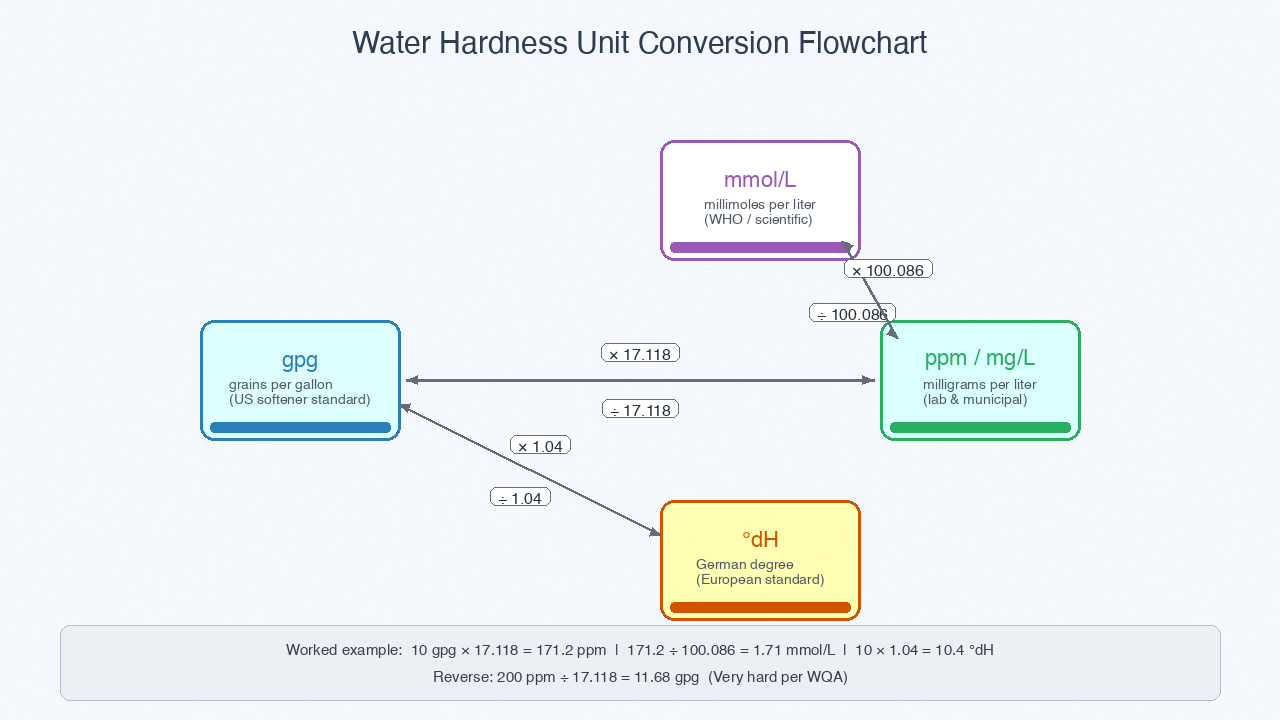
Here are all six conversion pairs in one place. You’ll only need one or two depending on what your water report or test kit gives you.
- gpg → ppm: multiply by 17.118
- ppm → gpg: divide by 17.118
- ppm → mmol/L: divide by 100.086
- mmol/L → ppm: multiply by 100.086
- gpg → °dH: multiply by 1.04
- °dH → gpg: divide by 1.04
Don’t round down when sizing a softener. Rounding 11.68 gpg down to 11 instead of 12 undersizes the system by roughly 6 percent. Always round up for capacity calculations — the small extra capacity costs less than scale returning after six months.
Why 17.118 specifically? A grain is an archaic mass unit (64.79891 mg, originally based on a grain of barley). A US gallon is 3.785412 liters. Divide 64.79891 by 3.785412 and you get 17.118 mg/L — the exact conversion factor. It’s not a rounded approximation; it’s the precise mathematical result of two fixed unit definitions.
How to use this chart (decision tree)
Pick the branch that matches what you already know. Each path ends with the gpg number you need for softener sizing or comparison.
If you know your gpg number
Look up the WQA classification in the table above. You’re done — no math needed. If you also need ppm for a lab comparison or a municipal report, multiply by 17.118.
If you know your ppm or mg/L number
Divide by 17.118 to get gpg, then find your WQA classification. This is the most common conversion path — most municipal water reports list hardness in mg/L. For example, a report showing 150 mg/L means 150 ÷ 17.118 = 8.77 gpg, which lands in the hard range.
Another common scenario: your water report says “total hardness 85 mg/L as CaCO3.” Divide 85 by 17.118 and you get 4.96 gpg — moderately hard. At this level you’ll see some spotting on glassware but probably not heavy scale buildup. A softener helps but isn’t urgent unless you’re also dealing with iron in your water or other issues.
If you know your mmol/L or °dH number
For mmol/L: multiply by 100.086 to get ppm, then divide by 17.118 for gpg. For °dH: multiply by 0.9633 to get gpg directly. These paths are mostly for international readers or lab reports — US softener specs always use gpg.
If you don’t know your number at all
Test first. A hardness test strip gives you gpg in under a minute for about $7. Don’t buy a softener based on a guess — a wrong gpg can change capacity needs by 50 percent or more. Once you have your number, come back to the table and look it up directly.
Skip the math if you already have a gpg result from a test strip — use the table column instead of re-converting. And if you need exact mg/L rather than an approximate strip reading, a Hach drop-count titration kit narrows it down to the nearest 1 mg/L.
One note on systems: the gpg number matters for sizing a salt-based water softener (ion exchange). It’s different from a whole-house carbon filter (chlorine and taste) or an under-sink reverse-osmosis system (drinking water only). If you only care about drinking taste, RO may matter more than a softener — but gpg still drives softener capacity. See softener vs RO vs filter for the full comparison.
Severity classification: soft → very hard
Three authoritative organizations classify water hardness, and they don’t all use the same unit. USGS and WHO use mg/L. WQA uses gpg. That’s why conversion matters — you need to translate between them to compare scales.
USGS scale (mg/L as CaCO3)
From the USGS Water Science School:
- 0–60 mg/L: Soft
- 61–120 mg/L: Moderately hard
- 121–180 mg/L: Hard
- More than 180 mg/L: Very hard
Source: USGS, “Hardness of Water” (usgs.gov).
WQA scale (gpg)
From the Water Quality Association:
- Less than 1 gpg: Soft
- 1–3.5 gpg: Slightly hard
- 3.5–7 gpg: Moderately hard
- 7–10.5 gpg: Hard
- More than 10.5 gpg: Very hard
Source: WQA (wqa.org/learn-about-water).
WHO scale (mg/L)
From the WHO background document “Hardness in Drinking-water”:
- 0–60 mg/L: Soft
- 60–120 mg/L: Moderately hard
- 120–180 mg/L: Hard
- More than 180 mg/L: Very hard
Source: WHO, “Hardness in Drinking-water” background document.
The WHO and USGS scales are nearly identical — the only difference is boundary wording. The WQA scale uses gpg, which is why the conversion between gpg and ppm exists. If you’re in the very hard range above 10.5 gpg, you’re likely a candidate for a softener — but confirm your exact number with a test strip first.
What does each classification mean in practice? Soft water (under 1 gpg) rarely leaves spots or scale — you may not need a softener at all. Slightly hard (1–3.5 gpg) causes minor spotting but usually doesn’t justify a whole-house system. Moderately hard (3.5–7 gpg) is where most people start noticing soap scum and reduced detergent effectiveness. Hard water (7–10.5 gpg) leaves visible scale on fixtures, shower doors, and appliances. Very hard water (above 10.5 gpg) accelerates scale buildup in pipes, water heaters, and dishwashers — and shortens appliance lifespan if left untreated.
Salt-free honesty: Salt-free systems typically don’t bring hardness grains to zero on a strip. They may change how scale sticks, but they usually don’t remove calcium and magnesium the way ion exchange does. Match the claim to your goal before you buy.
Real-world city water comparison
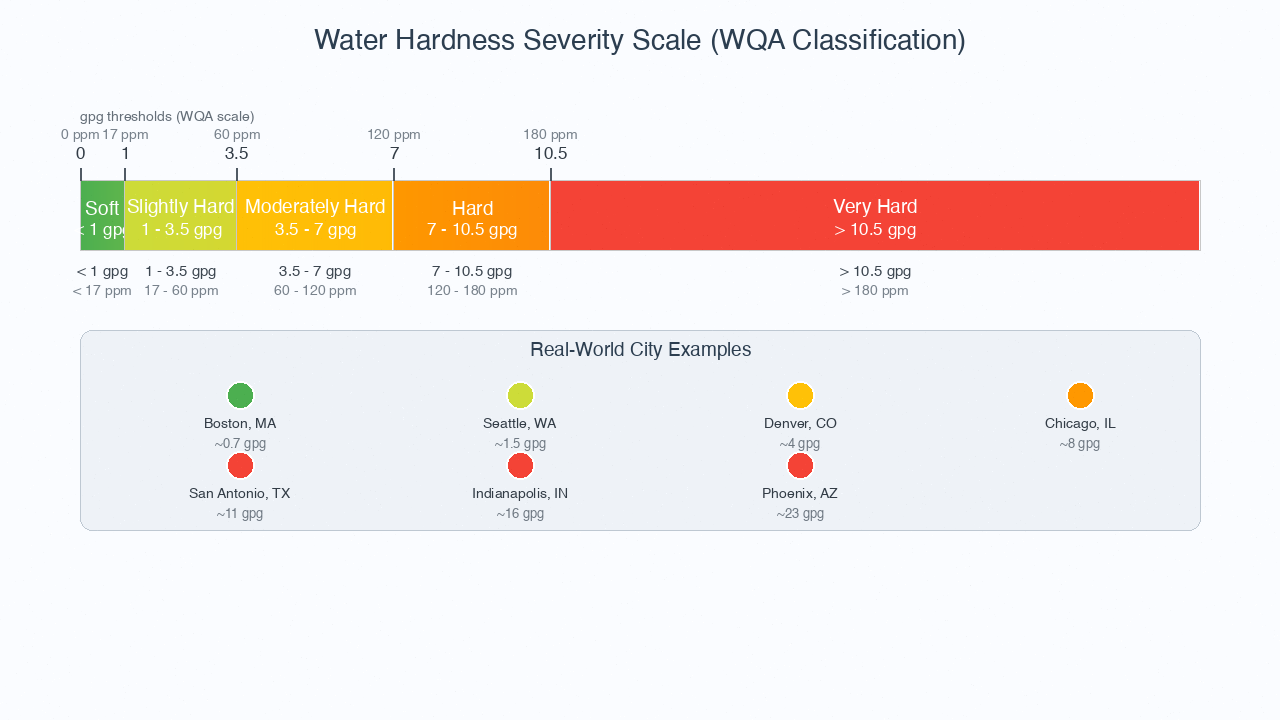
City averages vary wildly across the US. Here’s how major metros stack up — approximate values from regional USGS surveys and city Consumer Confidence Reports.
| City | State | Approx. gpg | Approx. ppm | Classification |
|---|---|---|---|---|
| Indianapolis | IN | ~16 | ~275 | Very hard |
| Las Vegas | NV | ~16 | ~275 | Very hard |
| Phoenix | AZ | ~23 | ~390 | Very hard |
| San Antonio | TX | ~11 | ~190 | Very hard |
| Chicago | IL | ~8 | ~140 | Hard |
| Denver | CO | ~4 | ~70 | Moderately hard |
| Seattle | WA | ~1.5 | ~25 | Soft |
| Boston | MA | ~0.7 | ~12 | Soft |
Sources: USGS regional water quality surveys and city Consumer Confidence Reports. Values shown are commonly reported approximations, not exact current-year readings.
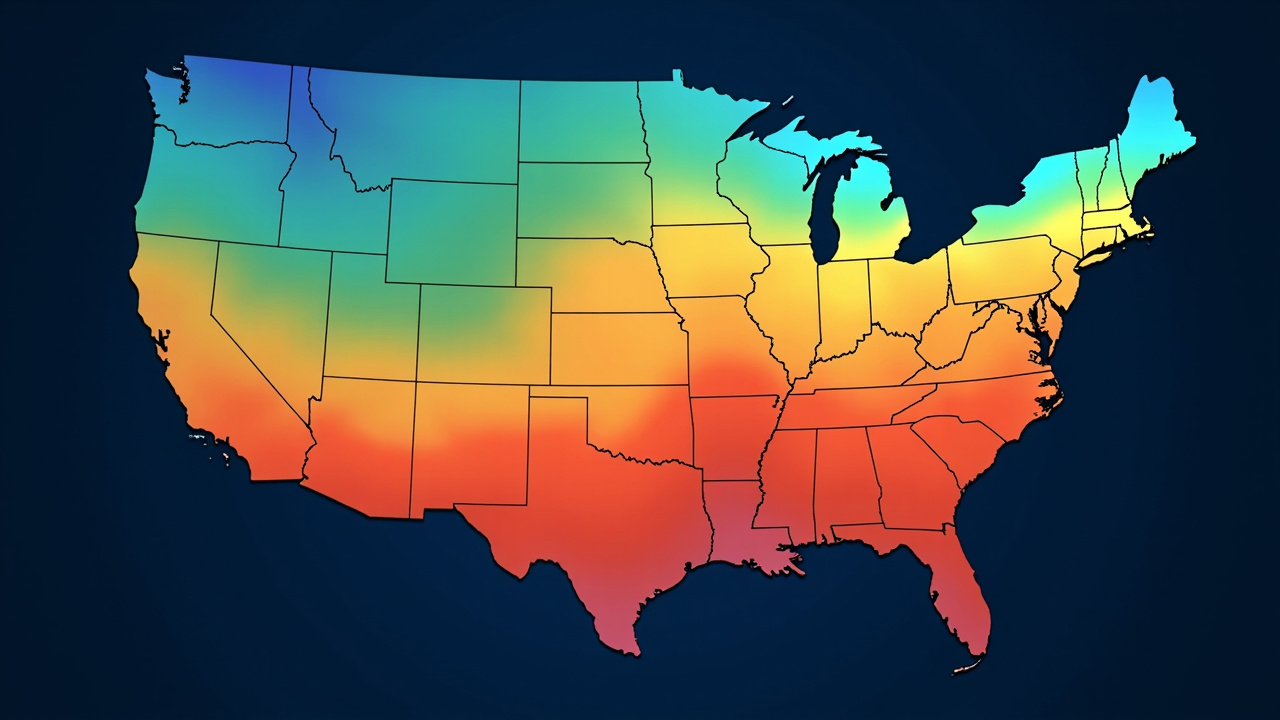
The pattern is clear: the Southwest and Midwest sit on limestone-heavy geology, so groundwater picks up calcium and magnesium as it moves through aquifers. The Pacific Northwest and New England draw from surface water (rivers, snowmelt, reservoirs) that hasn’t spent as much time dissolving minerals — so their water tends to be soft.
Don’t assume your city’s average is your number. City averages mask neighborhood-level variation. Well water can be 2–3 times harder than the city average. Even within the same city, different neighborhoods on different water sources can see a 5-gpg swing. If you’re on a well, always test your own water — the city number doesn’t apply to you.
What you’ll need to get your number
Before you can use the conversion table, you need a hardness reading. Here are four ways to get one, from fastest to most precise.
Test strips (fastest, cheapest)
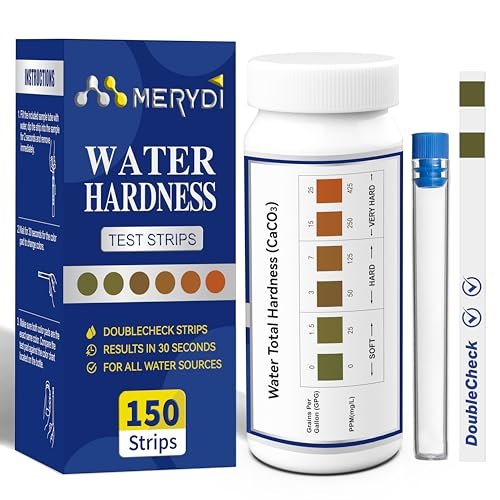
Test strips give you gpg in under a minute. The Merydi 150-strip kit ($7.39) includes 150 double-color-pad strips and a sample tube. Dip, wait, match the color — no math required before you even open the conversion table. Best for a quick check before shopping for a softener.
Drop-count titration kit (lab-grade)
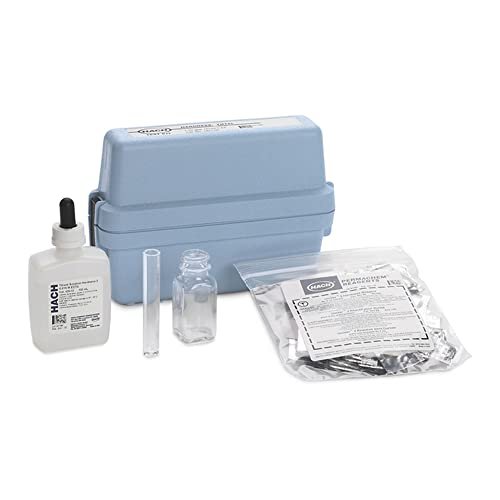
For precise mg/L readings, the Hach Total Hardness Model 5-EP drop-count kit ($52.01) is the professional standard. Hach titration narrows hardness to the nearest 1 mg/L — more accurate than strips. Ideal for well owners and anyone sizing a system where a 2-gpg error matters.
Digital hardness meter (continuous monitoring)
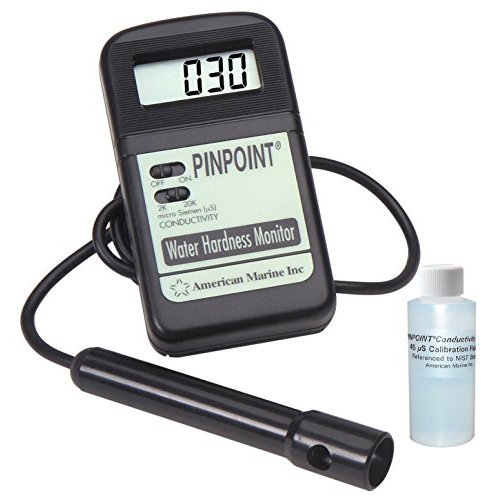
The Pinpoint conductivity meter ($125.00) is a lab-grade benchtop unit for users who need ongoing monitoring — wells, post-softener verification, or multi-point sampling. It’s overkill for a one-time check, but if you monitor hardness trends over months, it earns its cost. Pair it with a baseline test strip reading before install so you can verify the softener actually brought your gpg down to near zero.
TDS meter (companion reading)
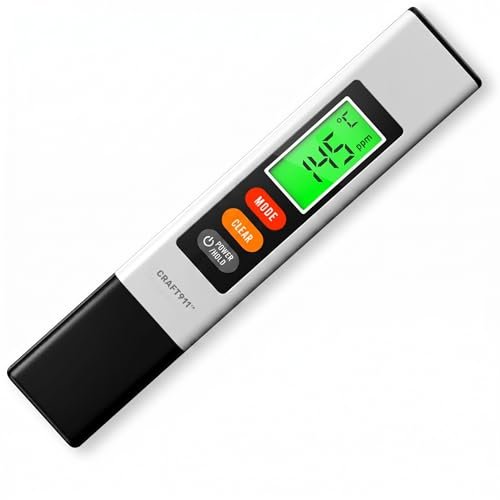
A TDS meter doesn’t give gpg directly, but it tracks total dissolved solids as a trend line. The Craft911 TDS meter ($9.99) is a budget cross-check — if TDS drops after you install a softener, the system is working. Just remember: TDS includes sodium and chloride, not just hardness minerals. For more detail on choosing a test method, see the hardness test kit buying guide.
Common mistakes
- Confusing TDS ppm with hardness ppm: TDS measures all dissolved solids (sodium, chloride, sulfates). Hardness measures only calcium and magnesium. A TDS meter cannot give you gpg — you need a hardness-specific test.
- Using old water report data: City hardness can shift when water sources switch (reservoir to groundwater, or seasonal blend changes). Test within the last 12 months for sizing accuracy. A fresh test strip costs less than a wrong softener.
- Rounding down gpg for softener sizing: Rounding 11.68 gpg to 11 instead of 12 undersizes the system by about 6 percent. Always round up for capacity.
- Assuming city water is consistent year-round: Seasonal reservoir changes can shift hardness by 2–3 gpg. A single test is a snapshot, not a guarantee. If you’re on a well, hardness can vary more dramatically with water table levels.
Related
- Water Hardness Explained — the sister page covering what hardness is and how it affects your home
- How to Choose a Water Softener — once you know your gpg, this guide helps you size and select
- Softener Size Calculator — plug in your gpg to get recommended grain capacity
- Hardness Test Kits — buying guide for the test kits mentioned above
- What Is Hard Water? — foundational overview for new readers
- How Water Softeners Work — the ion-exchange process that uses your gpg number
- Iron in Water — iron is not hardness; this page disambiguates
- Hard Water Stains on Glass — what happens when you don’t treat hard water
Key takeaways
- 1 gpg = 17.118 ppm (mg/L) — memorize this single conversion and you’re set.
- USGS and WQA classify differently: USGS in mg/L, WQA in gpg. Convert before comparing.
- Anything above 10.5 gpg (180 ppm) is very hard per the WQA.
- To convert ppm to gpg: divide by 17.118. To go the other way: multiply gpg by 17.118.
- Round up your gpg when sizing a softener — rounding down undersizes the system.
- TDS ppm is not hardness ppm — they measure different things. A TDS meter can’t give you gpg.
- Test your water before buying any treatment system — a $7 test strip prevents a $500 sizing mistake.