Quick answer
Hard water shows up as chalky white buildup on faucets and shower glass, soap that won’t lather, spotty dishes, dry itchy skin, dull hair, scale in the coffee maker, slowly dropping water pressure, and stiff laundry. But dry skin, spotting, and dull hair can have other causes too. Confirm with a $10 hardness test strip before spending a cent on a softener. Below: the eight signs, what each means, and a confirm-before-you-buy path.
What this is (and is not)
This page lists the physical signs that make homeowners suspect hard water, then shows you how to confirm before spending money on a system.
It is not a medical page. Dry skin and brittle hair are one factor, not proof. Weather, soap, shampoo, skin conditions, and hard water can all cause the same feeling — only a hardness number settles it.
It is not a softener selection page. Once you’ve confirmed hardness, head to how to choose a water softener or the softener size calculator.
Skip this page if: you already have a gpg number from a lab or utility report — jump straight to the selection pages above.
For the underlying science behind these symptoms, see water hardness explained.
The 8 signs you’ll actually notice
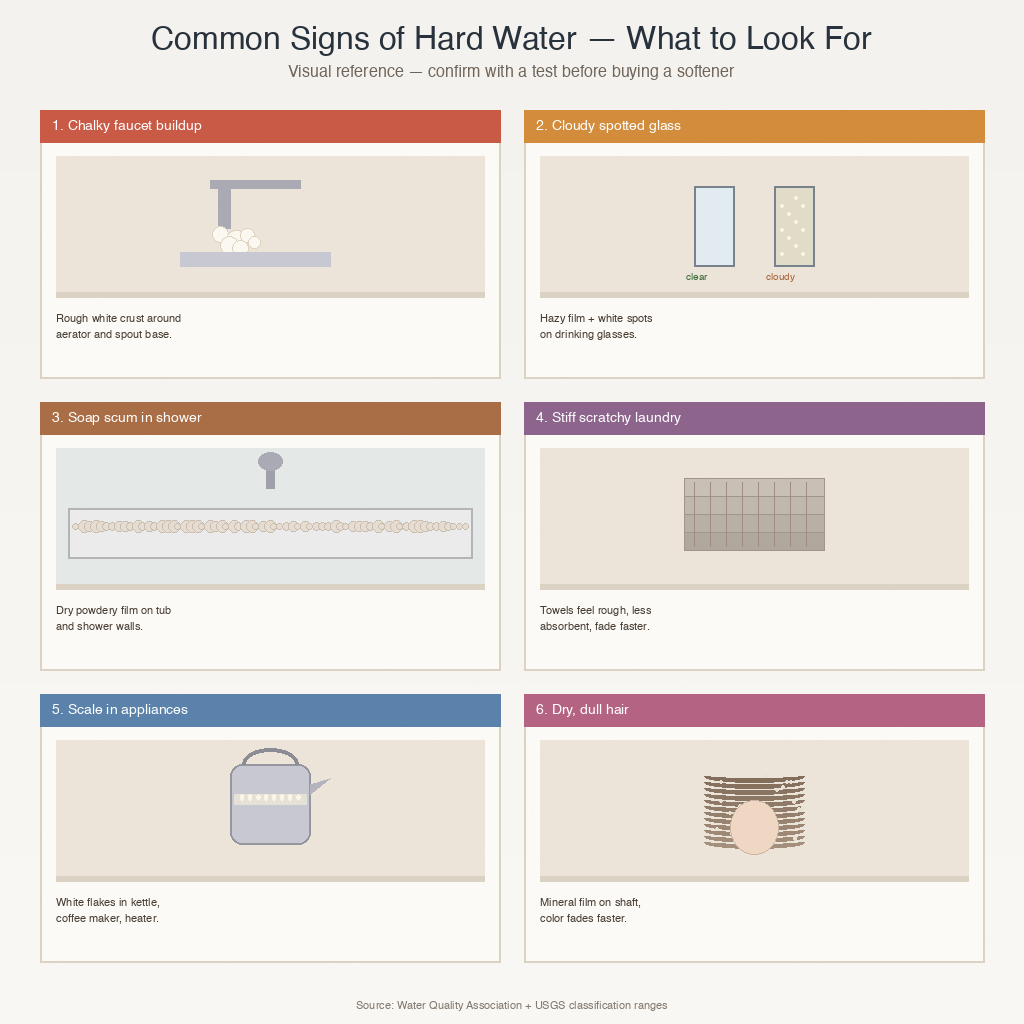
Each sign below covers what it looks like, why hard water causes it, and how to tell it apart from look-alikes that aren’t hardness at all.
Sign 1 — White chalky buildup on faucets and showerheads
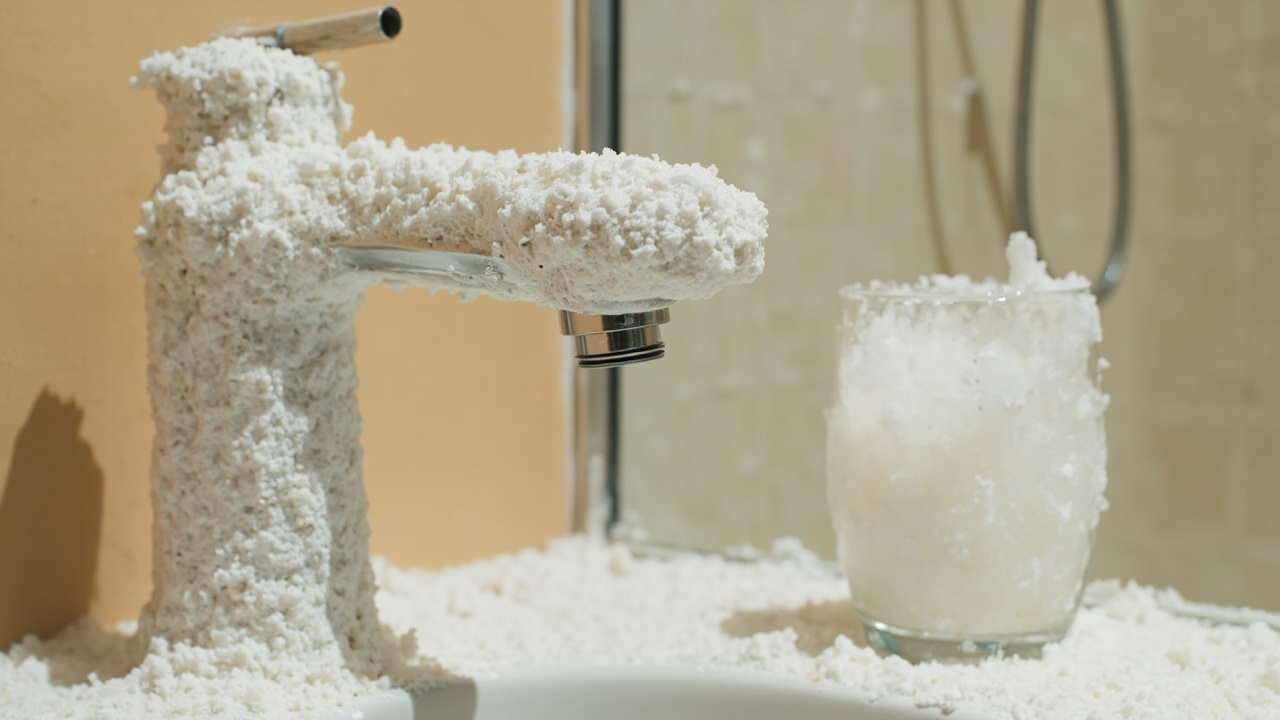
A rough white or off-white crust around aerators, shower nozzles, and the base of taps. It wipes off as powder and grows back in days.
Dissolved calcium carbonate precipitates out when water evaporates. Faster buildup means harder water.
Vinegar test: wipe the buildup with white vinegar. If it fizzes and dissolves, it’s limescale (calcium carbonate). If it doesn’t dissolve, it may be soap scum, mold, or silica residue.
Don’t confuse with: silica residue (won’t fizz in vinegar), mold (organic, fuzzy), or pink/orange Serratia marcescens bacteria around drains (wipes away, comes back in damp bathrooms).
For the deeper treatment path on shower glass, see hard water stains on shower glass.
Sign 2 — Soap scum in the shower and bathtub
A white, gray, or pink-tinged film on shower walls, tub rims, and shower curtains that rinses poorly.
Calcium and magnesium react with soap to form an insoluble salt — the industry calls it “soap curd.” More minerals mean more curd and harder cleaning.
Don’t confuse with: mold and mildew (organic, fuzzy, musty smell). Mineral soap scum is dry and powdery when rubbed.
The Water Quality Association documents that hard water can reduce soap effectiveness and increase scum formation.
Sign 3 — Spotty, cloudy, or filmed dishes
White spots on glasses, a film on plates, or a cloudy haze that won’t rinse off after the dishwasher.
During the heated dry cycle, water droplets evaporate and leave mineral deposits behind. The harder the water, the worse the spotting.
Honest note: spotting can also come from low rinse-aid use, a failed heating element, or the wrong cycle — not only hardness. Test before assuming.
Don’t confuse with: permanent etching. If the surface feels smooth and still looks cloudy after soaking in vinegar, the glass may be permanently etched by hot phosphate-free detergents. No cleaner will reverse etching.
See dishwasher spotting and film for the full fix path.
Sign 4 — Dry, tight, or itchy skin after showering
Skin feels tight, dry, or itchy even after using a moisturizer. Eczema or dermatitis may flare more.
Hard water leaves a mineral residue on the skin that some studies suggest interferes with the skin barrier. Soap also fails to rinse fully in hard water, leaving a residue behind.
Hard water is one factor, not the only one. Cold dry weather, harsh soaps, fragrance sensitivity, and atopic dermatitis are more common causes of dry skin. Peer-reviewed studies have found a correlation between hard water and eczema severity in some children, but correlation is not proof that hard water causes the dryness you personally feel.
Don’t confuse with: chlorine sensitivity (often from municipal supply, not hardness — a shower filter targets chlorine).
Sign 5 — Dull, brittle, or color-faded hair
Hair feels rough or “squeaky,” tangles easily, color fades faster than the salon warned.
Mineral buildup on the hair shaft creates a film that blocks moisture and can trap soap residue. Some cosmetology studies suggest color-treated hair is more visibly affected.
Don’t confuse with: over-processing from bleach, protein overload from keratin treatments, harsh shampoo detergents, or breakage from heat styling.
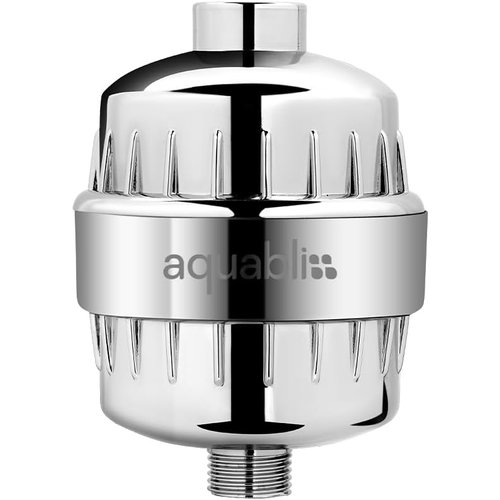
For point-of-use relief before a whole-home system goes in, see shower filters explained.
Sign 6 — Scale in the coffee maker, kettle, or water heater
White flakes or a chalky ring inside anything that heats water.
Heating causes dissolved calcium and magnesium to precipitate out faster — hot surfaces scale up more quickly than cold ones.
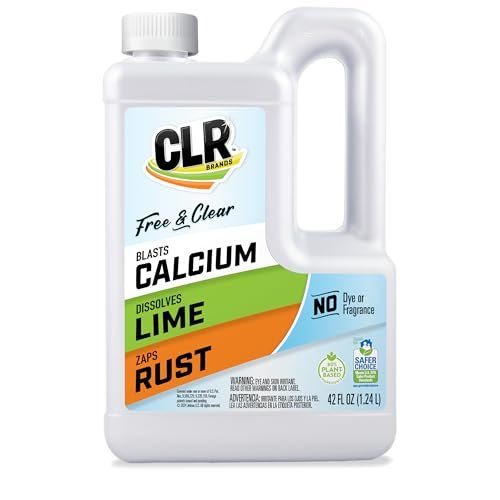
Cost impact: the U.S. Department of Energy and Battelle Memorial Institute study often cited in the industry found that even a thin layer of scale (around 1/16 inch) can reduce water heater efficiency. The exact percentage depends on heater type and age, but the takeaway is clear: scaling appliances cost more to run and die sooner in hard water. A descaler like CLR cleans existing scale from kettles and coffee makers between deep cleans — but it’s a stopgap, not a fix for the underlying hardness.
Sign 7 — Gradually reduced water pressure
Flow drops slowly over months or years, especially at one or two fixtures.
Scale builds up inside pipes, aerators, and valve bodies, narrowing the opening over time.
When to suspect hard water: older home, located in a known hard-water region, and a gradual decline (not a sudden drop, which is usually a plumbing failure or a partially closed valve).
Don’t confuse with: a clogged aerator alone. Unscrew it and soak in vinegar — if pressure jumps back, that was the aerator, not the pipes.
Sign 8 — Stiff, scratchy, or fast-fading laundry
Towels feel rough and less absorbent, dark colors fade faster, detergents seem weak even at full dose.
Hardness minerals bind to detergent molecules before the detergent can bind to fabric, leaving both soap residue and mineral deposits in the fibers.
The Water Quality Association publishes that hard water can shorten clothing life and increase detergent use.
Don’t confuse with: too much detergent (rinse cycle under-performs), a failing washer inlet screen, or detergent quality.
Hardness levels — what your number means
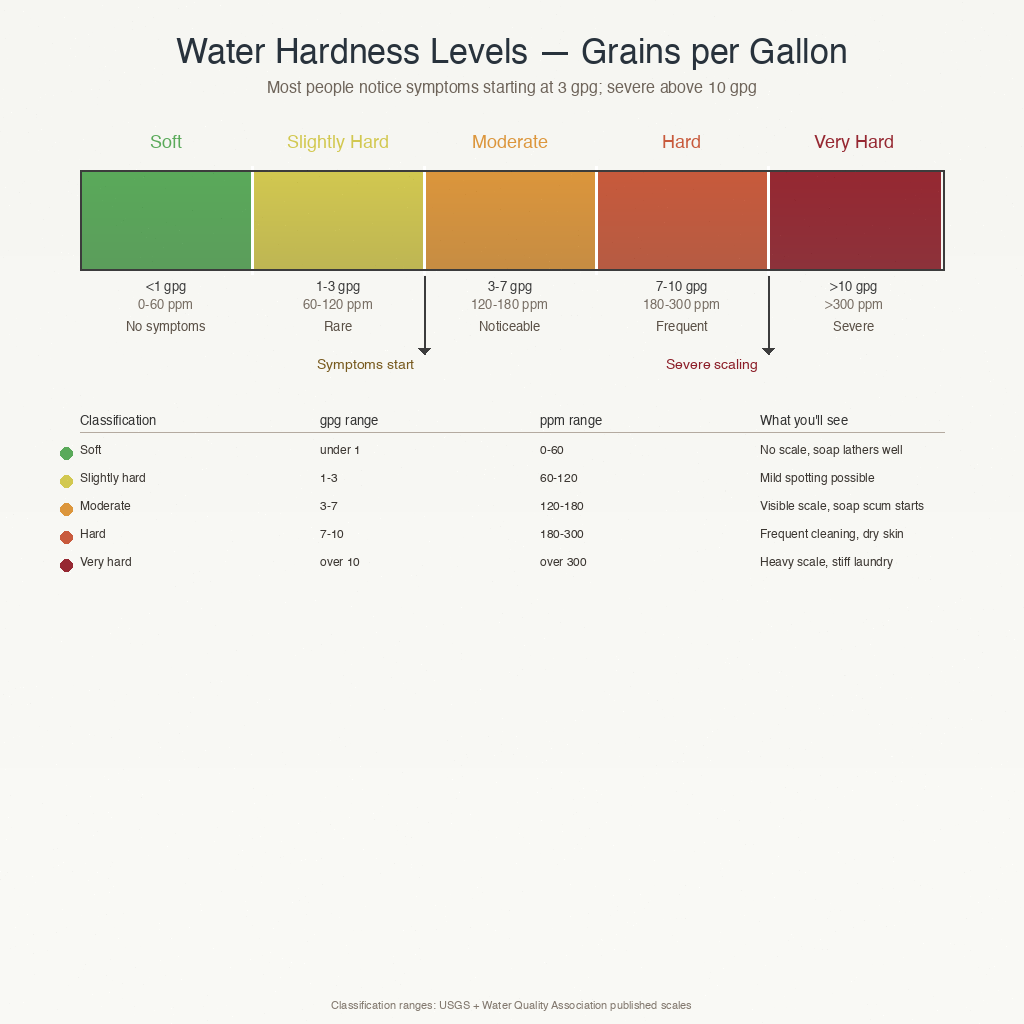
| Grains per gallon (gpg) | mg/L or ppm | Classification |
|---|---|---|
| under 1 | 0–60 | Soft |
| 1–3 | 60–120 | Slightly hard |
| 3–7 | 120–180 | Moderately hard |
| 7–10 | 180–300 | Hard |
| over 10 | over 300 | Very hard |
Classification ranges derived from the USGS and the Water Quality Association’s published scales.
Symptoms usually start to bother people at “moderately hard” (3–7 gpg) and get severe above 10 gpg. A “soft” reading with hard-water-looking symptoms means you should look at chlorine, pH, or soap — not hardness.
Need to convert between units or interpret your strip color? See the gpg to ppm conversion chart.
What to do if you spot these signs
Confirm before you buy anything. Each step below costs either nothing or under $35 and removes a guess from the next step.
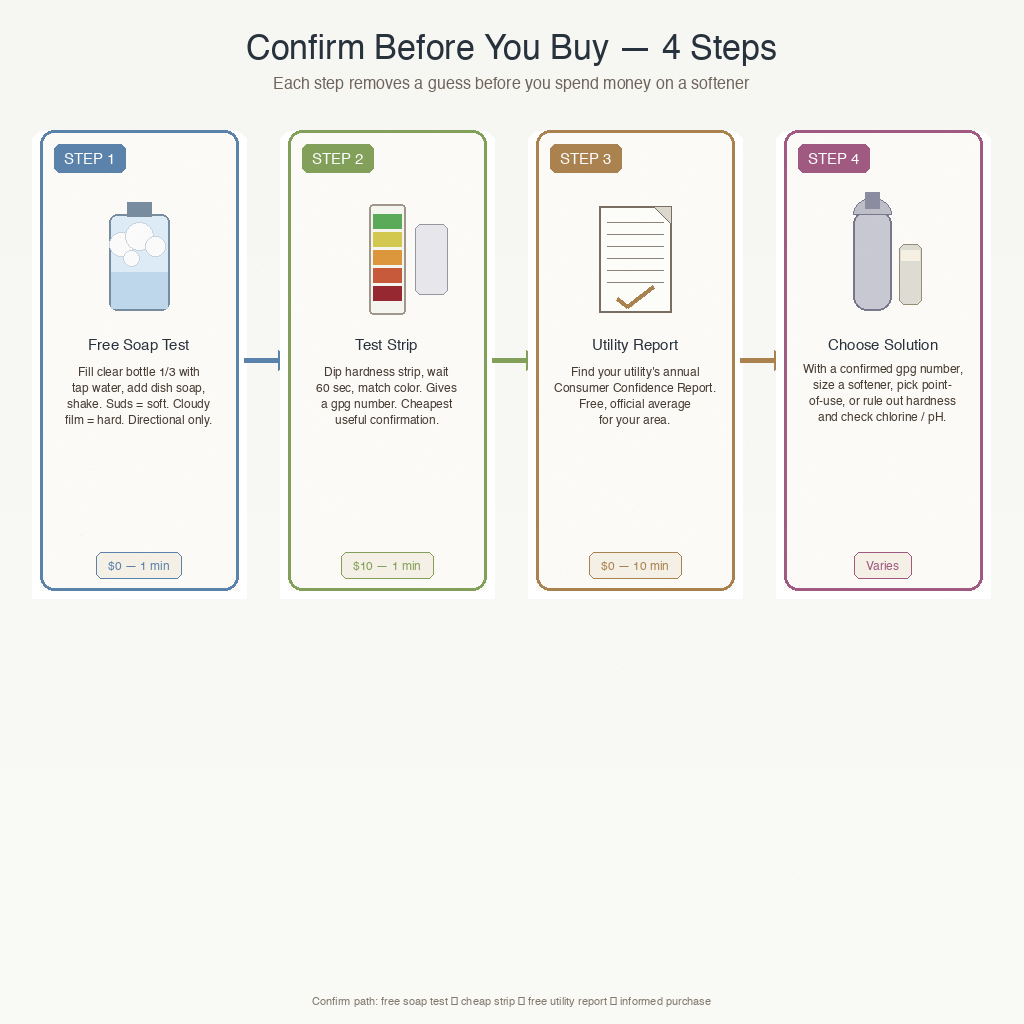
Step 1 — Free soap test (instant, zero cost)
Fill a clear bottle about one-third with the suspect water, add a few drops of plain dish soap, cap, and shake. Soft water produces a thick layer of suds quickly. Hard water produces few suds and a cloudy film on top.
This is a directional indicator only — it won’t tell you your gpg.
Don’t skip Step 2 even if the soap test is dramatic. Soap doesn’t reliably distinguish 3 gpg from 10 gpg, and that range is exactly where softener sizing matters.
Step 2 — Confirm with a hardness test strip (under $10, 60 seconds)
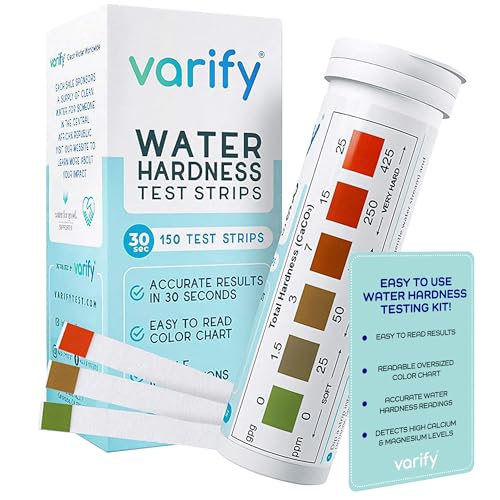
Dip a strip, wait the time on the chart, compare the color. You’ll get a number in gpg and/or ppm. This is the smallest useful purchase for confirming hard water.
We link a 150-strip hardness test kit (Varify, under $10) in the What to buy section below.
Step 3 — If you need a defensible number — titration kit ($20–35)
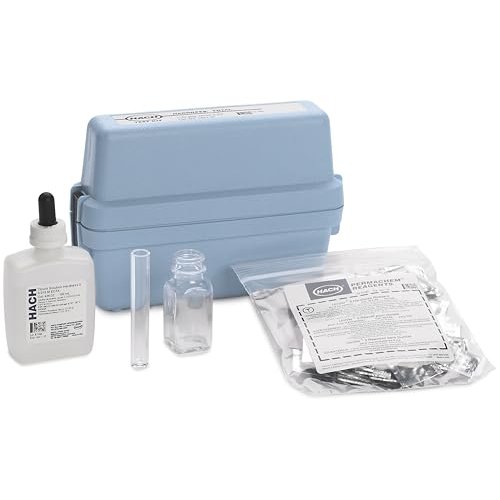
If you’re sizing a softener, calling a plumber, or the strip result is borderline, a drop-count titration kit gives a repeatable gpg value. You count drops to a color change — slower than a strip, but trusted by municipal labs.
We link the Hach Model 5-EP titration kit in the What to buy section.
Step 4 — Free: check your water utility’s Consumer Confidence Report
Most U.S. utilities publish an annual water quality report (Consumer Confidence Report) that lists hardness in mg/L. Search your utility name plus “water quality report.” This is free, official, and useful even if you also test at home — it confirms the utility average, while your tap captures what actually reaches your fixtures.
Step 5 — Choose a solution based on confirmed severity
Once you have a number, the path forks:
- Under 3 gpg with skin or taste complaints: point-of-use fixes — a shower filter for chlorine, or an under-sink reverse osmosis system for drinking taste. A salt softener may not be worth it.
- 3–10 gpg: a salt-based water softener is the standard fix. See how water softeners work and the softener size calculator.
- Over 10 gpg: softener plus check for related issues — iron in water, pH and alkalinity, or well-specific filtration.
If you already own a softener and still see these signs, check why your softener isn’t working or salt bridge and mushing before buying new equipment.
What to buy only if needed
Each item below ties to a specific decision-tree step. Don’t buy all five — buy the one that matches where you are in the confirm path above.
- Step 2 confirmation — hardness strips (~$10): Varify 150-strip hardness test kit — cheapest way to put a gpg number on your water. Dip, wait 60 seconds, compare the color.
- Step 3 defensible number — titration (~$52): Hach Total Hardness Model 5-EP — drop-count titration kit referenced in municipal and lab contexts. Reads grains per gallon directly.
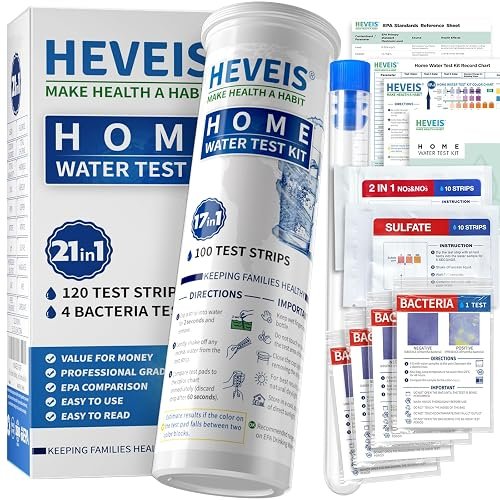
- Step 5 broad test — 21-in-1 kit (~$29): HEVEIS 21-in-1 testing kit — covers hardness, iron, pH, chlorine, lead, and bacteria. Useful when symptoms could be hardness or something else entirely.
- Stain stop-gap — descaler (~$13): CLR Calcium, Lime & Rust Remover, 42 oz — removes existing limescale and soap scum from shower glass, faucets, and toilet bowls. A cleaner, not a fix — pair with a test so you know why the scale keeps coming back.
- Skin and hair relief — point-of-use (~$37): Aquabliss shower filter — reduces chlorine and sediment at the shower arm. A stopgap for the shower only, not a whole-home softener.
Common mistakes
- Assuming dry skin means hard water. Dry skin has many causes — cold weather, harsh soap, fragrance sensitivity, eczema. A hardness test strip costs under $10 and settles it. Don’t buy a softener from a skin symptom alone.
- Buying a softener without testing first. A “soft” reading (under 3 gpg) with hard-water-looking symptoms means chlorine, pH, or soap is the real issue — a salt softener won’t fix those.
- Ignoring the free utility report. Your water utility’s annual Consumer Confidence Report lists hardness in mg/L for free. It won’t match your tap exactly (pipes and heaters affect what reaches you), but it confirms the supply average.
- Testing only one tap. If you’re on a private well, hardness can vary seasonally. If you’re on municipal supply, a single tap reading is usually representative — but a 21-in-1 test kit can rule out iron, pH, or chlorine at the same time.
- Treating symptoms forever instead of confirming the cause. Endlessly scrubbing shower glass or buying stronger detergent without testing is the most expensive path. A shower filter buys temporary relief for skin and hair, but it’s not a whole-home fix.
Key takeaways
- The eight common signs are limescale, soap scum, spotty dishes, dry skin, dull hair, appliance scale, reduced pressure, and stiff laundry.
- Each sign has look-alikes — vinegar dissolves limescale but not silica or etching; dry skin can be weather or soap, not just hardness.
- Hard water symptoms usually start at 3–7 gpg (moderately hard) and get severe above 10 gpg.
- Test before you buy anything. The free soap test is directional; a $10 hardness strip confirms.
- The confirm path is: soap test → strip or titration kit → free utility report → choose a solution sized to your gpg.
- Dry skin, eczema, and brittle hair are one-factor-not-proof situations — we don’t make medical claims.
- For the underlying science, start with water hardness explained or the gpg to ppm conversion chart.