Quick answer
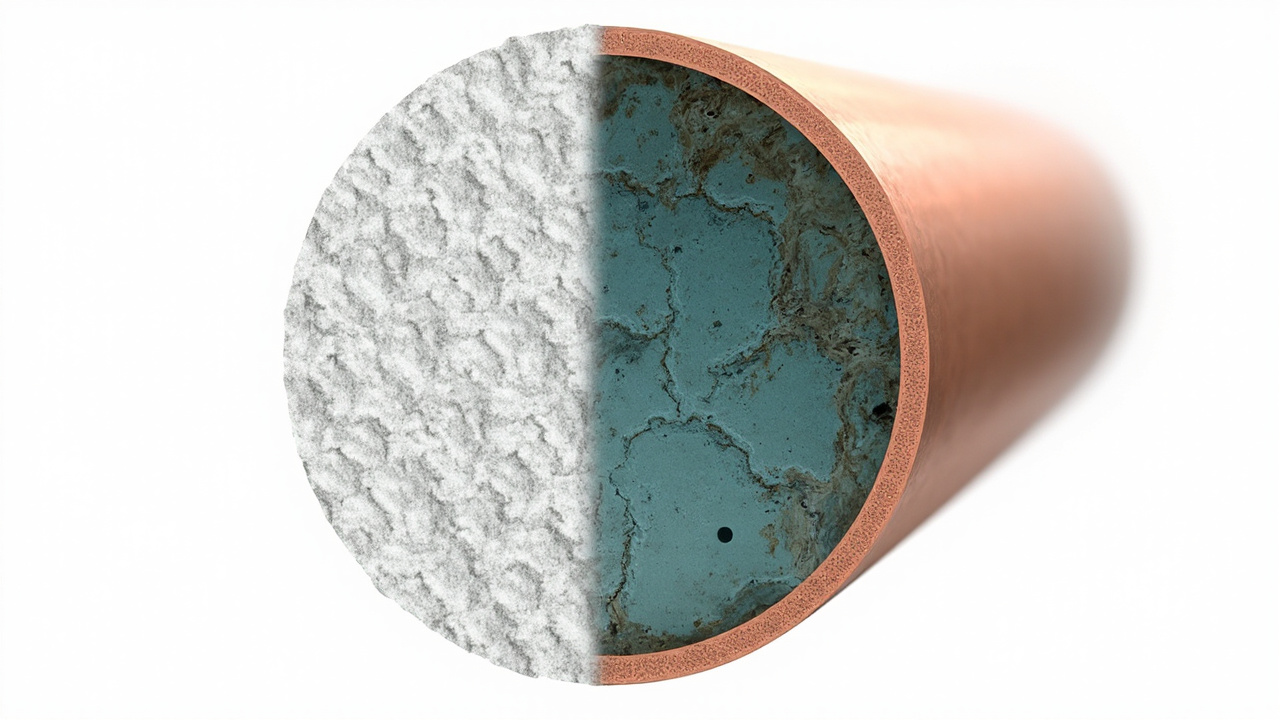
Hard water leaves calcium carbonate scale inside pipes — that is deposition, not corrosion. The scale actually forms a thin protective lining that slows metal loss. Real corrosion, like copper pinhole leaks, is caused by aggressive water chemistry: low pH, high chloride, and low alkalinity. The Langelier Saturation Index captures the trade-off: a slightly positive number means your water lays down a protective film; a negative number means it dissolves metal. Most homes want water that is barely scale-forming.
What “corrosion” actually means
This is the single most common misconception in residential water treatment. Regional plumbing blogs routinely say “hard water corrodes pipes.” The chemistry says otherwise, and the distinction matters because the fixes are sometimes opposite.
Scaling is deposition, not metal loss
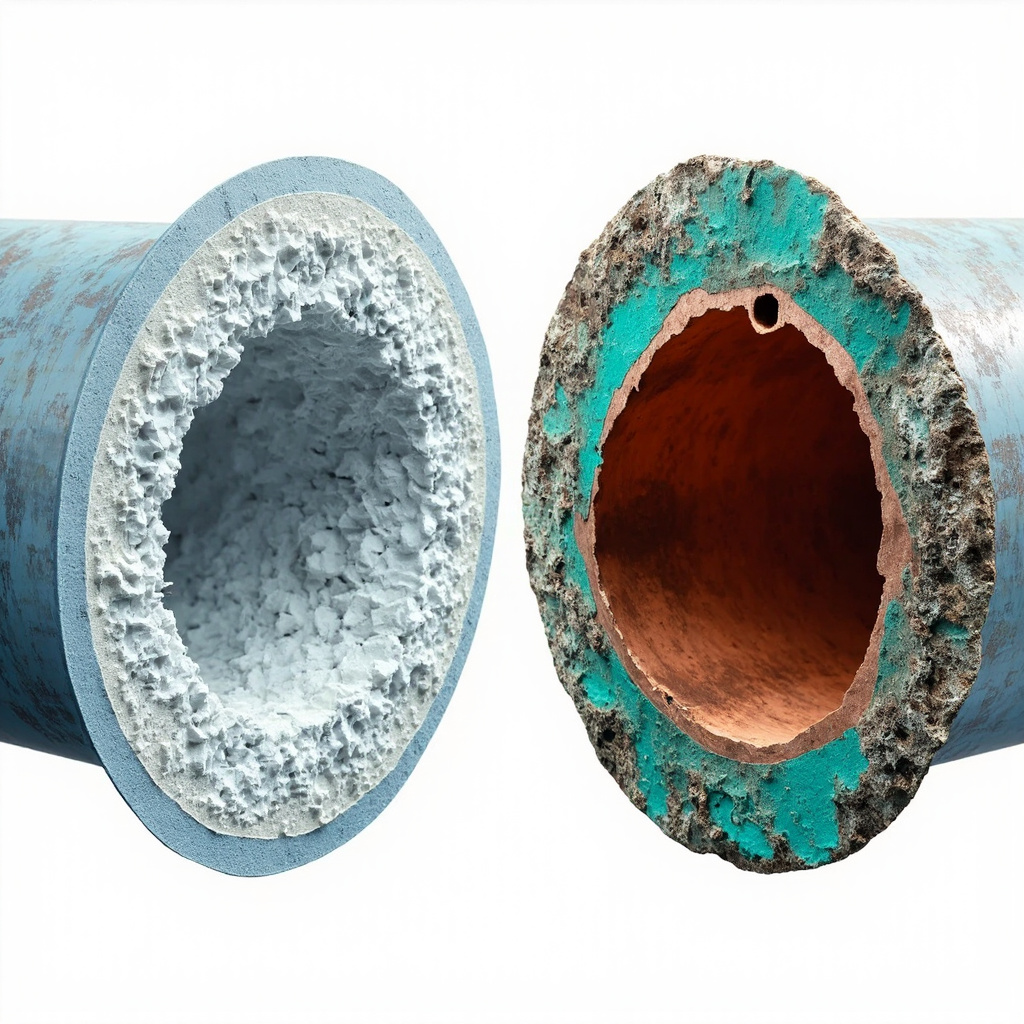
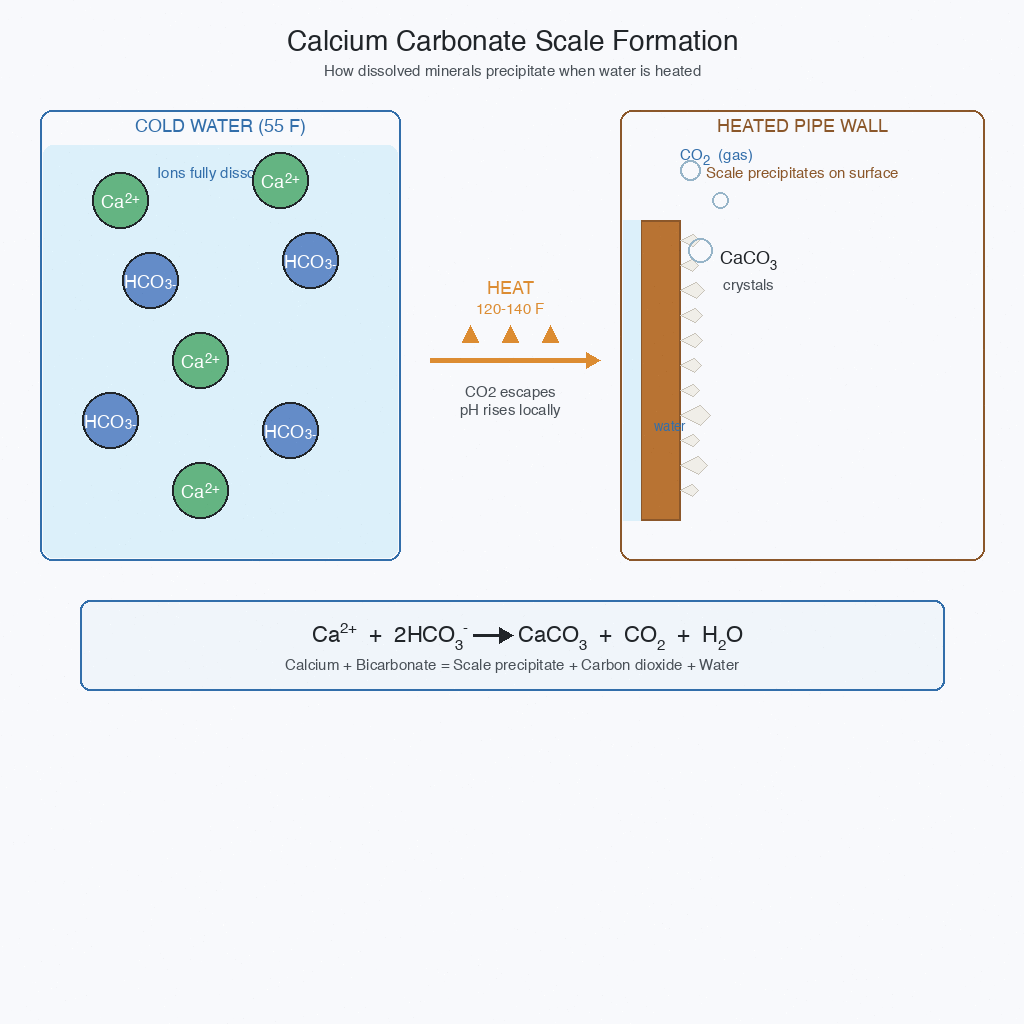
Calcium carbonate precipitates out of hard water when it is heated or when carbon dioxide escapes. The mineral collects on pipe walls, heater elements, and fixture openings. This is deposition — material being added to the pipe, not removed. The AWWA M58 manual and Copper Development Association literature both classify carbonate scale as a protective film that slows corrosion by physically separating the metal from the water.
True corrosion is metal loss at the pipe wall
Corrosion is the electrochemical dissolution of metal from the pipe wall into the water. In copper plumbing it shows up as pinhole leaks — tiny perforations that spray water into wall cavities. The driver is aggressive water chemistry: low pH, high chloride or sulfate, low bicarbonate alkalinity, and high free chlorine residual all accelerate copper pitting. EPA’s Lead and Copper Rule treats this as a public-health issue because corrosive water also leaches lead from older service lines and brass fixtures.
The paradox: hard water scales, soft water can corrode
Fully softened water has had its calcium and magnesium removed by ion exchange. Without those minerals, the water has nothing to precipitate as a protective film, so it stays undersaturated with respect to calcium carbonate. Undersaturated water will dissolve any existing scale and then start dissolving metal. Plumbers and water-treatment operators have a saying: “soft water is hungry water.” This is why a well-meaning homeowner who over-softens can suddenly start seeing pinhole leaks two years after installing a softener.
Scale formation chemistry
When hard water is heated, the equilibrium shifts and calcium carbonate precipitates:
Ca²⁺ + 2HCO₃⁻ → CaCO₃↓ + CO₂↑ + H₂O
Three things push the reaction toward more scale:
- Temperature — the solubility of CaCO₃ decreases as water warms, so heating elements, kettle walls, and the bottom of the water heater are the first places scale appears.
- CO₂ loss — when water sits in a heater or sprays from a showerhead, dissolved CO₂ escapes, which raises pH locally and triggers precipitation.
- Magnesium follows — Mg²⁺ forms softer, lighter compounds than calcium scale, contributing to the white haze on glass shower doors.
This is why a single home can have a heavily scaled water heater and almost clean cold-water copper lines. The cold lines carry the same hardness, but the reaction is slow at 55°F. The hot side, running at 120–140°F, precipitates calcium carbonate almost continuously, which is why heater elements fail first and why flushing the tank every six months extends element life.
The practical test is hardness in grains per gallon (gpg). Over about 7 gpg, the rate of scale accumulation becomes noticeable inside heaters and on fixtures. Use the hardness conversion chart (gpg to ppm) to translate a lab report into the gpg number softener sizing uses.
pH, alkalinity, and the Langelier Saturation Index
Why pH drives the scale-vs-corrosion branch
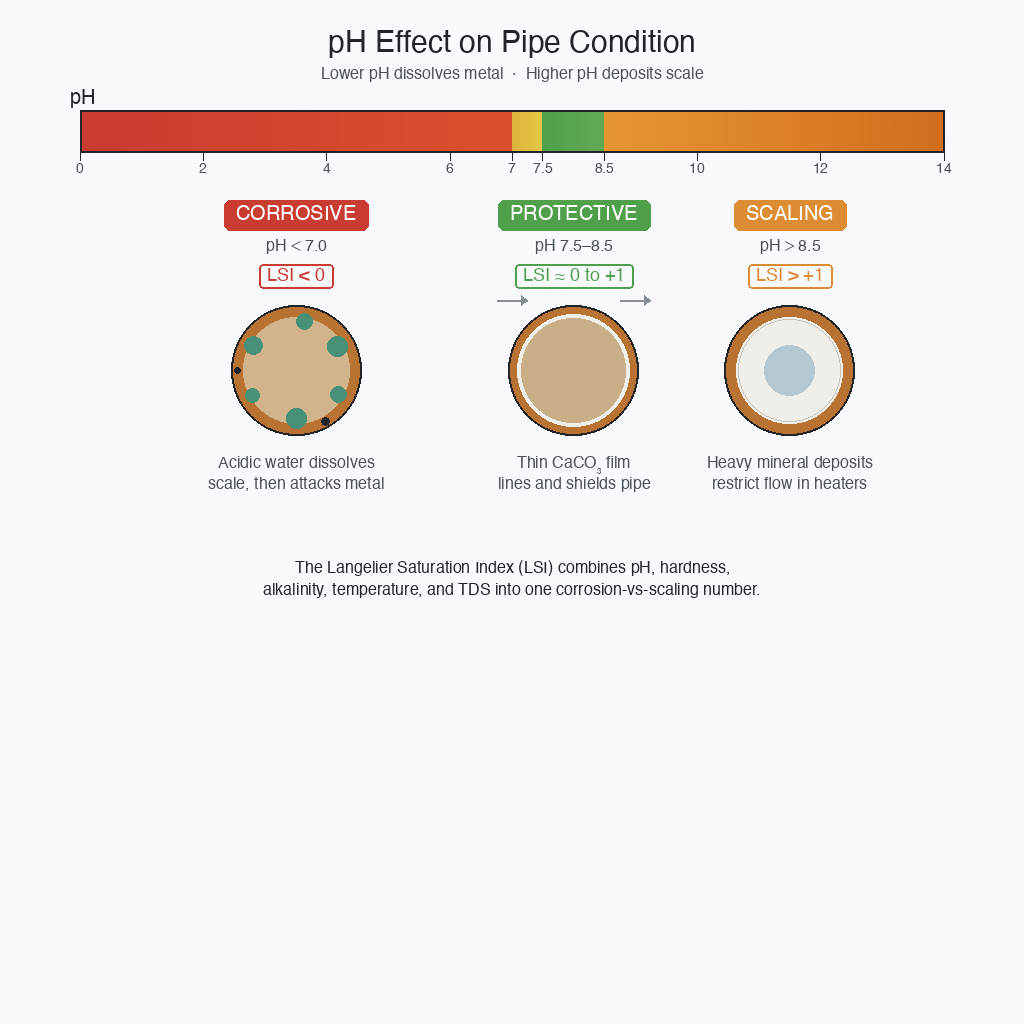
- pH below 7.0 — water is acidic and aggressive. It dissolves CaCO₃ scale, then attacks copper, lead, and iron. Common in New England well water and Pacific Northwest surface water.
- pH 7.0–7.5 — neutral but low buffering. Can swing corrosive when chlorine is added at the treatment plant.
- pH 7.5–8.5 — optimal. CaCO₃ precipitates slowly and forms the protective film inside pipes.
- pH above 8.5 — alkaline. Less corrosive to metal but increased scaling on heaters and fixtures.
The LSI in one paragraph
The Langelier Saturation Index (LSI) is a single number that tells you whether your water will deposit scale, dissolve metal, or stay balanced. It is calculated from five measurements: pH, calcium hardness, total alkalinity, water temperature, and total dissolved solids (TDS). LSI above zero means water is scale-forming — protective, but it builds up in heaters. LSI below zero means water is corrosive — it will dissolve existing scale and then metal. LSI near zero means water is balanced. Municipal water plants in the U.S. target a slightly positive LSI (0.5 to 1.0) so that a thin protective film forms without plugging service lines. You do not need to calculate it by hand — most water testing labs report it on the results sheet, and online LSI calculators take five inputs and return the index in seconds. The key insight is that any treatment change (softening, acid neutralizing, adding a filter) shifts the LSI, so you’ll want to re-check the LSI.
For pH and alkalinity in hard water — the deeper parameter page on pH chemistry — and for TDS (total dissolved solids) — which drives conductivity and therefore galvanic corrosion rates — see the linked sister pages. If you are starting from scratch, the water hardness guide defines the gpg scale this article references.
Corrosion mechanism
The LSI tells you what your water will do; the mechanism below explains how it does it. Three electrochemical pathways do most of the damage in residential plumbing.
Pitting corrosion in copper
Copper is normally protected by a thin, tightly-adhering layer of cupric oxide (Cu₂O). When water at the pipe surface has chloride above ~100 ppm, chloride ions penetrate that layer at microscopic weak points and the underlying copper goes into solution as Cu²⁺. The cavity that forms grows inward because the chemistry inside the pit diverges from the bulk water (lower pH, higher copper ion, no oxygen) — and a single pinhole can spray several gallons per hour before detection. This is why chloride from road salt or softener brine backup is one of the three drivers we test for on the 21-in-1 strip. Pitting almost always initiates on the cold-water side first because cold water holds more dissolved oxygen and chloride, and because the cold branch is the one running through unconditioned exterior walls where temperature swings expose the pipe to more aggressive chemistry.
Galvanic corrosion at mixed-metal joints
Where copper connects to galvanized steel (often at water-heater nipple connections or transitions from main service line to interior plumbing), the two metals with different electrode potentials form a galvanic cell. The less noble metal (galvanized) becomes the sacrificial anode and corrodes preferentially. The current flow depends on water conductivity, which rises with TDS. Hard water with high TDS accelerates galvanic attack at every dielectric union — sometimes within a decade. Dielectric nipples and plastic-lined transitions slow this, but only when they’re installed in both directions — the failure I see most often in older homes is a dielectric at the heater inlet only, with the cold branch still directly bonded to galvanized at the main shutoff.
Tuberculation in galvanized steel
In galvanized pipes, iron and hardness together form rust-encrusted mounds called tubercles that restrict flow and trap standing water against the pipe wall. The trapped water loses oxygen, becomes locally acidic, and the corrosion front advances under the tubercle until the wall thins enough to leak. Tuberculation is the slow-motion cousin of copper pitting — the visible symptom is reduced flow at the tap, not a pinhole leak. Galvanized lines installed before 1970 had thinner walls and shorter zinc coatings; a 50-year-old galvanized home on the same well as a 10-year-old PEX neighbor will routinely fail first, even when neither shows a pinhole.
For the chemistry behind chloride-driven pitting and bicarbonate buffering in residential water, see the pH and alkalinity in hard water parameter page. If you have iron alongside hardness (which most Appalachian wells do), iron in water covers the tuberculation mechanism in more depth.
How pipe material changes the story
| Pipe material | What hard water does | What aggressive water does | Typical lifespan |
|---|---|---|---|
| Copper | Lays down thin CaCO₃ film — usually invisible | Pinhole leaks from pitting; blue-green stains | 20–50 years |
| Galvanized steel | Scale + iron tubercles restrict flow | Rust-through from inside; brown water at taps | 40–60 years |
| PEX / CPVC plastic | No scale adhesion; no corrosion | Immune to corrosion; immune to scaling | 40–50 years |
| Lead (older service lines) | Scale can trap lead behind a film | Corrosive water leaches lead — health hazard | Replace |
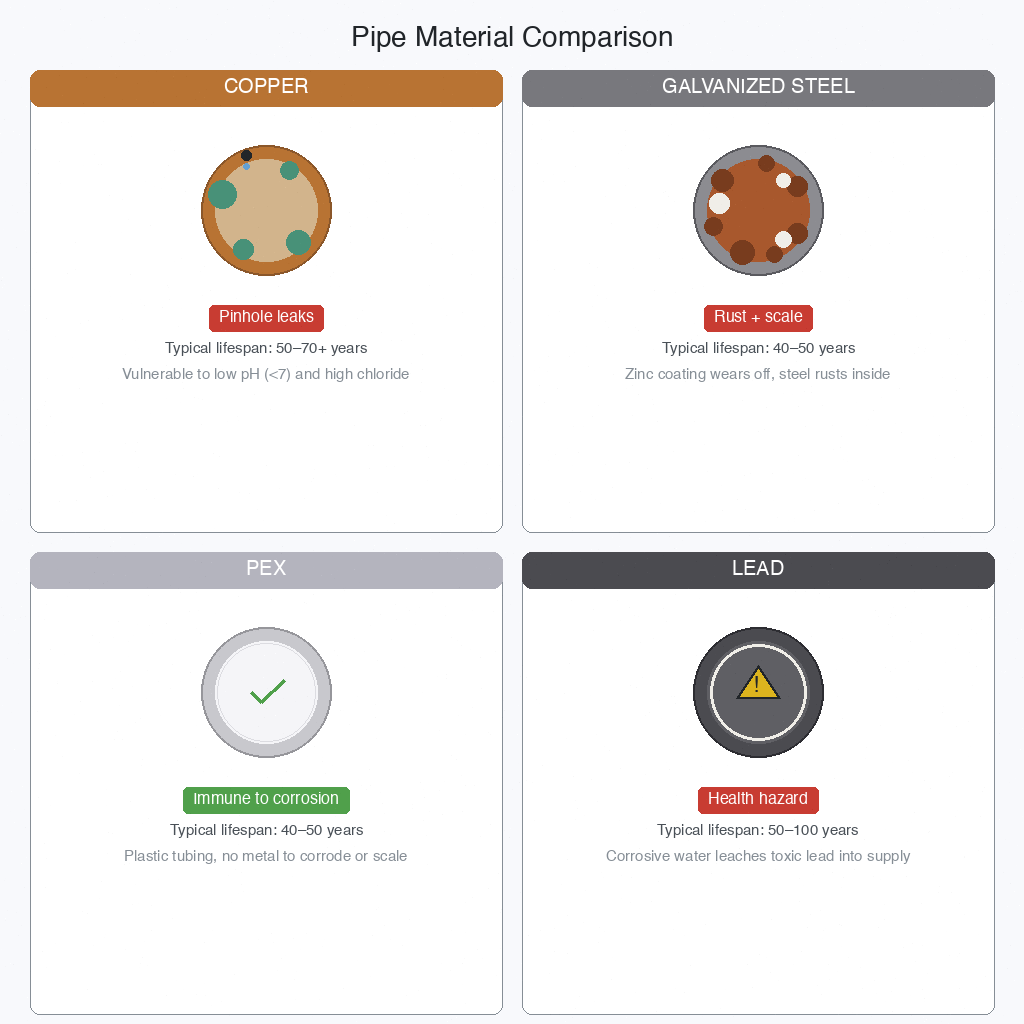
The copper row explains why homeowners blame hard water for pinhole leaks: they see the blue-green stain, they know they have hard water, and they connect the two. The chemistry says otherwise — pinhole leaks are driven by low pH, high chloride (often from road salt intrusion or softener brine backing up), and disinfectant residuals, not by calcium and magnesium.
How to diagnose your pipe problem (decision tree)
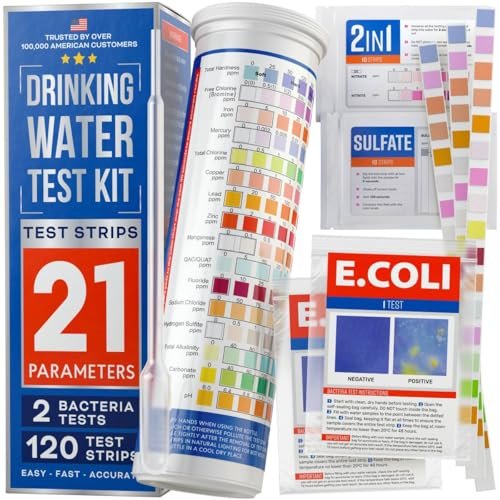
Start with what you can see. Each branch below leads to a different cause and a different fix. If you don’t have a water test yet, a 21-in-1 test strip gives you pH, hardness, alkalinity, iron, copper, lead, and chloride in under a minute.
Branch 1 — White, chalky buildup on showerheads or around the water heater
You have scaling (deposition), not corrosion. Hardness minerals are precipitating where water is heated or where it evaporates. The pipes themselves aren’t failing; the fixtures are. Test to confirm hardness above 7 gpg. If confirmed, the path is a water softener or a polyphosphate scale inhibitor cartridge if you do not want to soften.
Branch 2 — Blue-green stains on copper, or a pinhole leak
You have copper pitting corrosion. This isn’t caused by hardness. Test pH, alkalinity, and chloride. If pH is below 7 or chloride is above 100 ppm, the water is aggressive. Do not add more salt to an existing softener — over-softening makes this worse. Look at an acid neutralizer for low-pH well water, or a phosphate-based corrosion inhibitor that lays down a protective film.
Branch 3 — Brown, orange, or red water at the tap
You have iron or rust, not calcium scale. This is covered in our iron in water guide. Iron and hardness often co-exist in well water and accelerate each other’s effects inside galvanized or steel pipes — iron tubercles combine with calcium scale to restrict flow severely.
Branch 4 — No visible issues, but a lab report shows pH below 6.5
You have corrosive water that has not yet caused a leak. Act before pinholes appear. The fix is an acid neutralizer tank filled with calcite media — it raises pH and adds alkalinity in one step, installed where the main enters the house.
Branch 5 — You softened your water and suddenly started seeing pinholes
Over-softening has made the water aggressive. Fully softened water has zero calcium hardness, so its LSI is negative everywhere in the plumbing. The fix is bypassing one cold-water tap (usually the kitchen) so some hardness remains, or installing a calcite polisher downstream of the softener to push LSI slightly positive again. A resin cleaner used every 2–4 months can also help — if the resin bed’s fouled, hardness slips through even when the softener looks like it’s running.
Prevention: four real strategies
Each strategy below targets a different branch of the diagnosis above. Don’t stack them without understanding which problem you actually have.
1. Water softener — reduces scaling, may increase corrosion
A salt-based ion-exchange softener removes calcium and magnesium and replaces them with sodium. Scaling on heaters and fixtures drops to near zero. The trade-off, per AWWA M58, is that the softened water has a lower LSI and is more aggressive to copper and lead. Mitigation: bypass at least one unsoftened tap, or target a residual hardness of 1–3 gpg rather than zero. If you already run a softener, a resin cleaner keeps the resin bed pulling calcium at full capacity so the LSI does not swing negative from a tired bed.
2. Polyphosphate scale-and-corrosion inhibitor
A small cartridge feeder — typically a 10-inch housing on the cold feed to the water heater — slowly dissolves food-grade polyphosphate beads. The polyphosphate sequesters calcium so it cannot precipitate as scale, and forms a thin molecular film on metal surfaces that slows corrosion. It’s not a softener; your test strip will still read the same hardness. Best for homes at 3–10 gpg where a full softener is overkill. The AMI polyphosphate cartridge fits a standard 10-inch housing and lasts roughly six months depending on flow rate.
3. Acid neutralizer — for low-pH corrosive well water
A backwashing tank filled with calcite (crushed marble, CaCO₃) slowly dissolves into the water as it passes through. pH rises from 6.0 to 7.5–8.0, alkalinity increases, and the LSI moves from negative to slightly positive. This is the standard fix for New England and Appalachian well water with pH 5.5–6.5. The AFWFilters calcite tank is sized for whole-house flow and refills calcite every 6–12 months.
4. Pipe replacement — copper to PEX
When pinhole leaks are recurring, the copper has already been damaged and replacement is the only permanent fix. Modern PEX is immune to both scaling and corrosion (NSF/ANSI 61 certified for drinking water). Cost is comparable to copper repipe but with a longer leak-free life.
What you might need
Each product below maps to one decision-tree branch. Diagnosis first, product second.
- Step 1 — Test. A 21-in-1 test strip kit gives you pH, hardness, alkalinity, iron, copper, lead, and chlorine in under a minute. Without these numbers, you can’t choose the right fix without these numbers.
- Step 2 — Low-pH well water (Branch 4). An acid neutralizer tank is the standard fix. Calcite media slowly dissolves and raises pH and alkalinity together.
- Step 3 — Moderate hardness without a softener (Branch 1). A polyphosphate inhibitor cartridge feeds a thin protective film into the line feeding the water heater.
- Step 4 — Existing softener maintenance (Branch 5). A resin cleaner used every 2–4 months keeps the resin bed from fouling so the softener keeps pulling calcium out.
Prevention methods
The “four real strategies” above treat single-cause fixes. In practice, pipe protection benefits from a layered approach — and from preventing the softener-driven causes that show up two years after install.
Annual testing schedule
Re-test pH, alkalinity, chloride, and iron every 12 months — or after any treatment change. A 21-in-1 strip kit is the cheapest way; a lab test runs ~$30 and reports the same five numbers plus the calculated LSI. Test again after heavy road-salt winters (chloride spikes), after major well construction, and any time you change equipment upstream of the softener. Keep a one-page log: date, source-water pH, alkalinity, chloride, hardness, and any treatment change between samples. Two years of trend lines reveal the seasonal chloride pattern and tell you whether your softener resin is keeping capacity or slowly fouling.
Set softener to 1–3 gpg residual, never zero
This is the single most common cause of post-install pinhole leaks. A salt bridge — the compacted salt crust that forms above the resin bed — can silently stop your softener from working even when the brine level looks fine. Confirm before any LSI recalculation. If your softener is pulling calcium correctly but the resin bed is partially exhausted, hardness slips into the plumbing and the LSI math gets messy: you can be both scaling at the heater (residual hardness) and corrosive at the copper lines (chloride + low pH). A resin cleaner every 2–4 months keeps the bed performing at specification.
Winter chloride spikes
In cold climates, road-salt runoff can push chloride from 30 ppm (summer) to 200+ ppm (winter) in surface-water sources and shallow wells. This winter spike is when pitting accelerates. Run pH/alkalinity/chloride in late February to catch the worst of it; if chloride is high, a polyphosphate cartridge ahead of the cold feed line and a kitchen-tap RO for drinking water (with bypass loop in summer) covers both protective and consumption needs. This is also the season to check anode rod condition — the magnesium rod in a standard water heater protects the tank by sacrificing itself, and a winter chloride spike burns through it twice as fast as the shoulder seasons.
Pipe replacement as last resort
When pinholes recur within 2–3 years of repair, the copper has reached end-of-life. PEX-A or PEX-B repipe is comparable in cost to copper and immune to both scaling and corrosion. Schedule replacement before another leak forces emergency dry-out costs — a single pinhole leak that runs overnight can run a $500 bill, and a recurring-leak pattern is the cue that the whole run has reached uniform end-of-life.
Common mistakes
- Treating “hard water” and “corrosive water” as the same thing. Hardness is deposition; corrosion is metal loss. The fixes are different and sometimes opposite — a softener fixes one and can worsen the other.
- Over-softening to zero hardness. A water analysis showing 0 gpg looks like a victory, but it means your LSI’s negative everywhere in the plumbing. Pinhole leaks appear 1–3 years later. Target 1–3 gpg residual hardness, not zero.
- Adding salt to fix a pinhole leak. If your copper is pitting, the cause is low pH or high chloride, not excess calcium. Adding more salt removes more calcium and pushes the LSI further negative — the leak gets worse, not better.
- Ignoring chloride from road salt or brine backup. High chloride (above 100 ppm) is a leading driver of copper pitting in cold-climate homes. Test for it specifically — a 21-in-1 strip covers chloride alongside hardness and pH.
- Assuming brown water is iron. Brown or orange water can be iron, but it can also be galvanized-steel rust-through. The fix for the second is repipe, not an iron filter.
Related
- Water hardness (gpg and ppm) — foundational parameter page; defines the gpg scale this article uses
- pH and alkalinity in hard water — pH is the primary driver of the scale-vs-corrosion branch
- TDS (total dissolved solids) — drives conductivity and therefore galvanic corrosion rates
- Iron in water — iron and hard water together accelerate tuberculation inside steel pipes
- Hardness conversion chart (gpg to ppm) — translate a lab report into the gpg number the decision tree uses
- Hard water stains on glass — the visible symptom of the same CaCO₃ precipitation chemistry
Key takeaways
- Hard water scales pipes. Scaling is deposition — material added to the pipe wall. It is not corrosion.
- Copper pinhole leaks are pitting corrosion driven by low pH, high chloride, and low alkalinity — not by hardness.
- The paradox: hard water scales but the scale protects; over-softened water has a negative LSI and corrodes faster.
- LSI above zero means scale-forming (protective). LSI below zero means corrosive. Municipal water targets 0.5–1.0.
- Hot water scales first because CaCO₃ solubility drops as temperature rises.
- PEX is immune to both scaling and corrosion; copper is the highest-risk metal for pinhole leaks.
- Test pH, hardness, alkalinity, chloride, and iron before buying any system — a 21-in-1 strip covers all of them in one minute.