Quick answer
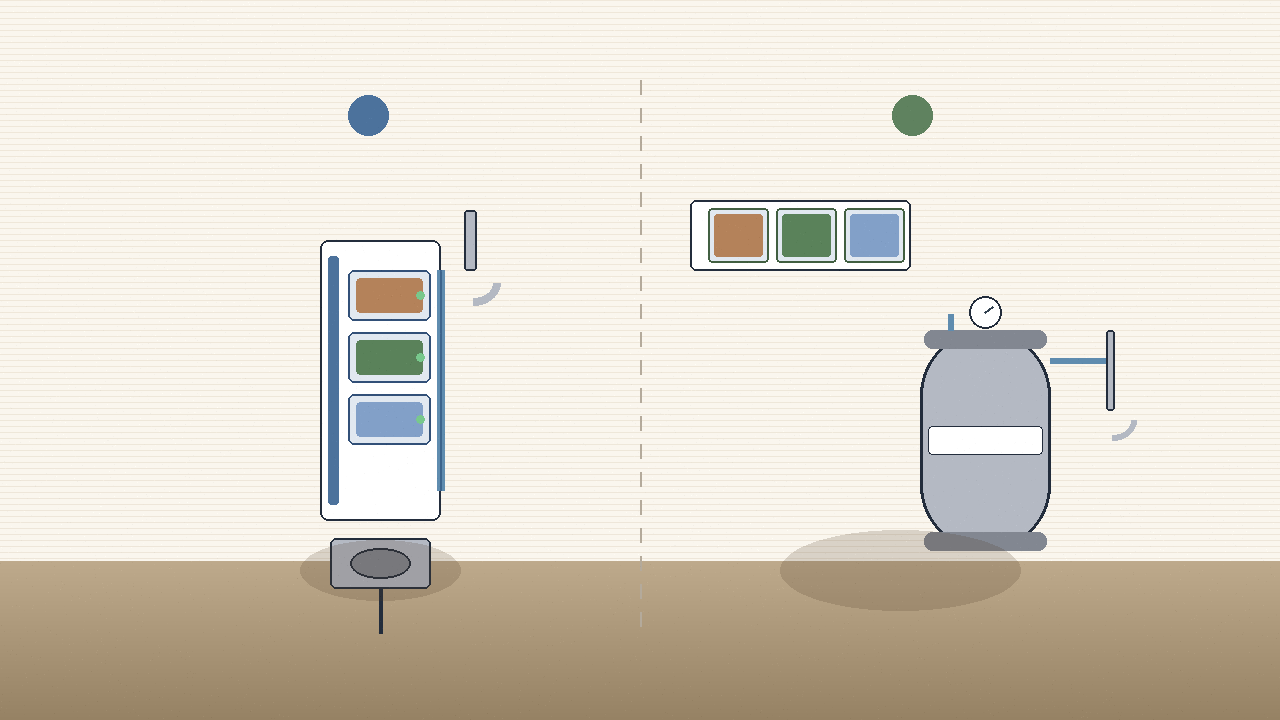
A tank reverse osmosis stores 2-4 gallons of filtered water in a pressurized tank, so the tap fills fast but wastes 3-4 gallons per gallon produced. A tankless RO makes water on demand and cuts waste to 2:1 or 3:1, but peak flow drops if multiple fixtures run at once. Pick tankless for clean cabinet space and lower bills; pick tank for higher peak flow on a tighter budget.
What “tank” and “tankless” actually mean in RO
A tank RO pushes water through 3-5 filter stages and a reverse osmosis membrane, then stores 2-4 gallons in a pressurized steel tank. The tank delivers normal tap flow when you open the faucet. A tankless RO does the same filtration but skips the storage tank; a booster pump pushes water straight to the faucet on demand. The five dimensions below drive the decision.
Dimension 1: Flow rate (GPM)
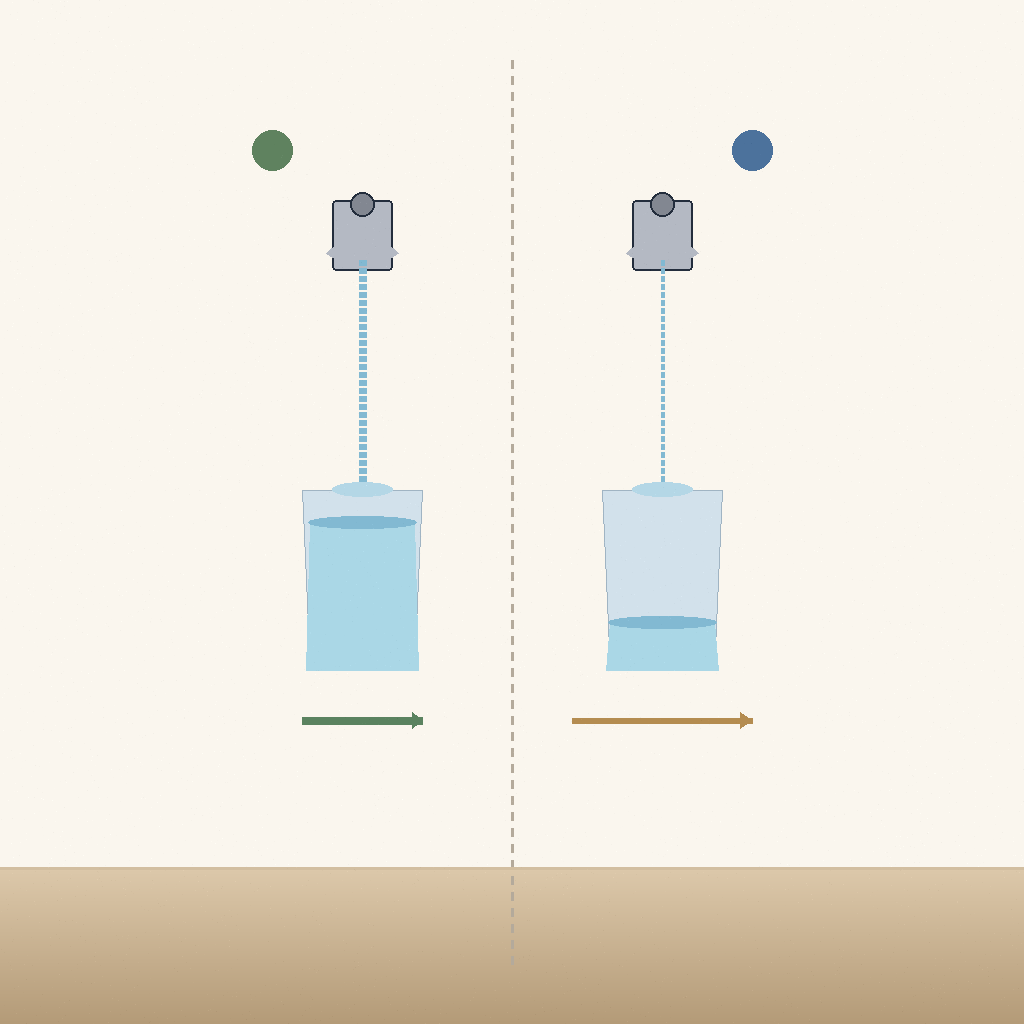
The main user-facing difference. Tank RO delivers 0.5-0.8 GPM at the faucet (basically tap pressure). Tankless RO delivers 0.2-0.4 GPM at the faucet — slower, but never runs dry.
| system type | faucet flow | source | real-world feel |
|---|---|---|---|
| Tank RO (50-100 GPD) | 0.5-0.8 GPM | 2-4 gallon tank | Glass in ~5 sec; tank refills overnight |
| Tankless RO (400-800 GPD) | 0.2-0.4 GPM | Direct membrane + pump | Glass in ~10-15 sec; never “runs out” |
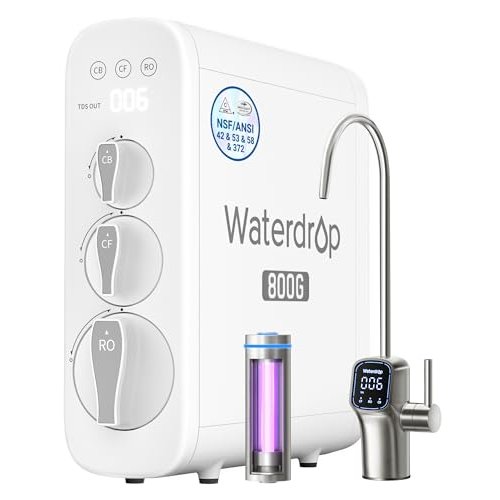
If you fill a large pot, an ice-maker tray, or a fridge line at the same time as someone else is filling a glass, the tankless RO feels slower. The Waterdrop G3P800 800 GPD tankless RO is sized for that workload. For the full math, see how RO works under the sink.
A tankless RO rated “800 GPD” produces 800 gallons over 24 hours — not 800 GPH. Real-world per-faucet flow is closer to the GPM number above. Manufacturers sometimes list GPD, sometimes GPM, sometimes both.
- Skip the tankless RO if two units are both rated “600 GPD” but one lists 0.4 GPM and the other lists 0.2 GPM. The 0.4 GPM unit refills your glass in roughly half the time. Don’t fall for the GPD arms race — that’s how the marketing hides a slower unit.
Dimension 2: Tank footprint and undersink space
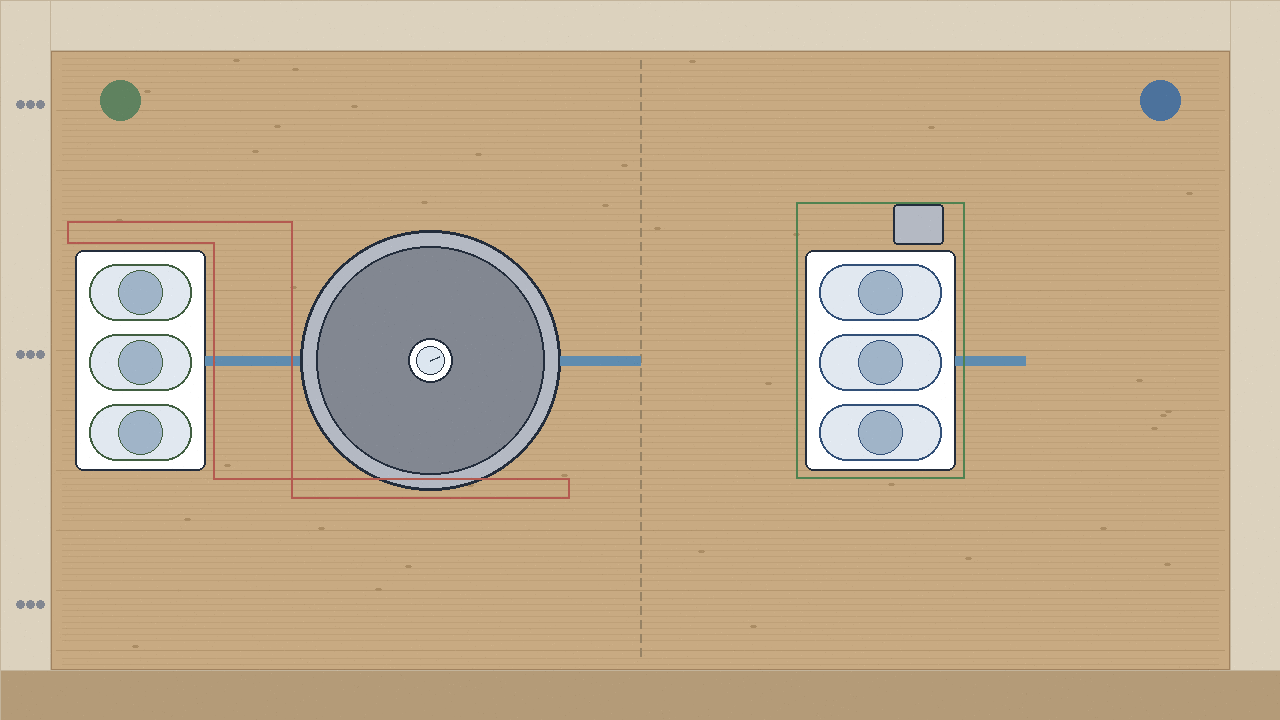
A tank RO needs room for the membrane housing, 3-5 quick-change filters, and a 2-4 gallon pressurized tank. A tankless RO replaces that tank with a smaller permeate pump and compact manifold, but adds a booster pump and power brick.
| system type | footprint (W x D x H) | total under-sink space |
|---|---|---|
| Tank RO | Manifold ~15” x 6” x 16” + 3 gal tank ~11” diameter x 15” tall | 2 cubic feet or more |
| Tankless RO | Single manifold ~16” x 7” x 18” | Under 1 cubic foot |
Apartments, tiny kitchens, and RV installs often cannot fit a tank. A tankless RO opens up the space. The 3-gallon steel tank weighs 12-15 lbs empty versus a tankless manifold at 8-10 lbs — long-term, this strains a particle-board shelf.
- Skip tankless if your cabinet is already tight on vertical clearance. Some manifolds are 18 inches tall — measure first.
- Don’t assume apartment-friendly always means tankless. A budget 50 GPD “tankless” RO is just a slow tank RO with the tank deleted. Real tankless RO starts at 400 GPD.
Dimension 3: Wastewater ratio (pure-to-drain)
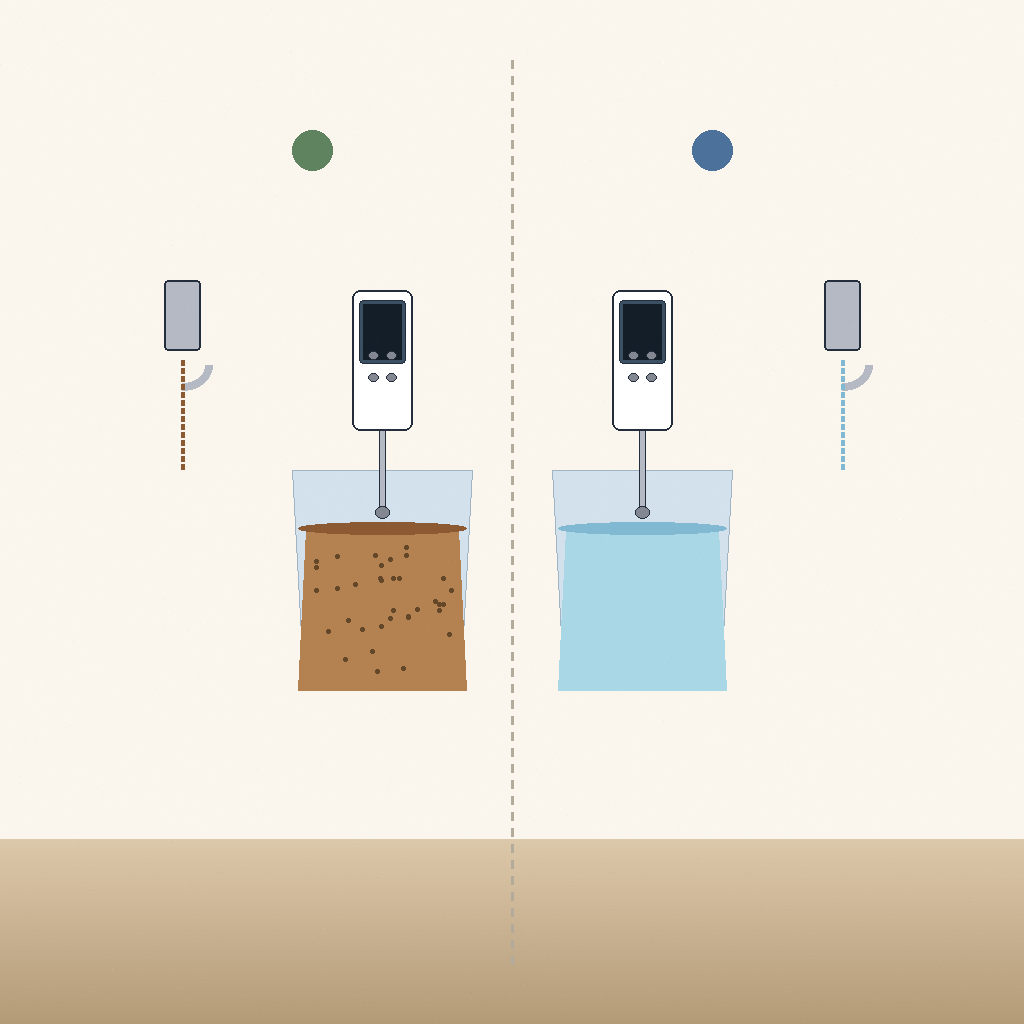
This drives tankless RO’s cost-per-gallon appeal. Tank RO wastes 3-4 gallons of brine per gallon of permeate. Tankless RO cuts that to 2:1 or 3:1 depending on feed-water TDS, feed pressure, and membrane age.
| system type | pure-to-drain ratio | annual water drained (family of 4) |
|---|---|---|
| Tank RO (50-100 GPD) | 1:3 to 1:4 | ~10,000-15,000 gallons per year |
| Tankless RO (400-800 GPD) | 2:1 to 3:1 | ~3,500-6,000 gallons per year |
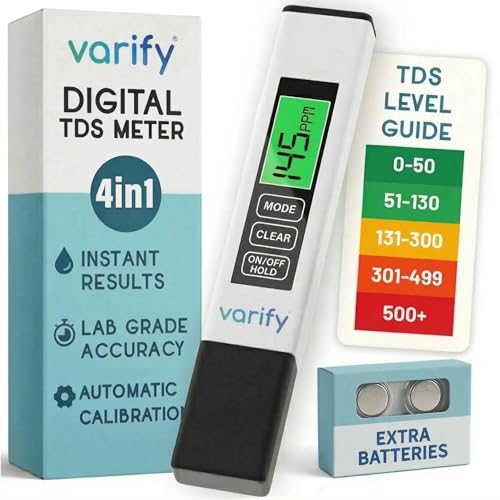
To verify your system: measure TDS on the drain vs the permeate with a TDS meter. If permeate TDS is creeping above 50 ppm and the membrane is more than 2 years old, the membrane is failing. For TDS limits, see what a TDS reading actually measures.
- Don’t trust “1:1 waste” marketing claims. Some tankless RO brands advertise “1:1 pure-to-drain” or even “zero waste.” Those claims usually mean “1:1 under lab conditions with 50 psi feed pressure and 50 ppm feed TDS.” In a real home with 70+ psi feed and 300+ ppm feed TDS, you’ll see 2:1 to 3:1.
Dimension 4: Filter replacement cycle
This is the dimension most buyers underestimate. Tank RO uses 3-5 quick-change cartridges plus a membrane, replaced on a 6-12 month cadence. Tankless RO does the same — but the membrane runs at higher pressure and may compact faster.
| filter | tank RO | tankless RO | cost per year (approx.) |
|---|---|---|---|
| Sediment pre-filter | 6 months | 6 months | $10-$20 |
| Carbon pre-filter | 12 months | 6-12 months | $15-$25 |
| RO membrane | 2-3 years | 2-3 years | $15-$50 (NSF-certified) |
| Post-carbon / alkaline | 12 months | 12 months | $15-$25 |
| Tank bladder (tank only) | 4-6 years | n/a | $25-$40 (one-time) |
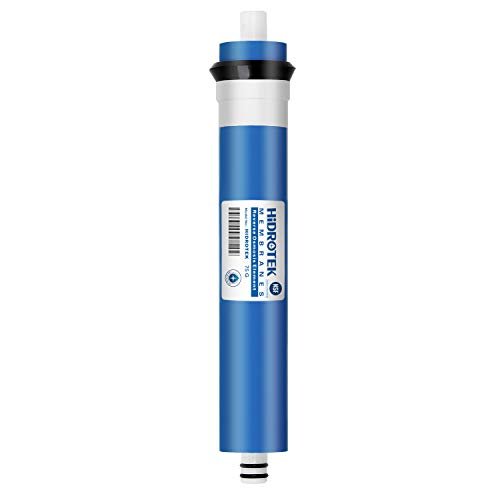
If you forget to change filters, the membrane fouls. A replacement membrane costs around $15 and gets swapped every 2-3 years per the RO filter replacement schedule. Tankless RO membranes run at 80-100 psi when the faucet is open, vs 50-60 psi in tank RO. Expect 2-3 years of life either way — verify with a TDS meter on the permeate line after the second year.
- Skip the post-carbon stage and the membrane fouls faster. Post-carbon polishing is what removes the “flat” taste people associate with RO water. Both systems need post-carbon replaced every 12 months.
Dimension 5: Household size fit
The deciding dimension. Tank RO is sized in GPD and tank size. Tankless RO is sized in GPD only. A household of 1-2 people uses 1-2 gallons a day. A family of 5 uses 3-5 gallons plus ice-maker and cooking water.
| household | RO demand / day | tank RO match | tankless RO match |
|---|---|---|---|
| 1 person, no ice-maker | 1 gal | 50 GPD tank | 400 GPD tankless (overkill, fine) |
| 2 people, occasional ice | 2 gal | 50-75 GPD tank | 400 GPD tankless |
| 3-4 people + fridge + cooking | 3-5 gal | 75-100 GPD tank | 500-800 GPD tankless |
| 5+ people, frequent cooking | 5-8 gal | 100 GPD tank + refill overnight | 800 GPD tankless (mandatory) |
Tankless RO only makes sense at 500+ GPD. Below 500 GPD, the slower peak flow and the booster pump add cost without payback. Above 800 GPD, tank RO tanks get bulky. For whole-house hardness, see RO vs softener — a softener before the RO extends membrane life on hard source water.
- Don’t pick a 50 GPD tankless RO. Some manufacturers sell “tankless” RO at 50-100 GPD output. That’s just a slow tank RO with the tank deleted — peak flow drops to a trickle and the waste ratio stays at 1:4. Real tankless RO starts at 400 GPD.
Who should pick what (decision tree)
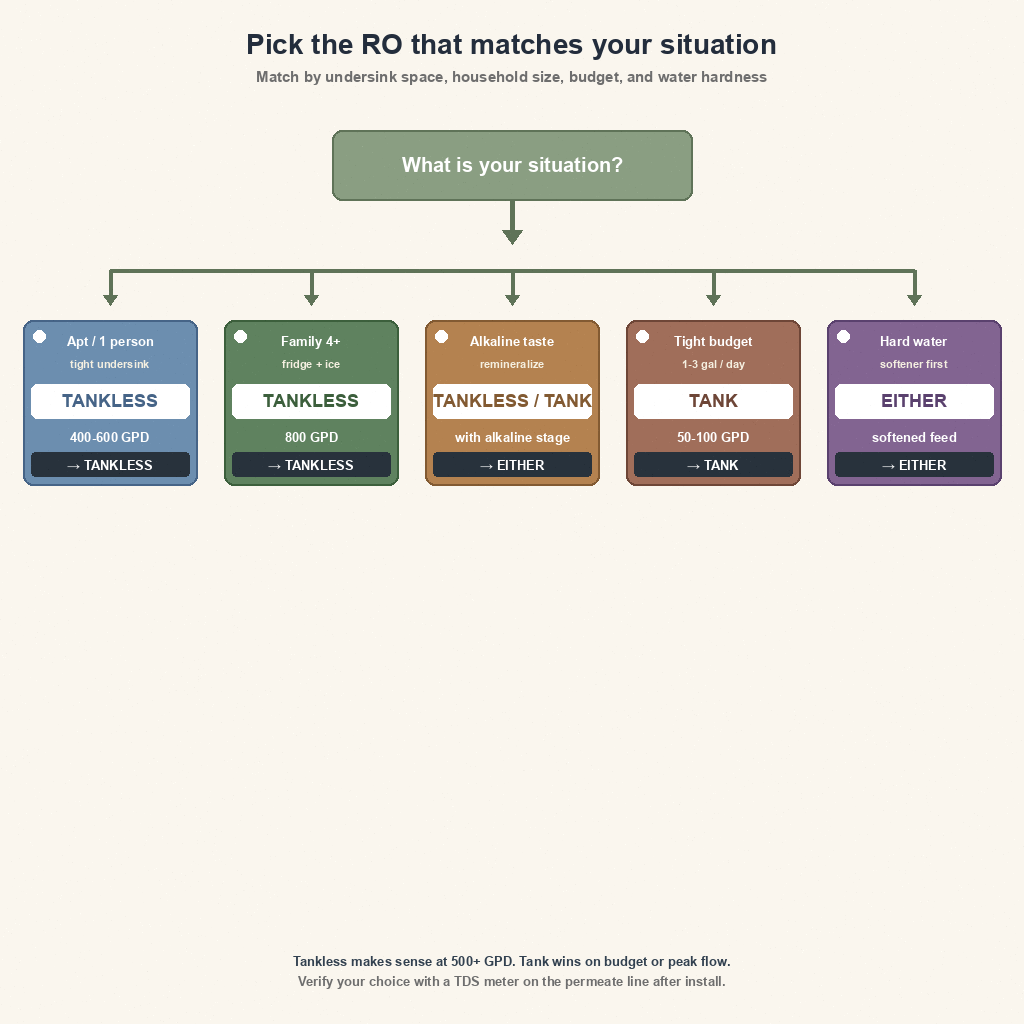
Five branches — pick the one that matches your situation.
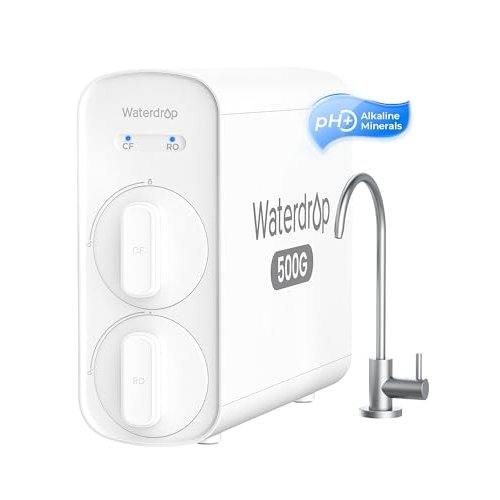
- Apartment, single person, tight undersink space → tankless RO at 400-600 GPD. The Waterdrop G5P500A 500 GPD tankless RO is the entry tankless pick.
- Family of 4+ with fridge/ice-maker → high-output tankless RO at 800 GPD. The Waterdrop G3P800 800 GPD tankless RO is the highest-output tankless.
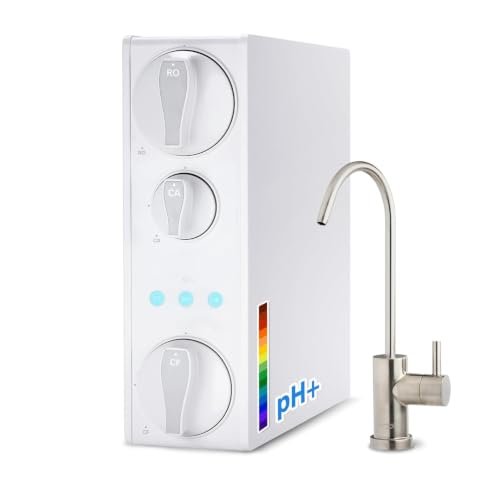
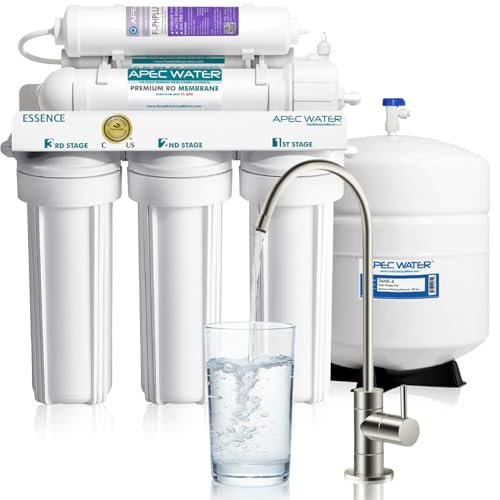
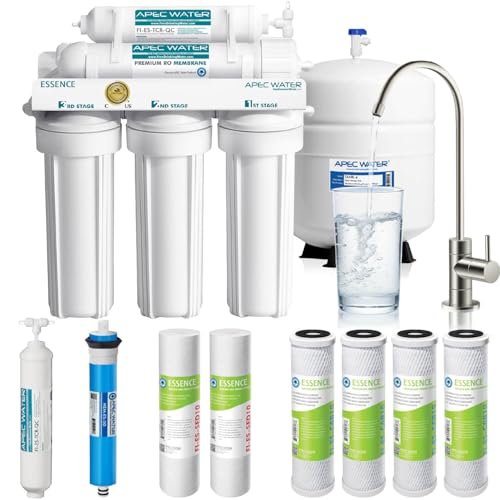
- Alkaline remineralization for taste → alkaline tankless RO (the iSpring RO500AK alkaline tankless RO) or a tank RO with alkaline stage (the APEC ROES-PH75 6-stage tank RO with alkaline).
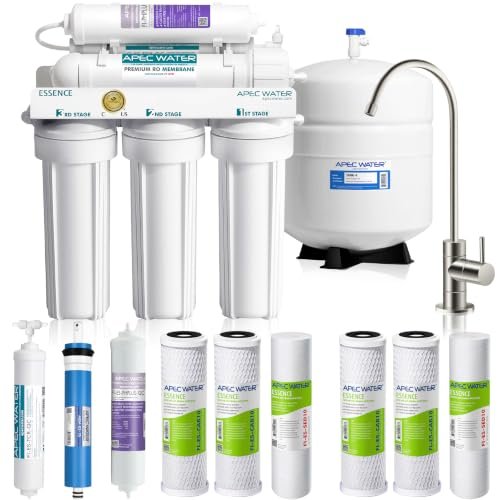
- Tight budget, only 1-3 gallons per day → tank RO. The APEC ROES-50X 5-stage tank RO is the budget pick, and the APEC ROES-PH75X tank RO with spare filters covers the first 12 months.
- Hard water (7+ gpg) plus a softener → either, but route the RO feed through the softened line. The softener cuts scale that fouls the RO membrane. RO vs softener has the full flow diagram, and you can verify your inlet hardness with a TDS meter before sizing.
Quick decision summary
- Tankless wins when: small cabinet, 3+ people, low waste matters, budget is $400+ up front.
- Tank wins when: single user or couple, tight budget ($200-$300), need fast peak flow, and undersink space is generous.
Common mistakes
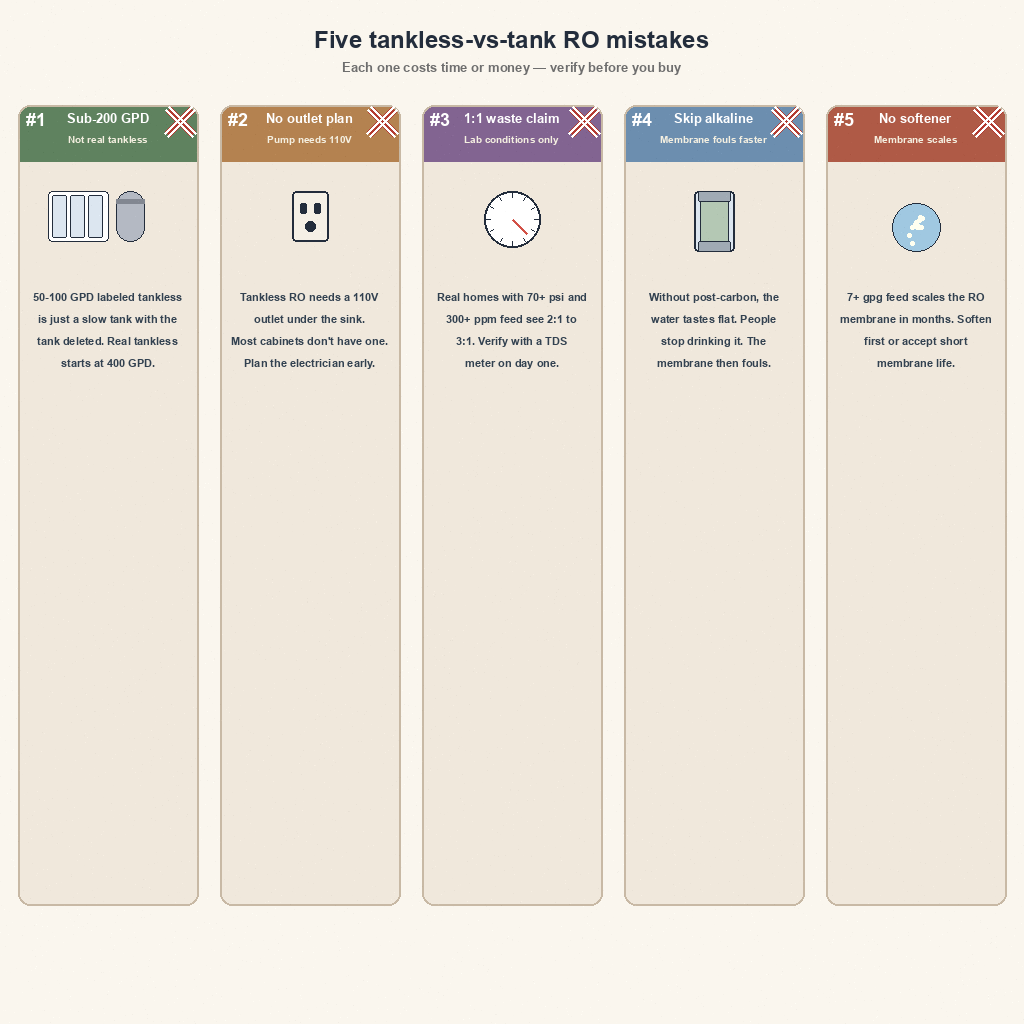
Five mistakes — distilled from Reddit threads and Amazon 1-star reviews.
- Picking a “tankless” RO under 200 GPD. Some manufacturers sell 50-100 GPD units labeled “tankless.” That’s a tank RO with the tank deleted — peak flow is a trickle. Real tankless starts at 400 GPD.
- Forgetting to plan a power outlet. Tankless RO needs a 110V outlet for the booster pump. Most undersink cabinets don’t have one. You will need an electrician or extension cord, which most product pages don’t mention.
- Trusting “1:1 waste” marketing claims. Lab-condition ratios. Real homes with 70+ psi feed and 300+ ppm TDS see 2:1 to 3:1. Verify with a TDS meter on day one and after 12 months.
- Skipping the alkaline / post-carbon stage. Without post-carbon, RO water tastes flat and people stop drinking it — then they stop changing filters, then the membrane fouls. A 75 GPD replacement membrane costs around $15 and gets swapped every 2-3 years per the RO filter replacement schedule.
- Routing hard water through the RO without a softener upstream. A 7+ gpg feed scales the RO membrane in 6-12 months. Soften first or accept shorter membrane life. RO vs softener explains the trade.
When to call a pro
Keep DIY if: swapping a cartridge, replacing the membrane, adding an alkaline post-filter, mounting a TDS meter.
Call a licensed plumber if:
- Cutting into the cold-water main to add a feed tee
- Installing a new drain saddle for the reject line
- Active leak at fittings, drain saddle, or tank
- Booster pump electrical faults beyond a power-cycle reset
- Well pump or pressure tank issues affecting feed pressure
We do not rank installer directories or sponsored local-service lists. For the staged system layout (softener before RO), see RO vs softener.
Softener vs filter vs RO (one screen)
This comes up every time someone buys an RO.
- Softener (salt): swaps hardness minerals for sodium or potassium — fixes scale and spotting on fixtures, shower, heater.
- Whole-house carbon/sediment filter: improves taste, chlorine, dirt — not the same as softening.
- RO (under sink): polishes drinking and cooking water — does not treat the shower or heater.
A tankless RO does not change the softener role. If your home has 7+ gpg hardness, the softener sits on the main line and the RO is fed softened water. For which job each one does, see softener vs whole-house filter vs RO. For the hardness scale, see how gpg and ppm relate to what your fixtures see.
Key takeaways
- Tankless RO saves cabinet space and cuts waste to 2:1-3:1, but slows peak flow. Real tankless RO starts at 400 GPD.
- Tank RO delivers faster peak flow at lower upfront cost, but uses 2-4 gallons of cabinet space and wastes 3-4 per gallon.
- Pick tankless for families of 3+ who value low waste and undersink room, and have a 110V outlet under the sink.
- Pick tank for singles or couples on a tight budget who need faster peak flow.
- Alkaline / remineralization stages restore the taste and pH that the membrane strips out. Skip only if you prefer flat water.
- Filter replacement cadence is the same. Plan for sediment 6 months, carbon 12 months, membrane 2-3 years.
- Verify performance with a TDS meter. Permeate TDS above 50 ppm is the first sign of a failing membrane.
Related
- Reverse Osmosis Under the Sink — full primer on how RO works, what NSF/ANSI 58 means, and when you need one
- RO vs Softener — when to soften before the RO, and the flow diagram for staged treatment
- RO Filter Replacement Schedule — typical cadence for sediment, carbon, and membrane swaps
- TDS Explained — what TDS measures, how to read a meter, and how it ties to RO performance
- Softener vs Whole-House Filter vs RO — the three-system screen for which job each one does